The alpha, twice a week
That was 8 min.
Get the best new moments in your inbox every Wednesday and Saturday. It's free.
Check your inbox
We sent a link to your address. Click it to finish signing up. Not there in a minute? Look in spam.
or
All-In · 8 min · Apr 17, 2026
Compute shortages could put a ceiling on AI growth
 Chamath Palihapitiya
The panel connects power and permitting bottlenecks to rising resistance against data centers.
The episode’s best minutes
Full episode- 22:09Enterprise coding is driving Anthropic's faster growth5 min
- 39:55Compute shortages could put a ceiling on AI growth8 min
- 1:15:55AI's enterprise payoff still lacks scaled proof8 min
- 4 more moments in the full episode
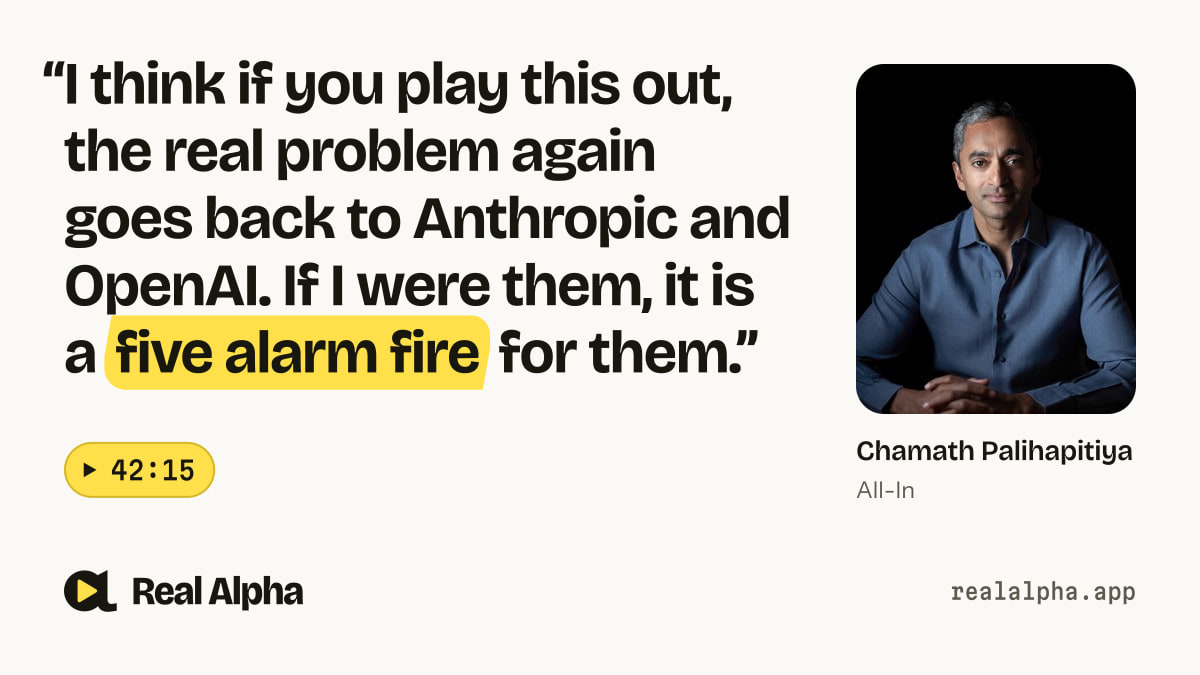
“I think if you play this out, the real problem again goes back to Anthropic and OpenAI. If I were them, it is a five alarm fire for them.”
 Chamath Palihapitiyaat 42:15 · All-In
Takeaways
- Power, land and permitting are constraining data center builds.
- Local opposition to data centers is growing.
- Limited compute could slow AI adoption regardless of product quality.
About this segment
The panel connects power and permitting bottlenecks to rising resistance against data centers. Chamath Palihapitiya argues that compute constraints could limit frontier labs even if demand keeps growing.

Chamath Palihapitiya, Host
Founder & CEO, Social Capital
Led Facebook's growth team; his firm backed Slack and AI chipmaker Groq.

Jason Calacanis, Host · Founder & CEO, LAUNCH
Early Uber angel; sold Weblogs Inc. to AOL; hosts This Week in Startups.

David Sacks, Host · Co-founder & partner, Craft Ventures
PayPal's first COO, founded Yammer; White House AI & crypto czar 2025–26.

David Friedberg, Host · CEO, Ohalo
Founded The Climate Corporation, sold to Monsanto for about $1.1B in 2013.
From “OpenAI's Identity Crisis, Datacenter Wars, Market Up on Iran News, Mamdani's First Tax, Swalwell Out”, Apr 17, 2026. Watch the full episode
Answers “Is there still a GPU shortage?” See all 32 answers
Answers “Is there enough power for AI?” See all 22 answers
Thanks. We'll look at and fix what's off.
Transcript
Transcribed by machine (Whisper) from the episode’s audio, so a word may be off here and there.
- 40:00
strained massively. And those are two problems. One is the power. So if you look at companies like Bloom Energy, it has gone absolutely straight up vertical nuclear. And the reason is because Bloom has a solution that allows you to use nat gas, that allows you to do something on site, and critically allows you to get your clean air permits very quickly because it has very, very little emissions. And it's been proven as such. And so instead of waiting for years to get on the grid, if you wanted to build a data center, you can now use their services. The other part that's going absolutely nuclear is the actual land and the shell, because it's turning out it's impossible to get these approvals. Now, why is that? And I sent Nick an image. The reason is because underneath at the core of it all is there's a tide that is shifting on ai the american
- 40:55
population is incrementally getting more and more negative on the whole subject matter writ large and it's not clear exactly why they're doing that maybe it's the doomerism which we talked about last week maybe it's the fear of the job laws that jason has been talking about maybe it's just this idea of yet another wave of innovation that's only going to benefit a few in an extreme way, minting trillionaires all over the place while everybody else stands still.
- 41:24
I don't exactly know what's causing it, but the sentiment is shifting. And as the sentiment shifts, the most scaled action that they can take, they're taking, which is then they are going and voting down data centers. Here's an example, which was insane. A town approves a $6 billion data center build, and then half the board gets ousted, and just voted out overnight so that they could put in new people to undo the decision.
- 41:52
So if you look at this all around the country, the answer is not, oh, we're only going to build in Texas. That doesn't work. There's not enough power. There's not enough grid capacity. There's not enough nat gas that allows that to happen. Maine just passed a bill that bans all data center buildings. So I think the reason why all birds went crazy is a very, very small canary in a very important coal mine, which is we are absolutely compute constrained. I think if you play this out, the real problem again goes back to Anthropic and OpenAI. If I were them, it is a five alarm fire for them. They more than anybody else needs to get their hands on compute. They need to have land power shell, but otherwise that revenue could either slow down or hit a wall and it will not be because of product quality and adoption.
- 42:43
it will entirely be because of the Friendster effect. You just couldn't keep the site up. And I think that that would be a huge, huge problem for everybody. Saks, final thoughts on data centers and the build-up? Well, I think Jamath is right that the data centers become very unpopular. Probably in 30 states, they're just going to ban them outright. And then it's very hard to get projects approved.
- 43:03
Look, I think there's a few reasons for this. One is that there are a lot of, let's call them real estate developers, who are kind of wildcatters, who are out there trying to get entitlements. And they did bring a lot of projects up for local permits where they didn't have a power solution. And there's no question that local communities do not want the data centers drawing off the grid, thereby increasing residential prices, if that data center is not bringing its own power generation.
- 43:31
And the administration agrees with this. This is why the president did the ratepayer protection pledge, where we got all the major users of the data centers, you know, all the hyperscalers to agree that they would not build new data centers without bringing their own power. So again, it was designed to be power neutral to the grid, or in fact, it would increase the amount of energy available to the grid because these data centers would give back when they're not at peak usage.
- 43:57
So that's sort of like category number one. is there's this fear of electrical rates going up. But there's a couple other categories, I think, of groups. So the second one was Future of Life and a lot of these like Doomer groups saw that data centers were a way to stop AI progress. And there are interviews with some of these Doomer folks who say things like we have to meet people where they are, meaning that they've been unable to convince people that AI is going to lead to the Terminator, but they can convince them that AI data centers are going to use up their water, for example, which isn't true. And so a lot of the NIMBYism has been kind of astroturfed by a lot of the Doomer groups, which have a lot of money, thanks to contributions from a few tech billionaires like we've talked about in the past.
- 44:43
So that's category number two. Category number three, ironically, again, is Anthropic itself. It has allied itself politically with a lot of the Doomer groups, a lot of the NIMBY groups. it didn't seem to matter in the first couple of years because Anthropic had made the strategic decision not to build its own data centers. So they probably thought that they were just throwing sand in the gears of OpenAI or XAI, their competitors, and they would just rely on hyperscalers to get their compute. And I think that that strategy has now backfired in the sense that they apparently have reached the limits of the compute that's available to them by buying it from a third party and they need to build their own data centers. It's going to be very interesting to see how they adapt to that and how the message around data centers changes over the
- 45:32
next year as let's call it the effective altruists decide that all of a sudden data centers or certain kinds of data centers might be a good thing because they serve their mission. So I think that's going to be a very interesting thing to watch. I'll tell you the one thing I think you're missing, which is that most people in America really are starting to really hate rich people and there's no physical space that better represents the wealth in america the wealth creation that's happened that a lot of people feel left behind from than the data center what other physical space is there to go to it is the temple of the wealthy it is the mechanism the tool the machinery of the wealthy it is the way that the rich elite tech kind of political connected billionaires that we're obviously all attached to are taking from the poor, getting themselves
- 46:26
ahead, shooting themselves to space, leaving everyone else behind. And the data center, I think, is the representation of their progress. And it is a representation of the progress that others don't feel. So that's why I think it is physically like the manifestation that people want to attack and destroy. There's very little rationale about, oh, let's stop AI robots from killing us. I think people just don't see the value in AI. The average person doesn't see the value in AI today yet. Like we just talked about, so much of the value of AI is showing up in the enterprise and in the rebuilding of enterprises. But for a consumer's life to actually be altered in a meaningfully positive way, most people don't feel that yet. The best thing they see is some medical advice they're getting on chat GPT or something. And that's kind of the end of it for
- 47:09
them. So I think there's a lot of this populism that's swollen, and that's taken over not just the US, but probably a good chunk of the West, and the data center is the target. It is the pied-à-terre of this space, in a way. This is their attack vector.