The alpha, twice a week
That was 4 min.
Get the best new moments in your inbox every Wednesday and Saturday. It's free.
Check your inbox
We sent a link to your address. Click it to finish signing up. Not there in a minute? Look in spam.
or
Prof G Markets · 4 min · Nov 5, 2026
Congress could curb tariff uncertainty by reclaiming trade authority
Catherine Rampell argues Congress could reclaim delegated trade powers and challenge tariffs, which raise consumer costs and disrupt companies.
In this episode
Full analysis- 30:28Markets may be overpricing a data-center crackdownPro pick 5 min
- 7:50An Iran exit may not remove the oil market's Hormuz risk3 min
- 10:28Congress could curb tariff uncertainty by reclaiming trade authority4 min
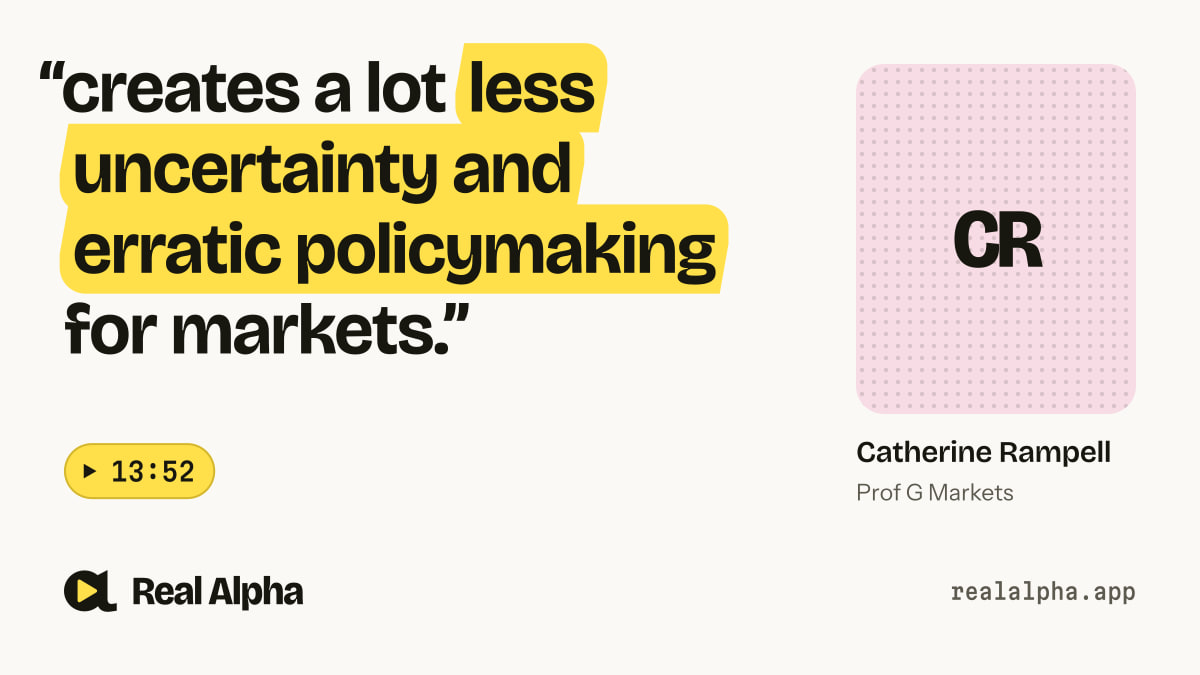
“creates a lot less uncertainty and erratic policymaking for markets.”
Takeaways
- Congress has tools to reclaim delegated trade authority.
- Tariffs raise costs for consumers and disrupt companies and markets.
- Less erratic policymaking could reduce uncertainty for markets.
About this segment
Catherine Rampell argues Congress could reclaim delegated trade powers and challenge tariffs, which raise consumer costs and disrupt companies. That could mean less erratic policymaking for markets.
Economics Editor, The Bulwark

Ed Elson, Host
From “Why Stocks Are Surging After A Historic Democratic Sweep”, Nov 5, 2026. Watch the full episode
Thanks. We'll look at and fix what's off.
Transcript
Transcribed by machine (Whisper) from the episode’s audio, so a word may be off here and there.
- 10:40
I mean, it brings up a very fundamental question about Trump and how he's going to respond to what happened on Tuesday. And that is, is he going to reverse his decisions? Is he going to reverse his decisions on Iran? Is he going to reverse his decisions on tariffs? Is he going to reverse his decisions on immigration? I think that one's probably less likely. But, you know, at least on Iran and tariffs, two of the most consequential economic decisions that have defined the experiences of every single American over the past two years.
- 11:18
years that have defined the trajectory of markets over the past two years. And I wonder if this might be the moment that actually he says, OK, my bad. That was a mistake. I mean, do you think that's actually feasible or realistic? I don't think he has he's capable of that level of introspection or strategic thinking, but he may lose interest in a lot of these things in the same way that if you saw his press briefing today, it was like showing off the ballroom. That was his response to this, again, generational route for his party that he himself caused. He was like, let's go look at this beam over here. And he answered a couple of questions about the election, but then disavowed any sort of responsibility for it and said, oh, it was maybe related to that Iran thing, now calling it a thing, a war in which 23 service members that we're aware of
- 12:18
have passed away is pretty callous. But it also reveals the fact that this is just not top of mind for him. He's never really been that interested in it. He's much more interested in these vanity projects. So will he actually like undo the damage or will he just get distracted and do something else? I think the latter is more likely. And the war aside on some of these other kinds of questions like tariffs, Congress does have a lot of power here. If you look at the Constitution, which one should in the current environment or always, the Constitution says that it is Congress that controls power of the purse and that is supposed to control trade among the nations. So Congress has really abdicated to responsibility or delegated away some of these authorities over the years, and they can clearly take those back and may have
- 13:14
more willingness to take those back. I think actually on the tariffs, what's been interesting is that even in the kind of rust belt states, the Midwest, places where Democrats used to run on a very protectionist message, they did not this cycle. Even people like Sherrod Brown were criticizing the Trump tariff agenda. So you may well see that on things like that, which besides raising costs, downstream costs for consumers, have also been really, really disruptive to companies and to markets.
- 13:48
You may see some greater intervention or like reclaiming of those constitutional responsibilities in a way that both hems in Trump, at least I hope maybe this is wish casting, but I hope this is what happens, you know, hems in Trump and also creates a lot less uncertainty and erratic policymaking for markets. So I think that's part of the market reaction here that we're seeing.