The alpha, twice a week
That was 3 min.
Get the best new moments in your inbox every Wednesday and Saturday. It's free.
Check your inbox
We sent a link to your address. Click it to finish signing up. Not there in a minute? Look in spam.
or
a16z Podcast · 3 min · Nov 13, 2026
Continuous security scanning needs to allocate its budget carefully
 Ami Luttwak
A single code scan can cost millions and quickly become outdated as models and code change.
In this episode
Full analysis- 22:36Continuous external attacks reveal risks code scans miss6 min
- 28:28Startups with AI credentials are becoming direct targetsPro pick 4 min
- 16:46Continuous security scanning needs to allocate its budget carefully3 min
- 32:45Secure architecture matters more than simply increasing security budgets3 min
- 41:08Open-source models are catching up faster than expected3 min
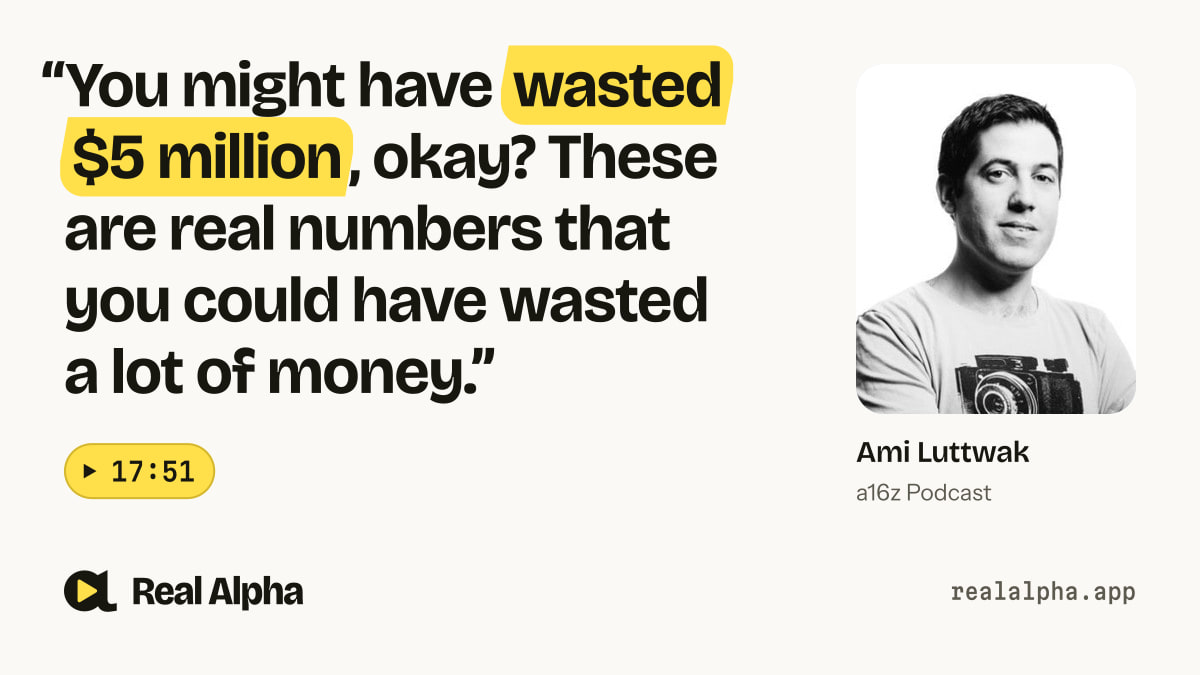
“You might have wasted $5 million, okay? These are real numbers that you could have wasted a lot of money.”
 Ami Luttwakat 17:51 · a16z Podcast
Takeaways
- One-off full-code scans can consume millions without staying current.
- Don't assume a single expensive scan solves the problem.
- Allocate budget across code, runtime and external exposure.
About this segment
A single code scan can cost millions and quickly become outdated as models and code change. Ami Luttwak argues for continuous testing that allocates spend across different kinds of risk.

Ami Luttwak is co-founder and CTO of Wiz.
Led Wiz Research in finding major cloud vulnerabilities, including OMIGOD, ChaosDB and flaws in cloud DNS services.

Erik Torenberg, Host · General partner, Andreessen Horowitz
Helped build Product Hunt; founded On Deck, Village Global and Turpentine.
From “Cyberattacks Used to Take Months. AI Can Do It in Minutes.”, Nov 13, 2026. Watch the full episode
Thanks. We'll look at and fix what's off.
Transcript
Transcribed by machine (Whisper) from the episode’s audio, so a word may be off here and there.
- 16:59
And just on this cost point, you talk about in, I think, a blog post that you guys wrote, but maybe summarize a little bit here, this paradigm shift that needs to happen around continuous testing, right? Sort of the focus being on the word continuous versus static. And cost obviously plays a big role in, you know, sort of the democratization of every company being able to do that, not just the sort of most profitable and sophisticated.
- 17:26
How far are we from getting there on a cost, from a cost perspective? And what else, I guess, needs to happen. Maybe it's also cultural shift, et cetera, like, you know, tooling shift. But how far are we from, I think, where do we, where do you think companies need to go and how far are we today? So, I mean, first of all, it's a, it's, it's, it's a big question. Like, let's take security, for example, and go back to the mythos moment, right? So people say, oh my God, there's mythos. I have to scan all of my code. Okay. Fine. Let's say you did it. Let's say you did it in in April, okay? You might have wasted $5 million, okay?
- 18:09
These are real numbers that you could have wasted a lot of money. It's very expensive. Now, okay, now there's meters 1.2. You do it again? I'm not talking about small budgets. I'm talking about some customers are spending now tens of millions of dollars on scanning calls. You have to think about a scalable system, right? Continuous system that scans but is intelligent. You can't just because there's going to be new models, new capabilities, new code, right?
- 18:36
So we see this as a major challenge for the industry. We're trying to figure it out, and I'm not going to tell you that we solved it, right? But the challenge is how do I use the budget wisely in a way that scans from the inside, from the outside? We have active attacks, we have passive attacks, we have code analysis, we can scan on the disk itself, we can look at the runtime. How do I use all of the budget in the most efficient way for the customer?
- 19:03
Not as a single scan, but as a continuous scan, right? And that is the challenge of security scanning right now. If I tell you, oh, yeah, just run Mythos on your code, great, you're right, you can do that. But does that actually solve your problem continuously? No, it's just going to get you like a big hole in the budget.