The alpha, twice a week
That was 5 min.
Get the best new moments in your inbox every Wednesday and Saturday. It's free.
Check your inbox
We sent a link to your address. Click it to finish signing up. Not there in a minute? Look in spam.
or
Merryn Talks Money · 5 min · Nov 2, 2026
Credit limits could turn the AI boom into a recession
Chris Clothier explains how tighter credit could halt AI investment and hit chip earnings, bank revenues and household wealth.
The episode’s best minutes
Full analysis- 2:13AI spending needs an implausibly large revenue base6 min
- 11:06Credit limits could turn the AI boom into a recessionPro pick 5 min
- 19:02Inflation protection favors linkers and infrastructurePro pick 5 min
- 3 more moments in the full episode
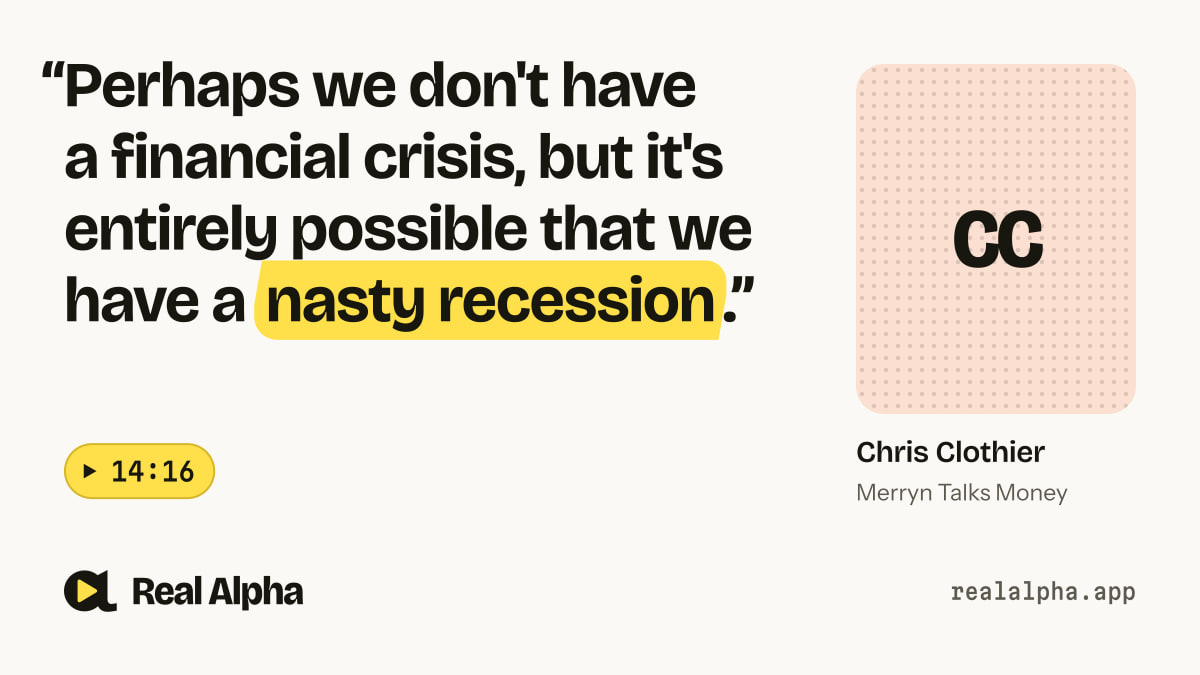
“Perhaps we don't have a financial crisis, but it's entirely possible that we have a nasty recession.”
Takeaways Pro pick
- A proposed €100 billion Meta bond deal shows the scale of funding needs.
- Chipmakers’ share of S&P earnings is expected to reach 17%.
- Low savings and limited fiscal room could deepen an earnings shock.
One of Pro's picks, open to you here. Try Pro free for 7 days
One of Pro's picks. The rest of the summary and the 3 takeaways are in Real Alpha Pro; the video, the quote and the transcript stay free.
Read it with Pro, 7 days freeAbout this segment
Chris Clothier explains how tighter credit could halt AI investment and hit chip earnings, bank revenues and household wealth. He sees recession risk even without a financial crisis.
Chris Clothier is co-chief investment officer at CG Asset Management.
- MW
Merryn Somerset Webb, Host
From “Where Do You Hide From an AI Bubble? | Merryn Talks Money”, Nov 2, 2026. Watch the full episode
Thanks. We'll look at and fix what's off.
Transcript
From the transcript Merryn Talks Money publishes with the episode.
- 11:10
So all in, it looks like it might end sooner than you thought, even when you wrote this piece, given the doubts creeping into the market as a whole. Do you think that is the case, that we might see this boom bubble coming to its end maybe even this year? And if it does, is there systemic risk in that or is it okay?
- 11:31
I think it has to be right that there is a chance of this comes to an end. And we're seeing all sorts of different elements of that. So partly it's the political resistance to the build out of these data centers, which may be the thing that causes this whole thing to slow down. And then on the other hand, it's the availability of credit to do this. And by the way, it is just worth touching on this because the numbers are absolutely wild. So I was talking to a credit trader and we've seen some of the issuance that's been going on in the bond market this year.
- 12:03
And so in round numbers, Google and Amazon both came to the UK market and the Euro market and issued sort of four to five billion sterling and 10 or 11 billion euros each. He reported that some large fund managers in London were getting sounded out by syndicate desks of investment banks about the prospect of raising 100 billion euros for Meta in a single transaction. And those numbers are just absolutely wild. And so I think it is possible that if the availability of credit just isn't there, then all of this does slow down. And then actually, I think the fallout at that point Setting aside what might happen to the neo clouds and perhaps some of the weaker players. I think the fallout would be relatively Limited because actually what AI compute has been deployed is actually likely to be pretty valuable Because as we've seen
- 13:04
the demand for this stuff is very high so whenever you listen to the quarterly earnings reports of Microsoft of Google their CFOs are saying, look, we've got these huge backlogs of demand. And so all of the investment that's going on today is entirely rational. But it's this sort of runway of kind of unlimited investment that strikes me as being kind of economically insane, frankly. Yeah.
- 13:30
But with that rising cost of credit, with all the doubts, you have to look at the equity market as well and say that if this comes to a juddering halt, we may also see, because lots of the rises in the AI-related companies and the industries have been based on very sharply rising earnings. And if we say, well, do you know what? Maybe this wasn't a valuation bubble. Maybe this is kind of an earnings bubble. And then you do begin to see prices fall. And if that happens, there's a massive wealth effect in the US, right? In that people's wealth is more tied up in the equity market.
- 14:03
This is a historical high. So if you do start to see an AI and AI-adjacent equity-led fall in the stock market, that's going to feed into the economy relatively quickly, or not?
- 14:18
100%. And so I think that that's the... Perhaps we don't have a financial crisis, but it's entirely possible that we have a nasty recession. And just to put some numbers on that, we tried to come up with an estimate of the profit pool that would arise from this $ 1 trillion capex spend. And we came up with a number of about $ 400 billion. because of the fact that particularly the chip companies have such high gross margins. Chip companies' proportion of S & P earnings this year is 10%, and their estimated share of S & P earnings next year is 17%. And so you're absolutely right that any major slowdown as a result of availability of credit would hit them. So the first order impact on S & P earnings would be very great. The second order effect is that so much of the fantastic earnings that we've
- 15:07
seen of the banks, for instance, has been wound up in trading revenues and their fixed income origination, but their DCM businesses and so on and so forth. And as you say, the US economy has never been more tied to the stock market. And also that the savings rate in the US is really very low at the moment. And so we're at this very interesting point where the three major pillars of society are are all essentially on a spending splurge. So obviously, the federal government is running a 6% budget deficit. Corporates, as we've seen, are investing on a scale that we've not seen since, I don't know, perhaps the railway boom. And then the private sector is Actually, as it happens, the savings ratio just got written up by the BLS. But depressingly, that's just because it turns out that the rich were even richer than we thought
- 16:02
they were. And obviously, they have a tendency to save. But nevertheless, as you say, the savings rate is well below its long-term average. And so you could entirely see that the savings rate would rise very dramatically if there were a major earnings slowdown in the stock market. And I don't see where the kind of classic fiscal stabilizers can come from. I can't see that the federal government can start spending even more. And so, yes, that could be very unpleasant.