The alpha, twice a week
That was 3 min.
Get the best new moments in your inbox every Wednesday and Saturday. It's free.
Check your inbox
We sent a link to your address. Click it to finish signing up. Not there in a minute? Look in spam.
or
Bloomberg Daybreak: US Edition · 3 min · Nov 1, 2026
Customer relationships can justify a longer commercial horizon
Judy Liu says 1–2% of customers account for nearly a third of Farfetch’s business, supported by personal stylists.
In this episode
Full analysis- 8:30Cultural partnerships should benefit the city and its clientsPro pick 2 min
- 10:39Global brands need to localize without losing their identityPro pick 3 min
- 18:19Curiosity helps you spot value and avoid market assumptions2 min
- 6:20China’s four largest cities represent only 5% of its population2 min
- 15:19Customer relationships can justify a longer commercial horizon3 min
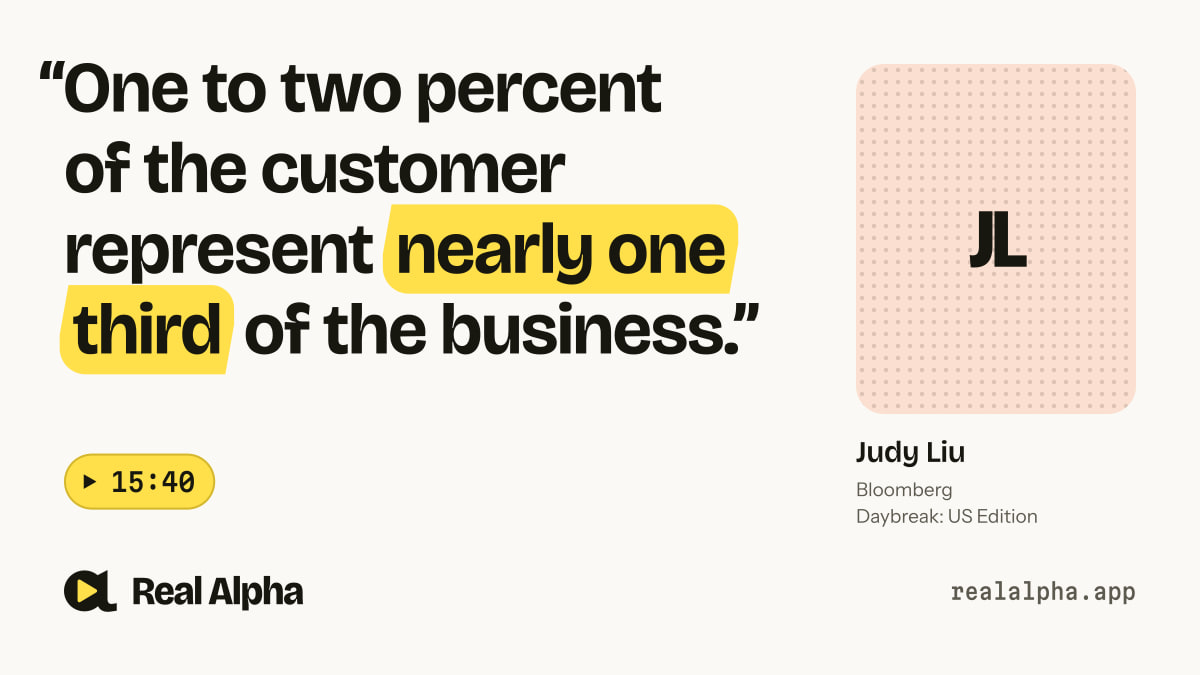
“One to two percent of the customer represent nearly one third of the business.”
Takeaways
- One to two percent of customers account for nearly a third of business.
- Farfetch used around 70–80 stylists for individual client contact.
- Local partners can help a sport build networks in a new market.
About this segment
Judy Liu says 1–2% of customers account for nearly a third of Farfetch’s business, supported by personal stylists. Alan Gilpin’s India example and Maggie Ng’s advice show why local ties and long-term client value matter.
Co-founder, Trinity Asia
Co-founded CuriosityChina, later acquired by Farfetch, and led Farfetch’s growth across Greater China and Asia Pacific.
From “Thinking Capital | Cultural Capital: How do you hone cultural fluency as a competitive...”, Nov 1, 2026. Watch the full episode
Thanks. We'll look at and fix what's off.
Transcript
From the transcript Bloomberg Daybreak: US Edition publishes with the episode.
- 15:21
Today, digital ecosystem is developing more than ever, but I still believe the human connection is very critical for the cultural understanding and build the trust and connections with our customers. When we run the Farfetch business, we have a very important department called private clan. One to two percent of the customer represent nearly one third of the business. So it doesn't matter where the customer they are coming from.
- 15:52
It's not necessary only for the first tier city. Although it's an online business, I really feel that The people collection is everything. That's the whole reason that why we built the private client team, which we have around 70, 80 stylists that actually collect and communicate, you know, individually with our very important clients. And sometimes the understanding between this kind of one-on-one conversation can actually convert it to a commercial result.
- 16:25
You know, to give you a live example of that, We've taken rugby sevens to India at an elite competition sense with Rugby India, a really developing national federation for us. Rugby is a relatively small sport in India compared to obviously, for example, cricket. So we've got a lot of work to do, but great relationship now between Rugby India and city and government partners. And then we can bring and HSBC to the table and say, okay, if we're going to deliver a competition in India, HSBC can create business connections and networks that will really help that competition be more successful more quickly. So that's a good example of trying to be quite smart about how we bring different partners together in a new and emerging market for rugby sevens.
- 17:14
So we've talked about cultural impact and commercial impact. How should we be thinking about bridging these two? We'll hear from Maggie Ng, CEO of HSBC Hong Kong.
- 17:26
Well, firstly, don't purely look at commercial value immediately. Take a longer horizon view. Many of the time, if you're very financial focused, you look at the immediate KPI, which is how many sales you brought from this event or the partnership. But instead, it is the lingering impact. that I think is subtle but even more powerful. My advice would be to look at it a bit more longer term rather than the immediate result and then also go back to the customer and ask them how this event or the cultural partnership has created benefit for them because what is good for our clients is also good for us.
- 18:10
Cultural fluency is very much the art of noticing. But in a world of algorithms, infinite content and rapidly moving trends, how do you notice something before everybody else?