The alpha, twice a week
That was 3 min.
Get the best new moments in your inbox every Wednesday and Saturday. It's free.
Check your inbox
We sent a link to your address. Click it to finish signing up. Not there in a minute? Look in spam.
or
Latent Space · 3 min · May 21, 2026
Customer urgency validated Daytona’s sandbox pivot
 Ivan Burazin
After rebuilding its sandbox MVP, Daytona heard from customers who wanted access immediately.
The episode’s best minutes
Full analysis- 10:25Customer urgency validated Daytona’s sandbox pivotPro pick 3 min
- 33:28Agents need computers when APIs hide the data5 min
- 1:02:39Token resale is not the same as SaaS growthPro pick 3 min
- 5 more moments in the full episode
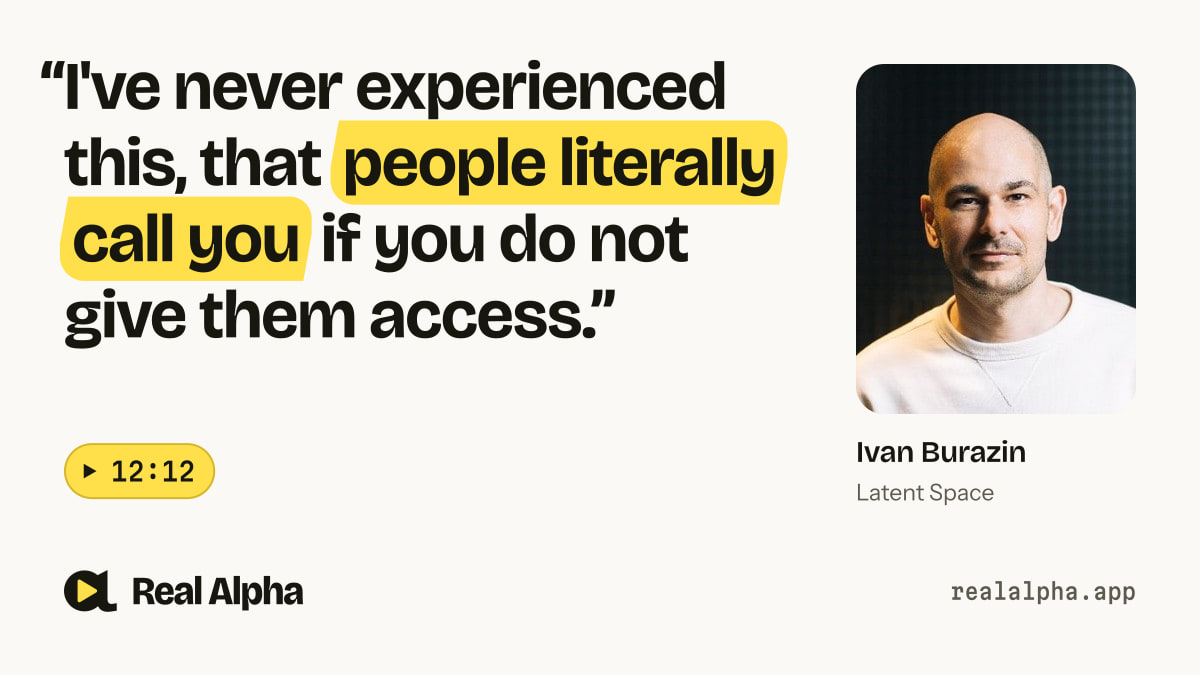
“I've never experienced this, that people literally call you if you do not give them access.”
 Ivan Burazinat 12:12 · Latent Space
Takeaways Pro pick
- The first product for agents missed what customers needed.
- A rebuilt MVP turned feedback into urgent demand.
- The team saw a much larger market in agent compute.
One of Pro's picks, open to you here. Try Pro free for 7 days
One of Pro's picks. The rest of the summary and the 3 takeaways are in Real Alpha Pro; the video, the quote and the transcript stay free.
Read it with Pro, 7 days freeAbout this segment
After rebuilding its sandbox MVP, Daytona heard from customers who wanted access immediately. That response convinced the team to leave its human dev-environment product behind.

Ivan Burazin is CEO of Daytona.
Co-founded Daytona, which runs sandboxes and computers for AI agents; earlier co-founded Codeanywhere.

Shawn Wang (swyx), Host · Co-founder, AI Engineer
Wrote “The Rise of the AI Engineer” and founded Smol AI, maker of AI News.
From “AI Agents Need Computers: 74% MoM Growth, 850K/Day Runs, & New Agent Cloud — Ivan Burazin, Daytona”, May 21, 2026. Watch the full episode
Thanks. We'll look at and fix what's off.
Transcript
From the transcript Latent Space publishes with the episode.
- 10:29
And so when we figured, when we sort of had an idea of what we had to build, literally over the New Year's Eve, literally on New Year's Eve, I half vibe coded the first MC, uh, first minimal viable product of what Daytona is today. And I went to sleep at like three AM or something like that. I was doing, I just put my like baby daughter and wife to sleep and, you know, Happy New Year's and go back to just, um, doing this. And I sent it to my co-founder, my CTO, and he saw it in the morning.
- 10:57
He's like, "This is absolute garbage." [laughs] "Do not show this to anybody at all. But the idea is good." And so he took two weeks and he rebuilt it. Well, did it like look like that last night? It was rough, rough again. Oh, no, not even cl- not even close. Oh, okay. Like it was m- it was way worse. I- But it was like a very, it was a simplistic view of what it should be like. It worked, but it was not ideal.
- 11:15
And so he went, we went down the whole, which is his job as CTO, um, to go and he c- came back with this version. We then called all the people that had said like, "This is garbage," you know, a quarter ago. And we set up these calls and we gave it to, we just sent it to everyone. And all the calls went long. Every single one. They were fifteen-minute calls, and they all went to like twenty-five, thirty minutes or whatnot.
- 11:38
And everyone said, "We need, we want access." There was no login, just an API key 'cause it was just a beta or an alpha. And they said, "Oh, we want access." And we're like, "Sure, yeah. Okay, thank you very much." But after like the next day, if we'd not send it every single one, like every call that we did, everyone came back, "Where is my API key?" Like everyone wanted it. We're like, "Shit. Like this is it."
- 11:58
Like, I've never felt... So one, the, the understanding to your point was like most people thought it was the same infrastructure for humans and agents. We understood a quarter ago it's not. We just didn't know what was the right primitive. And then when we came, and we can talk about what that is, and we gave it to these people, I've never experienced-- I've done multiple companies in my life. I've never experienced this, that people literally call you if you do not give them access. Like they want access right now. [laughs] And so it's like, okay, they don't want this.
- 12:25
The thing that they want doesn't seem to exist or they have not found it and they really, really want what, what we want. And then when we understood that we're onto something, and then when you think about the size of the market, like the market for human engineers and enterprise is a very large market, so think GitLab or, or whatnot. But the market for every single agent that will exist ever in the future is just like, what is that market? How big is that? And we're like, "We are all in on this."
- 12:50
And so that is where we made sort of the cut between the old product and the new one. Yeah. But it wasn't composable at the time.