The alpha, twice a week
That was 4 min.
Get the best new moments in your inbox every Wednesday and Saturday. It's free.
Check your inbox
We sent a link to your address. Click it to finish signing up. Not there in a minute? Look in spam.
or
Prof G Markets · 4 min · Apr 30, 2026
Dalio sees a riskier U.S. transition as debt demand weakens
 Ray Dalio
 expects a more dangerous period around the 2026 and 2028 elections, with political conflict and weaker demand for U.S. debt.
The episode’s best minutes
Full analysis- 13:09Diversification matters more than timing in a stagflationary cycle4 min
- 9:19Dalio sees a riskier U.S. transition as debt demand weakensPro pick 4 min
- 18:59AI cloud leaders are earning returns on rising capex4 min
- 2 more moments in the full episode
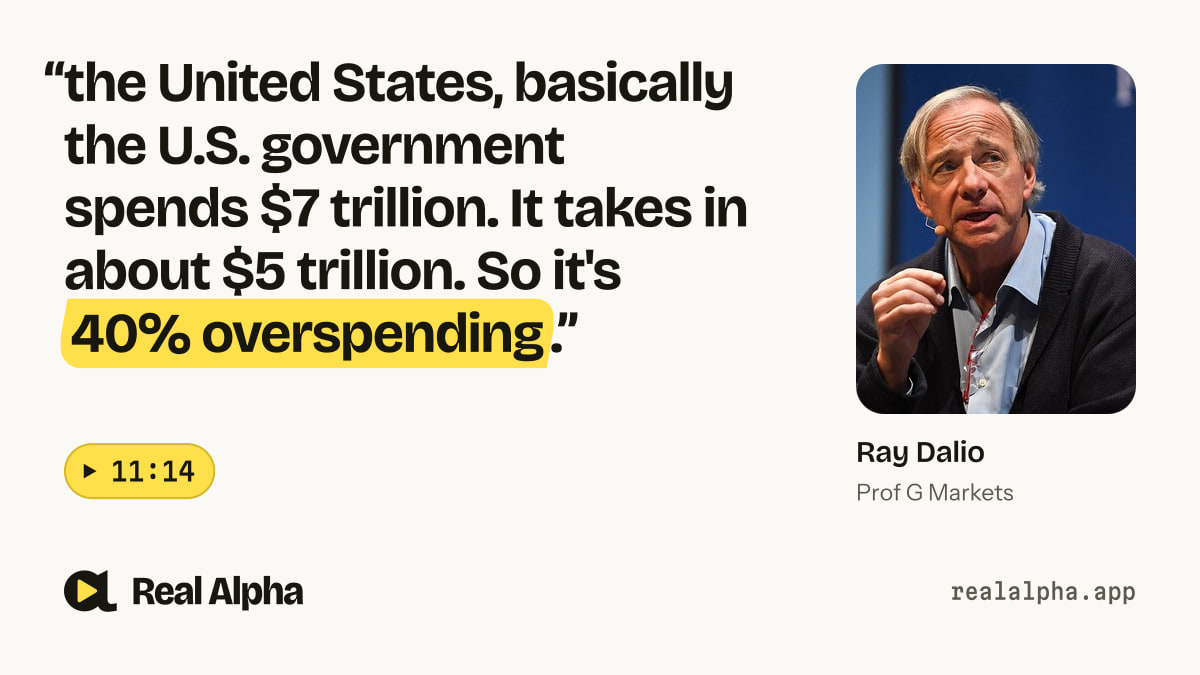
“the United States, basically the U.S. government spends $7 trillion. It takes in about $5 trillion. So it's 40% overspending.”
 Ray Dalioat 11:14 · Prof G Markets
Takeaways Pro pick
- He sees the period between the 2026 and 2028 elections as riskier.
- The U.S. spends $7 trillion and takes in about $5 trillion.
- Sanctions risk could make foreign holders less willing to own U.S. debt.
One of Pro's picks, open to you here. Try Pro free for 7 days
One of Pro's picks. The rest of the summary and the 3 takeaways are in Real Alpha Pro; the video, the quote and the transcript stay free.
Read it with Pro, 7 days freeAbout this segment
Ray Dalio expects a more dangerous period around the 2026 and 2028 elections, with political conflict and weaker demand for U.S. debt. He points to the government’s spending gap and the risk that foreign holders fear sanctions.

Founder, Bridgewater Associates
Founded Bridgewater and developed investment approaches like risk parity and All Weather for global institutions.

Ed Elson, Host
From “Ray Dalio: The World Order Has Unraveled”, Apr 30, 2026. Watch the full episode
Thanks. We'll look at and fix what's off.
Transcript
Transcribed by machine (Whisper) from the episode’s audio, so a word may be off here and there.
- 9:31
now the brink might be i would say uh particularly risky period um is between the uh two next two elections. Um, um, so between, after the 26 midterm election and the, uh, 28 presidential election, um, is a riskier period. And this is a very risky period. So what I would say, if I take the, um, monetary order, uh, risk, uh, we have debt service problems where they have big changes and, you know, we'll get into this, who is earning a lot of money, how this, who is not earning money, how wealth has changed. Um, for example, um, it's very interesting and very important that, um, to, to observe that the Chinese are making a tremendous amount of money and accumulating, they're running very large surpluses with the rest of the world and accumulating a lot of dollars and what does that mean in terms of how those are handled and then what does that
- 10:39
mean for our balances and so on. But if I'm back to your, to try to be on point, I would say in the midterm elections, we're going to... there's a likelihood that the Republicans will lose the House and that there will be great conflicts, including impeachments, investigations, and so on, that the conflict is going to be material. I think that the monetary situation will be more threatening. In other words, there's itself the supply-demand that we're referring to.
- 11:25
You know, the United States, basically the U.S. government spends $7 trillion. It takes in about $5 trillion. So it's 40% overspending. It has a lot of debt. And the demand for that debt is falling. And it's falling not only because of the supply-demand situation, the regular supply-demand, but we're now in a world where even wars, the worries of those who are holding dollar-denominated debt, that they could be sanctioned.
- 12:02
Imagine if you're holding – if you're Chinese and you're holding it and you could have a conflict. So these – there are these shifts that are happening in terms of that. So that plays a role. And of course, there is the international conflict. And of course, technology is changing at an incredible rate. And so I think that as we take the next two to three years, it will be like going through a time warp that we're going to have a riskier period, but also a period of great changes that we, you know, are difficult to deal with.
- 12:41
And particularly, I think the question is how you deal with that to have a well-diversified portfolio. But in answer to your question, it's a sort of long-winded answer, but I think that we're on the brink of some of these problems, and we are, I would say, particularly in the vicinity of two years away from what obviously is a confluence of more risks.