The alpha, twice a week
That was 2 min.
Get the best new moments in your inbox every Wednesday and Saturday. It's free.
Check your inbox
We sent a link to your address. Click it to finish signing up. Not there in a minute? Look in spam.
or
Balance of Power · 2 min · Nov 4, 2026
Data center backlash is tied to affordability and corruption
 Gautam Mukunda
 says 40 of 41 ballot measures to restrict data centers passed.
The episode’s best minutes
Full analysis- 8:14Morelle lays out Democrats’ priorities on costs and corruption4 min
- 34:02Data center backlash is tied to affordability and corruption2 min
- 26:59Lavorgna expects the Iran war to end by the first quarterPro pick 3 min
- 3 more moments in the full episode
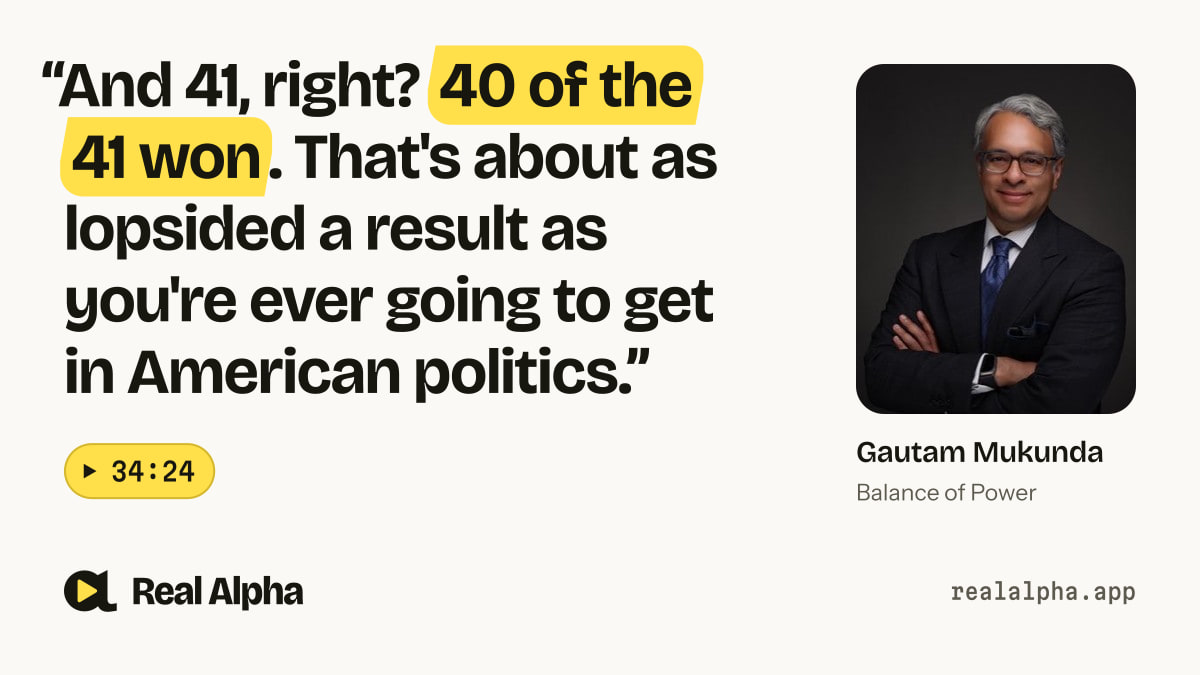
“And 41, right? 40 of the 41 won. That's about as lopsided a result as you're ever going to get in American politics.”
 Gautam Mukundaat 34:24 · Balance of Power
Takeaways
- Data center restrictions won 40 of 41 ballot measures.
- Voters connect data centers to affordability and corruption.
- The industry needs to persuade communities, not bully them.
About this segment
Gautam Mukunda says 40 of 41 ballot measures to restrict data centers passed. He argues the industry must address local costs and change how it deals with communities.

Lecturer, Yale School of Management
Studies leadership and innovation across public and private sectors, and wrote Indispensable and Picking Presidents.

Joe Mathieu, Host · Washington Correspondent, Bloomberg
Co-anchors Bloomberg’s Balance of Power and covers Washington; founded and hosted SiriusXM’s POTUS political news channel.

Kailey Leinz, Host · Washington Correspondent, Bloomberg
Co-anchors Bloomberg’s Balance of Power, interviewing presidential candidates, administration officials, lawmakers and regulators on policy.
From “Democrats Flips House & Senate, Clinching Huge Wins in Rebuke to Trump | Balance of Power”, Nov 4, 2026. Watch the full episode
Thanks. We'll look at and fix what's off.
Transcript
From the transcript Balance of Power publishes with the episode.
- 34:05
What in your mind is realistically going to happen with this story now? Will they act on the promises that they made? So they have to.
- 34:13
There's just no question that data centers are incredibly unpopular. Of the actual referenda that were put out, so the ballot initiatives on data centers, there were 41 of them to restrict data centers. If I recall correctly, 41 of them. And 41, right? 40 of the 41 won. That's about as lopsided a result as you're ever going to get in American politics. I think the one that won had something like 600 votes total cast. So they are going to have to. But this isn't quite as bad as it seems. Data centers, when you actually do the exit polling and you ask people, were data centers the most important thing.
- 34:49
That you voted on? Essentially, no people in the United States said that. Right? Like. Everyone in the United States agrees that data centers are bad. You may not like that, but that is an overwhelming political consensus. But it's not a major issue. It's not a top-tier issue. And so that creates a lot of room for an industry to sort of say, okay, so what can we do to make this more valuable to you?
- 35:11
What do we do to make this less hostile? But it also requires a sort of complete attitude transformation on an industry level. whose approach up to this point has basically been, we're just going to bully you into it and force you to get to accept these things. But don't, I mean, it may not be in a
- 35:25
vacuum a primary issue, but don't many voters see this as a sort of extension of the affordability issue?
- 35:32
My water bill's up, my electric bill's up. Whether that's not. True or is true about your local data center, that's just the perception across the country. Was that not on the ballot for a lot of people first and foremost?
- 35:46
No, I think that's exactly right. It's a tie to the affordability issue. It's also tied to the number one issue in this election, which was corruption, right? So the first time in the history of exit polling, the number one issue cited by voters was corruption for why they cast their vote. And because, again, the way in which the industry has sort of tied itself so closely to the Trump administration has been so open about, you know, working about pressuring legislators and pressuring political people at all levels to in ways that most Americans just don't like, it feels corrupt in a profound way. And that's the thing that they need to translate, as opposed to what I'm seeing on Twitter, people being like, oh, well, it's all over. Well, try to persuade people. Try to win them over to your side instead of what you have
- 36:27
been doing.