The alpha, twice a week
That was 5 min.
Get the best new moments in your inbox every Wednesday and Saturday. It's free.
Check your inbox
We sent a link to your address. Click it to finish signing up. Not there in a minute? Look in spam.
or
The Real Eisman Playbook · 5 min · Sep 29, 2025
Data center power needs make nuclear a key AI bet
 Dan Ives
 argues that data center growth will require far more power than the grid can supply, making nuclear important to the buildout.
The episode’s best minutes
Full analysis- 22:55Big tech can fund AI spending before adoption scales5 min
- 39:12Palantir turns customer data into operational decisions5 min
- 44:47Data center power needs make nuclear a key AI betPro pick 5 min
- 2 more moments in the full episode
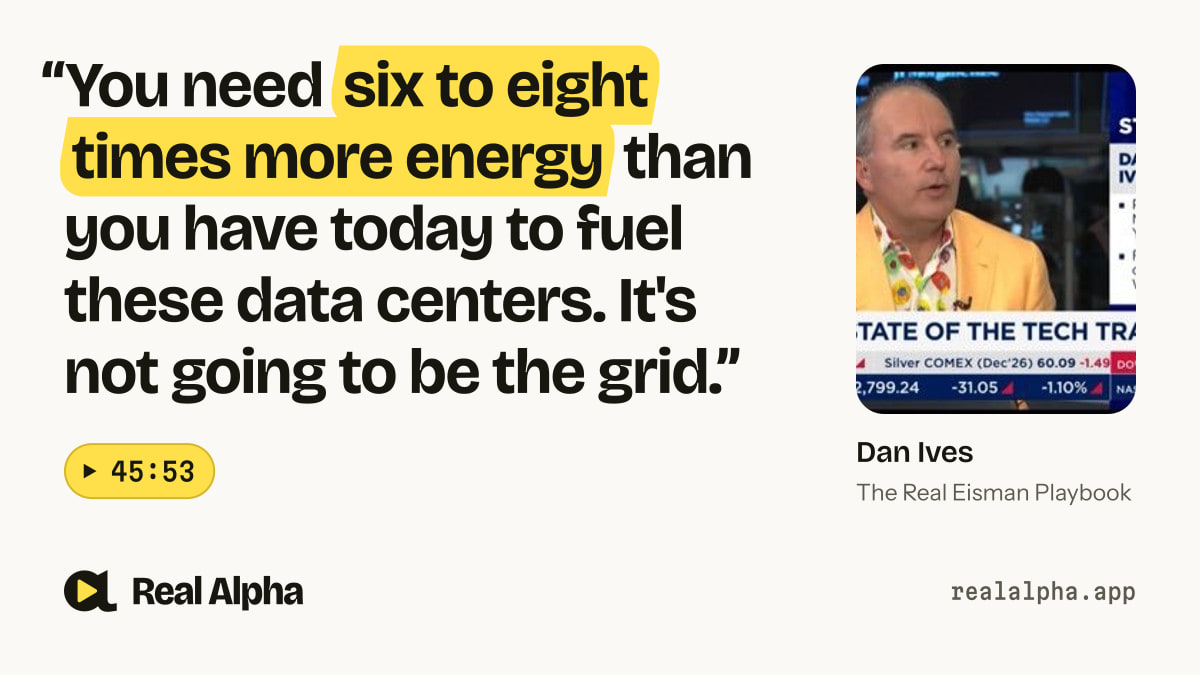
“You need six to eight times more energy than you have today to fuel these data centers. It's not going to be the grid.”
 Dan Ivesat 45:53 · The Real Eisman Playbook
Takeaways Pro pick
- Ives estimates data centers will need six to eight times more energy.
- He argues the grid alone cannot meet that demand.
- Oklo’s thesis depends on reactor buildout and regulatory approvals.
One of Pro's picks, open to you here. Try Pro free for 7 days
One of Pro's picks. The rest of the summary and the 3 takeaways are in Real Alpha Pro; the video, the quote and the transcript stay free.
Read it with Pro, 7 days freeAbout this segment
Dan Ives argues that data center growth will require far more power than the grid can supply, making nuclear important to the buildout. He sees Oklo’s small reactors and fuel-reuse technology as a possible fit, while approvals remain a hurdle.

Dan Ives is a tech analyst at Wedbush Securities.
Built a globally recognized technology research franchise, covering software and broader technology markets for over 25 years.

Steve Eisman, Host
From “The AI Revolution: Winners, Losers, & The Future of Tech | The Real Eisman Playbook Episode 27”, Sep 29, 2025. Watch the full episode
Answers “What will AI look like in the next few years?” See all 169 answers
Answers “Is there enough power for AI?” See all 29 answers
Thanks. We'll look at and fix what's off.
Transcript
Transcribed by machine (Whisper) from the episode’s audio, so a word may be off here and there.
- 45:00
that you're recommending oclo yep explain to people what oclo does it sounds good to be true But it's an Altman, an Altman name. Okay, just tell me, it's a nuclear reactor company. Like, what does this company do? First, so just take a step back. And we have our Ives AI-30, which are the 30 names. Right, it's one of these names. But the real, Aqua's zero revenues today. You're like, oh, is this a bubble?
- 45:23
How could you justify it? Because it's my view that there's more data centers under construction today than active data centers. Say that one more time. So there's more data centers. being constructed than actually exist how many data centers actually exist today and it depends on how you define data centers but basically like in terms like core ones today like the data center build out today I mean we believe you're eventually going to have like tens, hundreds of thousands of data centers as you're going to have many data centers as it all gets built out around the world but to me nuclear that's So the constraint, as we all know, is energy.
- 46:05
You need six to eight times more energy than you have today to fuel these data centers. It's not going to be the grid. Grid you'll have, obviously, you know, changes, utilities, the magic bullet. It's going to be nuclear. And it's like nuclear, to me, is going to be the huge piece here. And when you look at Oclo from a nuclear technology perspective, and obviously they've really been anointed by the U.S. government, and they are— So they build small nuclear reactors, and I was reading that they are able to reuse nuclear material.
- 46:45
Yeah, and that's a very significant piece of what they do. Yes, because we don't have to bury the stuff. Exactly. So to me, they are like the number one nuclear energy play when you think about... Now, where are they in terms of approval? There's an old joke about my criminal law professor was Alan Dershowitz. And they once asked him a question, they said, do you believe in plea bargaining. And he says, do I believe in it? I've actually seen it done. It's a funny line.
- 47:20
And so have you seen these reactors and do they work? No, so I've seen them. I've talked to regulators in DC and around the country. The point is like they are on the cusp of the buildouts of their data. When you think about the buildouts of the nuclear reactors because remember this is all this is all coming right um i believe like in the next three five years like they they're going to basically be like ubiquitous in terms of their build out across the u.s basically what you're saying you think this product is potentially so great that tremendous number of data centers right next to the data center is going to be this little nuclear reactor powering the data center.
- 48:07
That's basically your case. That's our thesis, like how I think it's going to play out. So what is sort of the next data point that you want to see? It's going to be the build-up. Because obviously it hasn't happened yet. Yeah, sure. I give you a look like last week there was like an approval they got. It's trying to find the little incrementals where it's like, okay, these things happen. Like, is the timeline going to accelerate?
- 48:30
Because guess what? U.S. government, they want to accelerate this. Because? Because they know that the biggest constraint— Oh, by the way, from which parts of the U.S. government does this thing need to be approved by? I mean, there's energy. I mean, obviously, there's a national security piece. I mean, there's a bunch of different components of it. But here's the problem. In China, you don't need the regulatory—you have one person that signs a deal, right, in Beijing.
- 49:01
So the point is, like, U.S. knows that when all the meetings, when Trump does these meetings with big tech CEOs, if you said what's the biggest constraint, it's power. Right.