The alpha, twice a week
That was 4 min.
Get the best new moments in your inbox every Wednesday and Saturday. It's free.
Check your inbox
We sent a link to your address. Click it to finish signing up. Not there in a minute? Look in spam.
or
Bloomberg Businessweek · 4 min · Nov 18, 2026
Data centers create jobs, but workers may have to travel
Laura Ullrich shares findings on data-center hiring, including who employs the workers and how permanent the jobs are.
The episode’s best minutes
Full analysis- 7:57Data centers create jobs, but workers may have to travel4 min
- 19:24Anthropic needs IPO cash to fund compute and model training4 min
- 4 more moments in the full episode
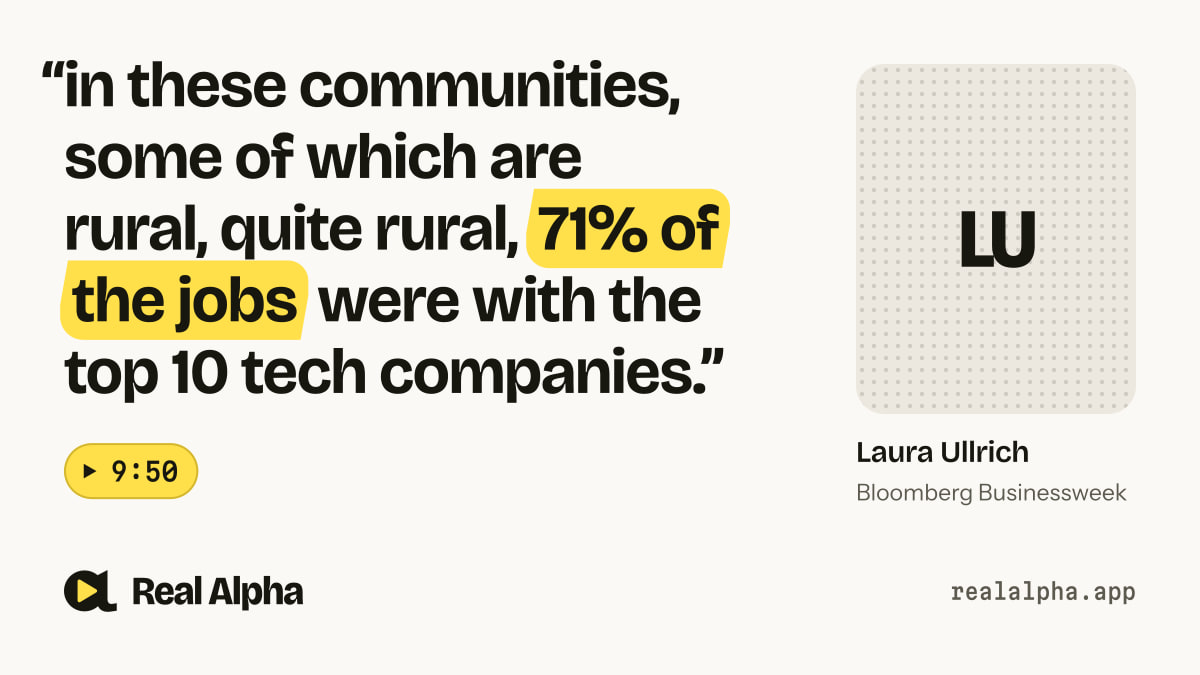
“in these communities, some of which are rural, quite rural, 71% of the jobs were with the top 10 tech companies.”
Takeaways
- 71% of jobs in the communities studied were with top 10 tech firms.
- Data-center postings were more likely to be permanent than other postings.
- Many jobs mentioned travel, raising questions about where workers will stay.
About this segment
Laura Ullrich shares findings on data-center hiring, including who employs the workers and how permanent the jobs are. The findings suggest local job gains may not mean workers stay in those communities.
Director of Economic Research, Indeed
- CM
Carol Massar, Host

Tim Stenovec, Host · Co-host, Bloomberg
Interviewed leaders including Reed Hastings, Stephen Schwarzman and Mary Barra as a Bloomberg Businessweek co-host.
From “Most Fed Officials See More Rate Hikes Incoming | Bloomberg Businessweek”, Nov 18, 2026. Watch the full episode
Thanks. We'll look at and fix what's off.
Transcript
From the transcript Bloomberg Businessweek publishes with the episode.
- 7:59
Yeah, it's a great question. And I've actually written a couple pieces on data centers and the labor that is being required to. Build these data centers. It is so interesting. So the labor markets are pretty local. At the end of the day, labor's all local, right? How the labor market feels to both job seekers and employers is definitely based on where your feet are planted. And what we're seeing is in the communities where they are building data centers, the number of postings to build these things is really wild.
- 8:29
And wages are high. I mean, it's interesting. You know, you just made me think of something. My wife is not going to be happy I brought this up because she does not like to. But okay, so I have to tell you guys. So she's an urban planner. She works for the city. I've talked about this on air before. She logged into LinkedIn the other day, and every job that came up, like you might be a good fit for, all data center.
- 8:53
Liaison community work. Seriously? All over the country. From all the different types of companies that we talk about all the time, but it was every single opportunity was related to data center and community relations. So going there and selling it.
- 9:07
That feels very much post-midterms, right, in many ways, or just in general. So what does that tell you? Is it slowing down the build? And I am curious when you say the workers at the types of jobs, is this to actually build? It's both. The picks and shovels? It's both. It's everything.
- 9:24
It's what he's mentioning about these community liaisons and economic development liaisons.
- 9:29
It's lawyers to deal with the legal contracts. It's construction workers. It's fiber and cable workers.
- 9:36
But here's the concerning thing that I think a lot of people think about, the temporary nature of those jobs. You go in, you build it, you move out. That thing runs and hums without people.
- 9:47
So I have an interesting stat for you from the work that we did. First of all, in these communities, some of which are rural, quite rural, 71% of the jobs were with the top 10 tech companies. So they were with the hyperscalers themselves rather than a staffing firm or a local construction firm, something like that. So permanent jobs? We also found that they were more likely to be permanent than non-data center jobs. That was a surprise to us because I went into it thinking these are going to be much more likely to be temporary.
- 10:17
That's actually not what we found. Now, what I will say is many of the job postings mention a lot of travel. Travel requirements seem to be higher. So one of the things that I have wondered. Are there jobs in the community? There are jobs there, but I do wonder if these hyperscalers are creating a highly trained workforce that they will then move around to build more data centers because it just.
- 10:38
the jobs are much more likely to mention travel. Oh, so like a group. Okay, so now we're in Columbus today and next week or six months we're in Austin or whatever.
- 10:50
I wonder about that. I mean, I think it's really hard to know until they're built out. Are they permanent because they are trying to court favor with local economic development organizations? I don't really know, but it's really interesting. I know, right?
- 11:03
Yeah, I mean, but okay, so if we think about the permanent... Well, nothing's permanent in this world. Right, absolutely. But the long-term economic implications of the way these– and if we look at last year, how much of the economic growth in this country was a result of this build-out, then what does that look like over the next couple of years, especially with the pushback. That we've seen locally? Right.
- 11:25
One of the things– another thing that I think is really interesting is I originally did this work back in June. Mm-hmm.
- 11:32
And it looked like the data center jobs were plateauing. In that moment, and we re-ran it recently, and they actually have taken off again since then, even in the midst of the backlash. So post-election they've taken off? Well, not post-election necessarily, but post-backlash era, I would say. And so I think that right now, many of these have already been approved, and so they're being built, right?
- 11:55
So in the near term, I don't think it slows down. In the intermediate term, where you need to get new projects... Maybe it slows down.
- 12:03
How much of job creation, according to your data and what you see, is somehow AI related?