The alpha, twice a week
That was 5 min.
Get the best new moments in your inbox every Wednesday and Saturday. It's free.
Check your inbox
We sent a link to your address. Click it to finish signing up. Not there in a minute? Look in spam.
or
Latent Space · 5 min · Nov 25, 2026
Decision models can route work without full inference
 Thariq Shihipar
 places decision models between hard-coded logic and tool-calling inference, using them to route flexible game or support-bot behavior.
The episode’s best minutes
Full analysis- 6:24A human folder keeps generated game code editable5 min
- 19:44Decision models can route work without full inference5 min
- 42:00Humans should choose which AI experiments get computePro pick 6 min
- 5 more moments in the full episode
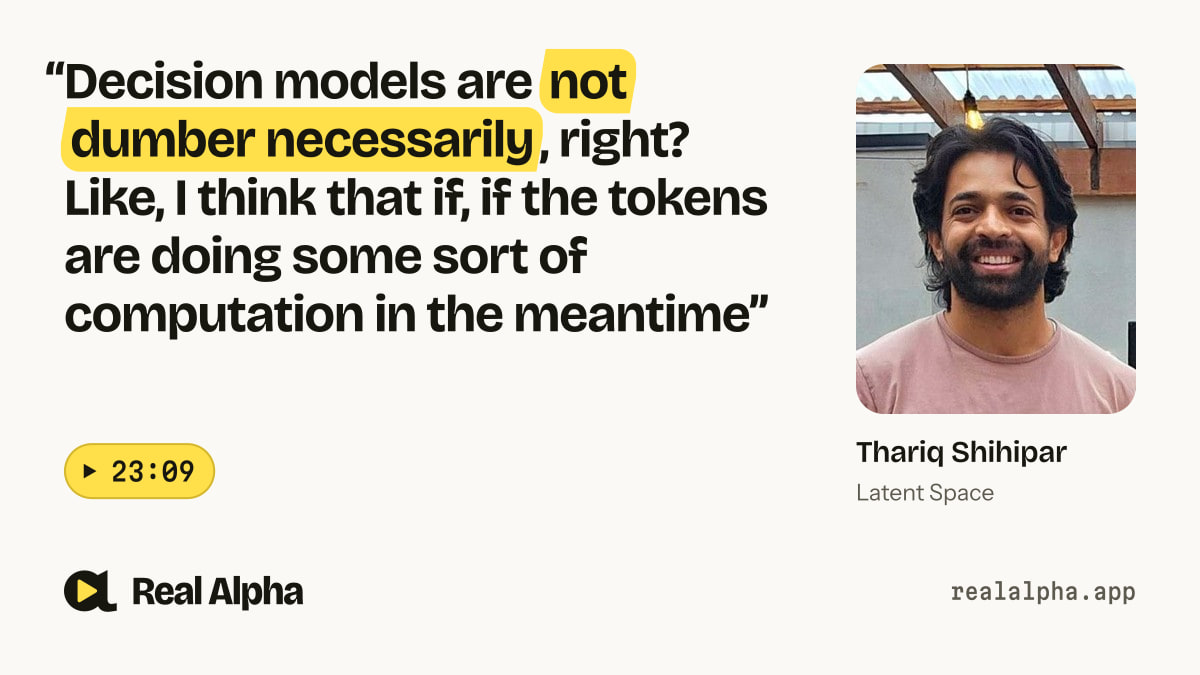
“Decision models are not dumber necessarily, right? Like, I think that if, if the tokens are doing some sort of computation in the meantime”
 Thariq Shihiparat 23:09 · Latent Space
Takeaways
- Decision models sit between fixed logic and full inference.
- They can route support-bot requests and decide when to fetch information.
- Extra generated tokens may add little when the answer is already known.
About this segment
Thariq Shihipar places decision models between hard-coded logic and tool-calling inference, using them to route flexible game or support-bot behavior. They may avoid extra decoding when the model already knows the answer.

Thariq Shihipar is a joined OpenAI after the interview.
Builds Claude Code's interface features like AskUserQuestion and writes widely read technical essays on agent harnesses.

Shawn Wang (swyx), Host · Co-founder, AI Engineer
Wrote “The Rise of the AI Engineer” and founded Smol AI, maker of AI News.

Alessio Fanelli, Host · Founder, Kernel Labs
Partner at Decibel, backing technical founders who build developer tools.
From “The Revolution vs The Renaissance — Thariq Shihipar, OpenAI”, Nov 25, 2026. Watch the full episode
Thanks. We'll look at and fix what's off.
Transcript
From the transcript Latent Space publishes with the episode.
- 19:54
Um, okay, so I, I think, like, one example is sort of like, uh, let's say that you were, um, writing an AI for this game, right? Um, and, like, one version of the... Like, I, I think there's, like, this, uh, branch of, like, okay, everything from, like, hard-coded everything to inferences everything. You know what I mean? Like, like, uh, and you can imagine on one hand you could have an AI that's literally all hard-coded.
- 20:22
Uh, you can imagine on the other hand that you have an AI where, like, every turn it's just a tool calling loop basically and, uh, like, you know, you have to imagine a very fast inference loop. But, um, decision models are, like, somewhere in between there, right? So you can sort of, like, pre, like, write out, you know, the behavior of the AI, but then you can also evaluate the game state at any one point and be like, "Oh, based on this game state, uh, you know, like, what, what do you want to do?"
- 20:47
And this is especially interesting when the user has a lot of ways to express itself in maybe, like, un- um, like, uh, uh, unpredictable ways. So for example, like, maybe if you could type or maybe if you can, like... Uh, the, the space of things you can do is, like, really high and hard to predict in, like, normal code. Um, I think a good example of, like, something I would try now is a support bot that is primarily decision model based, you know?
- 21:15
Um, because, like, effectively support bots are just, like, trees of things happening, right? And then, like, it can opt out into, you know, inference when needed, but you can sort of, like, have maybe best of both worlds, yeah. I, I think that the question is just, like, how much intelligence do you really need? Yeah. Because obviously decision models are going to have no thinking, no reasoning. Yeah. But, um, there's some level of intelligence that you need to understand what you're being asked in order to route correctly. Yeah.
- 21:42
And that's my problem, uh, my personal defense of why I try to adopt what TypeSafe does of not calling it a decision model. They call it a system one model. Mm. It's a very minor difference at the end of the day, but- Yeah... you know, you want a smart model making a decision sometimes. Yeah. I mean, I, I think that, like, that's kind of what the probability distributions- Confidence... are for, confidence is for as well. Uh, but yeah, I mean, it can be confidently wrong, too.
- 22:08
[laughs] But I think just like, you know, um- I'd be very keen on examples where JeV is confidently wrong. Yeah. 'Cause I don't think anyone's really explored that. Yeah, I mean, I, I think, uh, like... I, I think the cool thing about decision models is that you know that... You know, you know from interp that after one forward pass of the weights, the model knows, like, a lot of information. You know what I mean?
- 22:32
And that, like, um, in, you know, like many cases, uh, let... Okay, like let's say that you're, uh... I think this is Ilya's classic example where you're, you have like a huge novel, and at the end it's a mystery novel, and the, the last sentence is, "The killer," or, like, "What's the killer?" or something. Uh, then you say, "The killer is X." There's zero entropy in any of those words, right? The killer is whatever. Like, there's no information.
- 22:56
The model already knows, uh, who the killer is, you know, at the, after one forward pass, and you are just, like, decoding a bunch of extra words for kind of for no reason. If you know the answer is, like, here's a dict of, uh, here's an array of killers- Yeah... just tell me which one it is. [laughs] Um, and so, like, it... Decision models are not dumber necessarily, right? Like, I think that if, if the tokens are doing some sort of computation in the meantime, right, like if there's, like, some reason you need to reason or tool call around in order to, like, understand this question, um, I think, like, in the support bot question it might be like, "Oh, hey, um, you know, like, I missed my flight," or something, and, like, the model needs to know, like, what flight, right? It needs to do a tool call in order to do that.
- 23:49
Um, but you can even decision model around that, where you can be like, "Does, is the user, you know, like, uh, asking for in, more information, or does, does the user... Is it referencing information that you need to- Yeah... pull?" Or do you make it up? Yeah, yeah. Yeah. Which, which obviously you try not to make it up. Yeah. I, no, I was, I was...