The alpha, twice a week
That was 3 min.
Get the best new moments in your inbox every Wednesday and Saturday. It's free.
Check your inbox
We sent a link to your address. Click it to finish signing up. Not there in a minute? Look in spam.
or
BG2 · 3 min · Jul 10, 2025
Dell distinguishes national debt from a spending problem
 Michael Dell
 compares federal debt with the value of U.S. assets, but says that does not remove the need to control spending.
In this episode
Full episode- 4:09Dell’s six-day inventory created a lasting cash advantagePro pick 4 min
- 46:13AI productivity could justify trillions in annual investment7 min
- 57:13AI compute demand grows as models use more tokensPro pick 5 min
- 53:39Dell's AI server orders exceeded its prior-year shipments4 min
- 36:55Private capital gives AI labs room to spend on talent3 min
- 18:59Invest America accounts allow tax-free employer contributions4 min
- 27:37Dell distinguishes national debt from a spending problem3 min
- 1:12:17Export rules can leave foreign-made substitutes unrestricted3 min
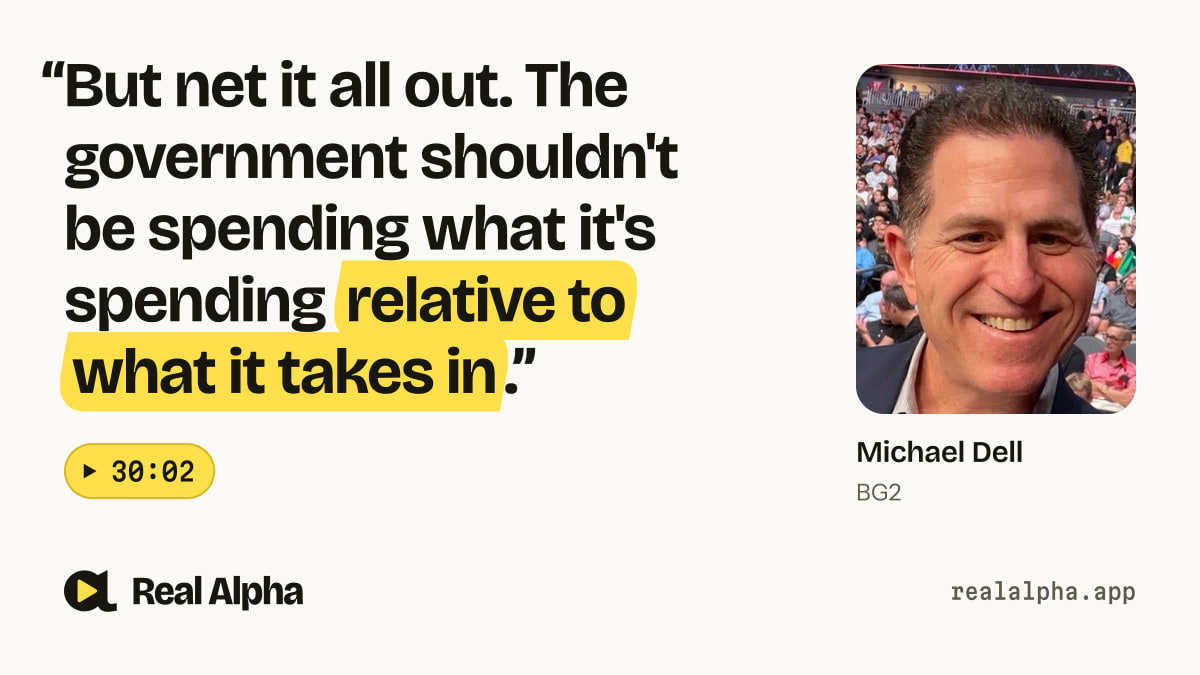
“But net it all out. The government shouldn't be spending what it's spending relative to what it takes in.”
 Michael Dellat 30:02 · BG2
Takeaways
- Dell cites $36 trillion in debt against more than $200 trillion in assets.
- He notes the government has taxing authority.
- He still says spending must come under control.
About this segment
Michael Dell compares federal debt with the value of U.S. assets, but says that does not remove the need to control spending. His analogy separates solvency from the ongoing budget problem.

Michael Dell is founder of Dell.
Founded Dell Technologies and committed $6.25 billion to investment accounts for 25 million American children.

Brad Gerstner, Host · Founder & CEO, Altimeter Capital
Started Altimeter with under $3M in 2008; an early backer of Snowflake.

Bill Gurley, Host · General partner, Benchmark
Backed and sat on the boards of Uber, Zillow, OpenTable and Stitch Fix.
From “Michael Dell – Invest America Act Becomes Law, AI Talent Wars, Compute Demand, Market Update | BG2”, Jul 10, 2025. Watch the full episode
Thanks. We'll look at and fix what's off.
Transcript
Transcribed by machine (Whisper) from the episode’s audio, so a word may be off here and there.
- 27:43
Any other thoughts on that particular point? Yeah, I mean government's obviously been spending too much and there's been some renewed attention and focus on that. That's a good thing. It gets priced into the currency, right? We see it in all the effects, you know, whether it's inflation or the value of the currency. And you can't really escape that. I think the spending has to come under control. Now, maybe we get this incredible productivity lift.
- 28:23
I'm sure we're going to talk about that as we get to the AI fund portion here. um but we shouldn't be spending uh so much more than than we're taking that as as a government we you know we i've sort of stepped back from the hysterics and you say we don't have a loan to value problem as a country uh we we have a spending problem talk to us about that i want to dig into that because it's a really important point talked about loan to value when you say loan to value. What do you mean by that? Yeah, what I mean is the value, the, you know, loan to value is a common term and phraseology used in banking and credit markets and essentially refers to, you know, the amount of a loan relative to the value that it's being borrowed pot. If you think about the deficit, as against the value of all the assets in the United States,
- 29:29
we don't have a loan to value problem. And of course- So the total value of all the assets in the United States are a couple hundred trillion. Our annual deficit is 2 trillion. So you would look at that and say, as a loan to value, that's not an issue at all. Well, I would look at the total deficit as against the total value of the assets. So $36 trillion of debt against $200 plus trillion of assets.
- 29:54
Right. Now you have to take into account private assets and private debt also. So it would be a different equation there. But also the government has taxing authority. And so it could increase the taxes. But net it all out. The government shouldn't be spending what it's spending relative to what it takes in. And there's many ways to address that. But we should be worried about where the deficit is and the rate of increase.