The alpha, twice a week
That was 3 min.
Get the best new moments in your inbox every Wednesday and Saturday. It's free.
Check your inbox
We sent a link to your address. Click it to finish signing up. Not there in a minute? Look in spam.
or
Sourcery · 3 min · Dec 22, 2025
Design weapons for factories the country already has
 Palmer Luckey
 argues that weapons should be designed for existing industrial capacity, not only specialized factories.
The episode’s best minutes
Full analysis- 4:28Anduril treats failed tests as part of product development3 min
- 14:18Visible-spectrum invisibility is easy but often not usefulPro pick 4 min
- 32:03Design weapons for factories the country already has3 min
- 4 more moments in the full episode
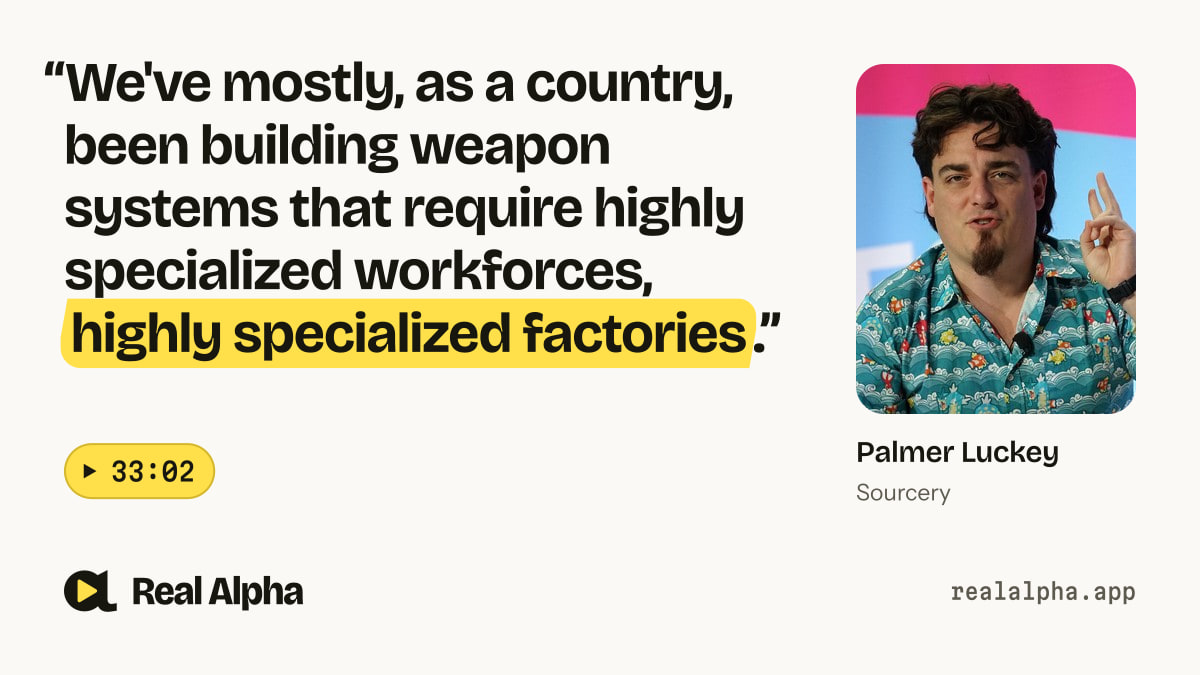
“We've mostly, as a country, been building weapon systems that require highly specialized workforces, highly specialized factories.”
 Palmer Luckeyat 33:02 · Sourcery
Takeaways
- Design around the tools and skills already available.
- Fury's landing gear favors broad manufacturability over lower weight.
- Existing factories could scale weapon production without a new industrial base.
About this segment
Palmer Luckey argues that weapons should be designed for existing industrial capacity, not only specialized factories. That could let the U.S. scale production quickly during a war.

Palmer Luckey is cofounder of Anduril.
Co-founded Anduril, which builds autonomous defense systems, and designed the Oculus Rift that revived VR.

Molly O'Shea, Host · Founder, Sourcery
Ex-Upfront Ventures investor; has interviewed Alex Karp and Palmer Luckey.
From “Palmer Luckey on UFOs, Anduril, Invisibility Tech, & Moon Wars”, Dec 22, 2025. Watch the full episode
Thanks. We'll look at and fix what's off.
Transcript
Transcribed by machine (Whisper) from the episode’s audio, so a word may be off here and there.
- 32:09
But we'll see as he grows up and becomes more of a challenge. I know. It'll start challenging you. Oh, yeah. I look forward to it. It's great. So as we close out, what are you most looking forward to for Andrel? One of the things that I am most excited about right now is how we're designing a lot of our weapon systems to be manufactured by the types of industry that the United States already has. If you look back at World War II, there's this story about how we turned our automotive factories into missile factories and into bomber factories. But it went the other direction, too. We designed bombers and missiles that could be manufactured by automotive factories, by tractor factories, by industrial equipment factories. Things like the thickness of the metal that we used, The level of heat treat that we could do, even the way that we fastened or welded those
- 32:59
pieces together, they were based on what we already knew how to do at scale in American industry. And I think that we've lost that as a country. We've mostly, as a country, been building weapon systems that require highly specialized workforces, highly specialized factories. I want to get back to the basics. How do we design cruise missiles and fighter jets that you can make in a Ford plant? How do I get back to making high-end weapon systems that you can make in any automotive factory, heck, any machine shop in the country?
- 33:27
One example is like Fury's landing gear is a few percent heavier than it could have been because we could have either made it manufacturable by only two places in the entire United States or any machine shop in the entire country. And we're trying to move more towards that because in wartime, Anduril's probably not going to be building all of our systems directly. We're going to need a whole of country effort to reconstitute what we've lost and keep fighting.
- 33:51
And so one of the things I'm most excited about is a lot of the weapon systems that we've already made and that we're going to be announcing in the future that are designed to be made on existing automotive style, tractor style, agricultural style factory lines. Because those are the ones that we're actually going to be able to scale up to hundreds of thousands or even millions of units without having to build an entirely new industrial base, without having to find, hire, and train an entirely new workforce just for building weapons.
- 34:20
I think that that is a model that is going to be a big deal here in the United States. And I think it's also going to be a big deal in allied nations that similarly have a lot of their own existing industrial capacity. You don't necessarily have to build so many weapons factories if your existing factories are capable of building weapons. And that's going to be a big change that I think people have not fully realized the importance of.
- 34:43
It's a great place to end it. Thank you so much. Of course. Thank you so much for coming.