The alpha, twice a week
That was 2 min.
Get the best new moments in your inbox every Wednesday and Saturday. It's free.
Check your inbox
We sent a link to your address. Click it to finish signing up. Not there in a minute? Look in spam.
or
Bloomberg Tech · 2 min · Oct 29, 2026
Driverless trucks could nearly double annual utilization
 Chris Urmson
 describes Aurora’s shift from operating trucks to selling its driver system to carriers.
The episode’s best minutes
Full analysis- 21:02Google needs ads to fund its AI expansionPro pick 2 min
- 24:51Microsoft can use its credit rating to fund AI spending3 min
- 33:16Driverless trucks could nearly double annual utilization2 min
- 5 more moments in the full episode
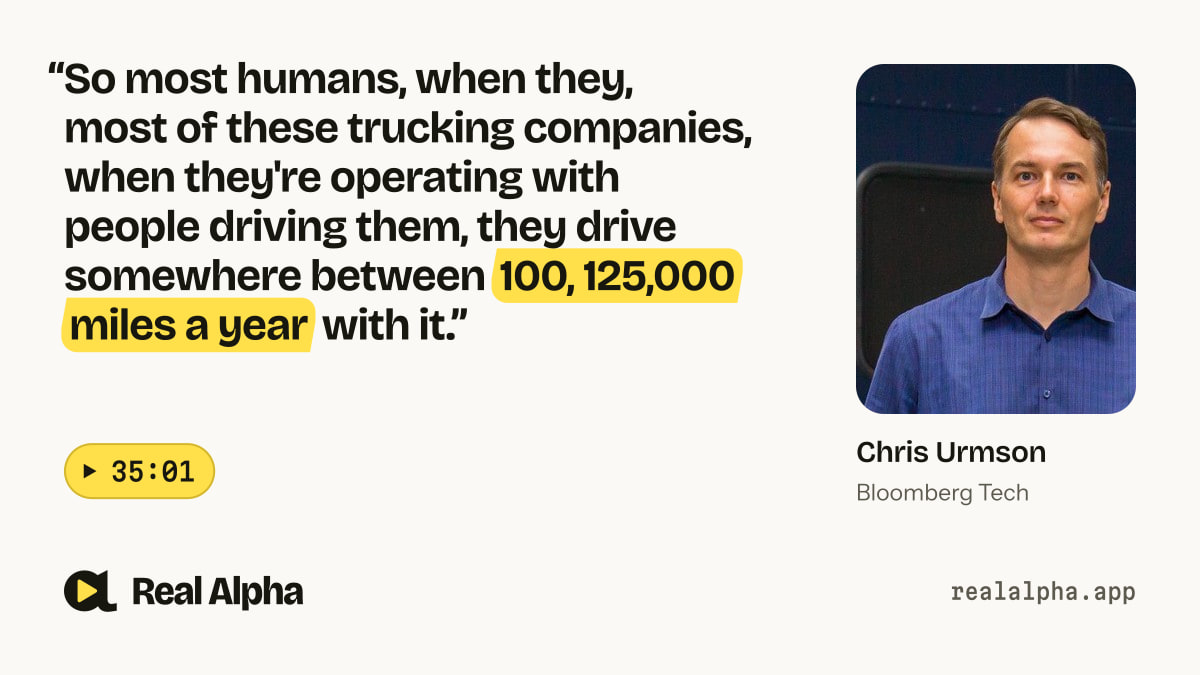
“So most humans, when they, most of these trucking companies, when they're operating with people driving them, they drive somewhere between 100, 125,000 miles a year with it.”
 Chris Urmsonat 35:01 · Bloomberg Tech
Takeaways
- Aurora expects its system to let carriers own and operate trucks.
- Human-driven trucks typically run 100,000 to 125,000 miles a year.
- In the Permian Basin, driverless trucks can make five to six loads a day.
About this segment
Chris Urmson describes Aurora’s shift from operating trucks to selling its driver system to carriers. More miles and extra daily loads can make the economics compelling where driver availability is limited.

Chris Urmson is co-founder and CEO of Aurora.
Built Google's self-driving program before co-founding Aurora, where he leads development of autonomous vehicle technology.

Ed Ludlow, Host · Host & correspondent, Bloomberg
Hosts Bloomberg Tech and reports on technology, supply chains, deals and finance for Bloomberg News.
From “Google Sales Miss Reignites AI Fears, Microsoft Eyes $25B Debt Offering | Bloomberg Tech”, Oct 29, 2026. Watch the full episode
Thanks. We'll look at and fix what's off.
Transcript
From the transcript Bloomberg Tech publishes with the episode.
- 33:18
Can we talk about commercialization? In the somewhat limited world of autonomous trucking or haulage, there are different ways you can go about it, right? But you have customers. How do you charge them to move a good from point A to point B? Yeah.
- 33:33
So today, we actually operate the trucks. And they pay us like they would pay someone else to operate that truck for them. What's really exciting is next year, we're going to move to what. We call drivers of service. This really allows the customer to focus on what they do best in the world, which is they own and operate trucks. They understand the financials of that. They really know how to maintain them, get the most out of them.
- 33:54
And we provide a driver to them that allows them to be more fuel efficient, allows them to.
- 34:00
Get- In this case, the driver is, let's call it a robot. Right. The right driver is the Aurora driver.
- 34:04
So this is our software and hardware that sees the world around the vehicle, keeps it moving through it, keeps that truck on the road, allowing them to maybe double the utilization they get out of a truck today.
- 34:14
And that's a huge win for them economically. Where are we at on the economics? Like, I guess you'd measure it on a dollar per mile basis for a human driven truck versus a driverless truck. Yeah.
- 34:27
So the second generation hardware that we just launched, Right. Right. Right. Macro sort of economic point is that if you would, it's utilization really. So if you were to do 225,000 miles a year in one of these trucks, like you're really getting something out of it. Like, but how would that compare to what a human driver could achieve in a year? Yeah.
- 35:04
So most humans, when they, most of these trucking companies, when they're operating with people driving them, they drive somewhere between 100, 125,000 miles a year with it. So we're basically doubling it. You're trying to target double. And then with a customer like Detmar, which hauls fracking sand in the Permian Basin, today it's really hard to get people to move to Midland, Texas. It's a lovely community, but it's not the place most people want to move.
- 35:28
And so they can only really get three loads of fracking sand per day moved with a person driving the truck. And they can't get a whole lot more people to go there. We can do between five and six. So again, for a business like that, this is an opportunity to double their revenue.