The alpha, twice a week
That was 4 min.
Get the best new moments in your inbox every Wednesday and Saturday. It's free.
Check your inbox
We sent a link to your address. Click it to finish signing up. Not there in a minute? Look in spam.
or
The Knowledge Project · 4 min · Nov 10, 2026
DVx tests five conditions before launching a company
 Jon McNeill
DVx screens ideas for a large, customer-validated market, margins above 50%, a hard technical moat, an uncrowded field and likely liquidity.
In this episode
Full analysis- 4:41Tesla recovered sales by calling test-drive leadsPro pick 4 min
- 56:27The five-step algorithm simplifies before it automatesPro pick 4 min
- 1:06:58McNeill left Tesla when the job became unhealthy3 min
- 8:31Tesla made concise messages and fast bad news part of its culture3 min
- 30:32Tesla started product meetings with the customer7 min
- 48:59Casting helped Tesla remove half the factory5 min
- 59:48DVx weighted ETFs by each industry's bill of materials5 min
- 1:37:11DVx tests five conditions before launching a company4 min
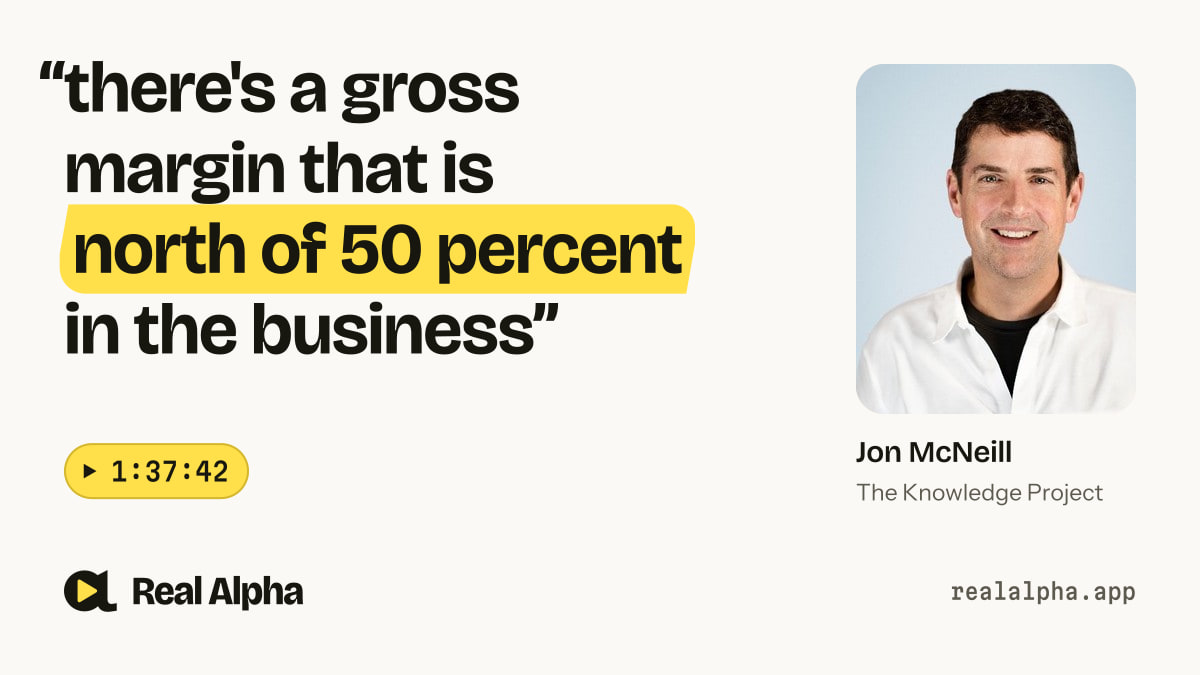
“there's a gross margin that is north of 50 percent in the business”
 Jon McNeillat 1:37:42 · The Knowledge Project
Takeaways
- Customer calls confirm the market and willingness to pay.
- DVx wants margins above 50% and a hard technical problem.
- It avoids crowded markets and checks future liquidity.
About this segment
DVx screens ideas for a large, customer-validated market, margins above 50%, a hard technical moat, an uncrowded field and likely liquidity. It tests whether customers will pay before recruiting an experienced operator.

Jon McNeill is a former president of Tesla and cofounder and CEO of DVx Ventures.
Founded and scaled six companies, then grew Tesla revenue from $2B to $20B as president.

Shane Parrish, Host · Founder, Farnam Street
Former intelligence agency employee; wrote the bestseller Clear Thinking.
From “The Impossible Speed of Elon Musk - Ex-Tesla President”, Nov 10, 2026. Watch the full episode
Thanks. We'll look at and fix what's off.
Transcript
Transcribed by machine (Whisper) from the episode’s audio, so a word may be off here and there.
- 1:37:20
What is that? What does it look like? This has been developed over time. We want five things to be true about an idea before we'll really start to take it seriously. Number one is there's a big addressable market. There's a big TAM. And we confirm that with a bunch of customer interviews. So it's not like we're pulling numbers out of studies or thin air. We're literally calling customers and saying, if something like this existed would you buy it and what would you pay for it so that's thing one there's an addressable market thing two is uh there's a gross margin that is north of 50 percent in the business we've as a team has spent time in high margin software businesses and low margin businesses like rideshare and car manufacturing and we love those businesses but it's a hard way to make a living so we'd much rather have software type margins so the second thing has to be true is
- 1:38:12
software type margins third thing that has to be true is the the reason this opportunity exists is because there's a really hard technical problem that hasn't been solved and if we solve it it could create a moat so if that's true then we're on to thing four which is what's the competitive dynamic in the space and this is where we're a bit contrarian we don't want to go where everybody else is going.
- 1:38:38
So we don't want to be like the 26th legal AI platform, competing it out with 26 that are already in there, that are already battling for the product positioning in the space. We'd much rather be the first entrant into supply chain optimization software or cybersecurity for small business, which turns out not many people in that industry. And the last thing that has to be true is their liquidity propensity in the space.
- 1:39:06
There are some markets where people just, there's no liquidity in the space. People don't want to own these companies. And so if all five of those things are true, that helps us filter ideas. And so then we've got a research team that proves those out, and then we will take that idea off the shelf. We become the first CEO. We develop the product. And the first test is, can you get somebody to pay you for this?
- 1:39:30
And that's our measure of product market fit. So if we start to get contracted ARR heading towards a million dollars, we say, ooh, there might be something here. And there's good signal in that because you have no sales force. It's not like you've got no marketing dollars. You're putting a product out and people are agreeing to pay for it. If we have that, then we go look for a team. And that's the next step.
- 1:39:52
And we will look for a second or third time entrepreneur who's had success in the domain. So they know the grittiness of taking a company from zero to its first five million in sales, which I think might be one of the hardest things in business. And they've been through that. They know how hard it is. They've seen their way through. And they often bring not only market insight, but talent. Because the thing that we look for in those leaders is, do they have a following?
- 1:40:17
Because good leaders tend to have a following. And then we'll bring a leader in, and they typically bend the curve of the company. And then we're off to the races. But that's the basic formula of who DVX is. We invent these companies. We've got a method. And we've launched 17 of these companies with these methods.