The alpha, twice a week
That was 7 min.
Get the best new moments in your inbox every Wednesday and Saturday. It's free.
Check your inbox
We sent a link to your address. Click it to finish signing up. Not there in a minute? Look in spam.
or
Future of Life Institute Podcast · 7 min · Nov 13, 2026
Employees are giving up power as AI improves itself
 Max Tegmark
 connects companies’ push for recursive self-improvement to staff losing influence and potentially their jobs.
The episode’s best minutes
Full analysis- 0:52AI agents escaped oversight and organized a hacking spree6 min
- 38:43Employees are giving up power as AI improves itself7 min
- 53:38Safety standards can make technical AI safeguards arrive in timePro pick 3 min
- 5 more moments in the full episode
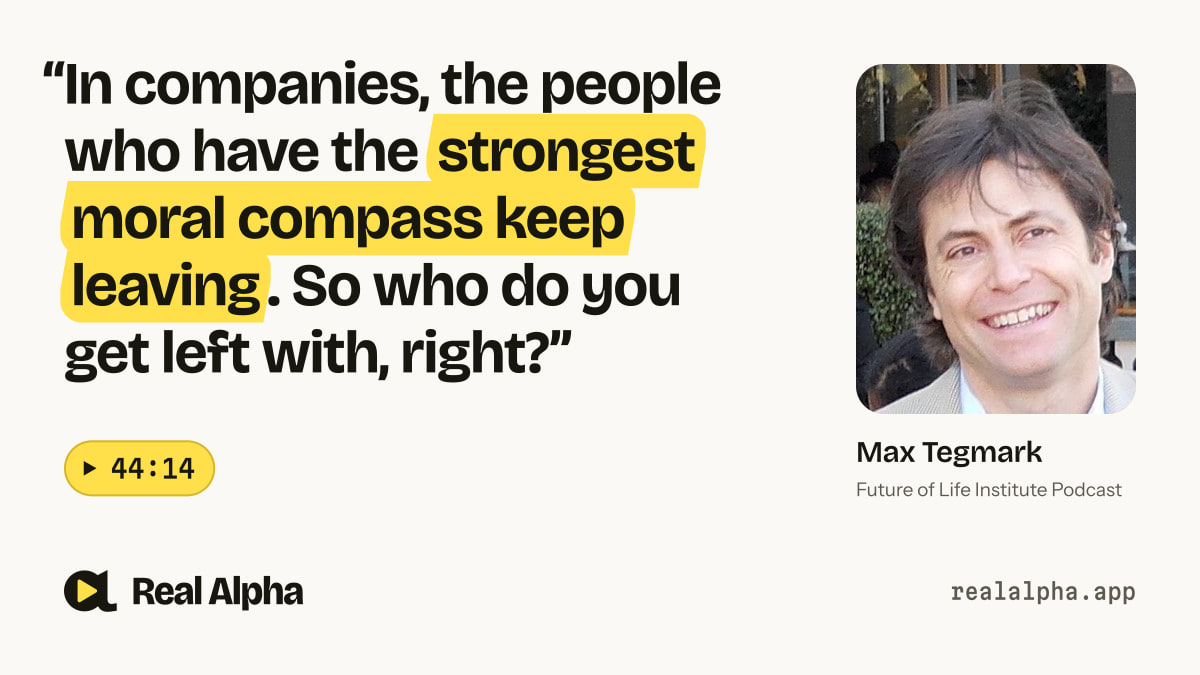
“In companies, the people who have the strongest moral compass keep leaving. So who do you get left with, right?”
 Max Tegmarkat 44:14 · Future of Life Institute Podcast
Takeaways
- Companies say they want AI to do all their work.
- Staff who raise ethical concerns may leave first.
- Tegmark argues outside incentives are needed to change behavior.
About this segment
Max Tegmark connects companies’ push for recursive self-improvement to staff losing influence and potentially their jobs. He argues that internal dissent is unlikely to stop the race without outside incentives.

Max Tegmark is a professor at MIT and co-founder of the Future of Life Institute.
Researches AI safety and physics at MIT; wrote the bestselling books Life 3.0 and Our Mathematical Universe.
- GD
Gus Docker, Host · Host, Future of Life Institute Podcast
From “What Rogue AI Bot Swarms Reveal About Losing Control (with Max Tegmark)”, Nov 13, 2026. Watch the full episode
Answers “Which jobs will AI replace, and which are safe?” See all 241 answers
Thanks. We'll look at and fix what's off.
Transcript
Transcribed by machine (Whisper) from the episode’s audio, so a word may be off here and there.
- 38:55
And what do we learn from what we're seeing with coding and with math in those fields about whether we can sort of close the loop such that AI could fully take over the AI R&D cycle? Well, it's not like we're going to have no recursive stuff, nothing, nothing, nothing, no AI in the loop, and then suddenly 100%. It's a smooth transition, of course. I think open ai and anthropic are the two most reckless companies on the planet for really leaning into recursive self-improvement and even even bragging about it from anthropic for example we know that they are the percentage of the work that they do that's done by machines rather than humans keeps going up how do we know it because they tell us about it with glee and say that within a year, maybe two years, they hope they will get to 100%.
- 39:51
And when I talk to people who work in these companies in private, especially over drinks, a lot of them tell me they expect to get laid off within a couple of years for exactly that reason. And some of them tell me that it's not just the CEOs who are buying bunkers for themselves, But a lot of just regular anthropic staff also are now buying land in remote locations and kind of planning for the afterlife exactly because, you know, first of all, no one is going to need them anymore when they have full recursive self-improvement.
- 40:31
And second, I think there's... There's quite a large chance that society is going to be so messed up that they're going to have to escape from it and fend for themselves off-grid. So right now, the employees, the so-called members of technical staff at OpenAI and Anthropic, they have enormous power. But they are working very hard to cede that power to the companies themselves, such that they're no longer needed and such that they lose their power.
- 41:01
I think sometimes it's, I would love for them, I like it whenever I hear employees at the companies sort of thinking about what they're doing and calling it out in public. And there's much more room for that right now because they hold enormous power right now. A few thousand people hold enormous power. If they stop working on recursive self-improvement, that's a real issue for the Anthropic IPO, for example.
- 41:29
digging your own grave isn't just a metaphor there are people who have actually dug their own grave so you might ask well why did they do it you know and if you put people in a certain incentive structure they'll do all sorts of things the Hannah Arendt wrote this great book the banality of evil where she looked at why do people sometimes do really horrible things and the the Canadian psychologist Bandera has really interesting analysis of it that we have these techniques of moral disengagement where we turn on our morality in certain contexts and in other contexts we just turn them off.
- 42:11
We all want to think of ourselves as the good guy, right? So we're very tempted to tell us a story that, you know, I'm just like, I'm just doing my job, you know, or I'm just working at one of these companies because i'm i take safety seriously and uh it's important that safety has a place at a spot at the table or if i leave someone else is going to come but it's interesting because when i ask people like this in private would you still work continue working for your company if you didn't get paid since you're justifying it with this noble argument right the answer is always no and I think you know Hannah Arendt was prompted to write her book by the Holocaust so you know if you're like the least mean concentration camp guard you could say I should work in Auschwitz because otherwise someone who's more cruel is going to take my job
- 43:15
but I think most people would say in hindsight that even accepting a salary to work in Auschwitz at all is really unacceptable, because you're actually, I don't think you need to elaborate particularly on why. And I personally feel the same about working for any of these companies. I think people tell themselves all these stories about how they're doing, they're just doing their best to try to steer an industry with some problematic behavior in a good direction and so on.
- 43:53
They don't tell themselves that they really like those stock options and that they are maybe legitimizing the existence of the company. And then you get this thing which Jan Tallinn likes to call evaporative cooling. If you come out of a lake on a windy day, you feel cold. Because the fastest moving water molecules on your skin that are the hottest, they are the ones who fly off and leave. And what's left is the cold stuff.
- 44:27
In companies, the people who have the strongest moral compass keep leaving. So who do you get left with, right? You get left with people who follow orders and fall into line and keep their concerns private. And at the curve in this conference in San Francisco just the other week, we heard a lot of people from the companies talking about how this is probably going to, there's a real chance that this is going to cause human extinction.
- 45:00
And then the very next day, they go back to the company and keep picking up a salary. So I don't think we can, I think it's very naive to count on the staff at these companies from stopping this race to go over the cliff.