The alpha, twice a week
That was 2 min.
Get the best new moments in your inbox every Wednesday and Saturday. It's free.
Check your inbox
We sent a link to your address. Click it to finish signing up. Not there in a minute? Look in spam.
or
Bloomberg Tech · 2 min · Nov 19, 2026
Enterprise AI has more room to grow than consumer use cases
Peter Singlehurst argues that consumer AI may be hard to monetize, while enterprise use cases are far from saturated.
The episode’s best minutes
Full analysis- 20:13Altimeter passed early over commercialization and margin risksPro pick 3 min
- 25:09Anthropic balances compute investment with financial flexibility3 min
- 51:00Enterprise AI has more room to grow than consumer use cases2 min
- 3 more moments in the full episode
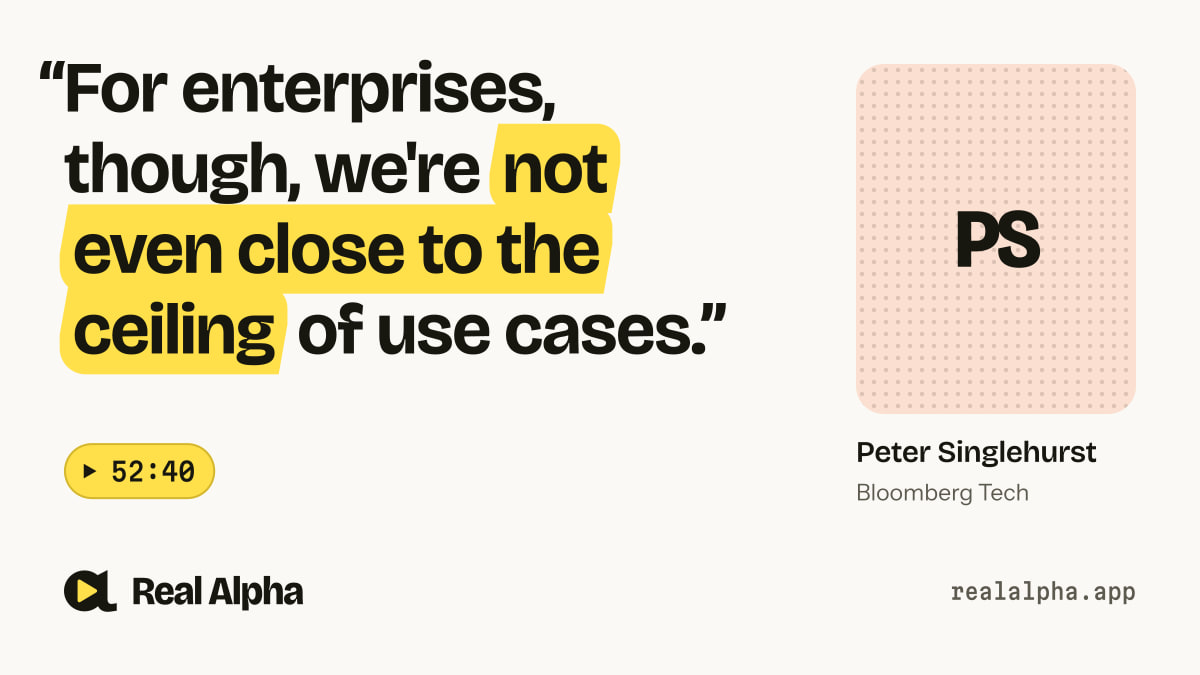
“For enterprises, though, we're not even close to the ceiling of use cases.”
Takeaways
- Many consumer use cases are already served by free models.
- Enterprise AI has years of new needs and use cases ahead.
- New models can expand markets and support pricing power.
About this segment
Peter Singlehurst argues that consumer AI may be hard to monetize, while enterprise use cases are far from saturated. New models can expand markets, support pricing power and produce stronger returns.
Head of private companies & partner, Baillie Gifford
Leads Baillie Gifford’s private companies team and manages the Schiehallion Fund.

Ed Ludlow, Host · Host & correspondent, Bloomberg
Hosts Bloomberg Tech and reports on technology, supply chains, deals and finance for Bloomberg News.
From “Anthropic Goes Public After Record-Breaking IPO | Bloomberg Tech”, Nov 19, 2026. Watch the full episode
Answers “What will AI look like in the next few years?” See all 395 answers
Answers “How do AI companies make money?” See all 122 answers
Thanks. We'll look at and fix what's off.
Transcript
From the transcript Bloomberg Tech publishes with the episode.
- 51:02
I think there's definitely an important aspect of that, but I think that also underplays the importance of diffusion. There are two growth drivers for Anthropic. One is the development of new models.
- 51:12
Could I pause you and ask you just to give a basic definition of diffusion? Because Pauline Yang of Altimeter mentioned it several times as well earlier in the hour.
- 51:19
It's basically taking the technology as it exists today and maximizing the distribution and the potential of that. There's a quote from William Gibson, a science fiction writer, who said, the future is here, it's just not evenly distributed yet. And that's the case with many of today's technologies in frontier intelligence. They are not equally distributed. And so we think there's a lot of growth to come just through the distribution and dissemination of that technology throughout industries and economies.
- 51:46
On top of that, you then have the growth that can come from frontier intelligence, new models, which then adds an additional multiplier to that growth potential.
- 51:53
The metric that Anthropic leaned on in that regard was to say, okay, this is the number of Fortune 500 companies that use our technology. But if you look at their aggregate spend, Anthropic is 0.1%, and so they see a huge TAM. But for Anthropic, that was always more in the enterprise. That was the early move they made. Do you want to see diffusion societally to everyday people beyond just those sort of SaaS companies that they're currently working with? And the banks and medical firms do.
- 52:25
So one of the reasons we invested in Anthropic was because of their focus on the enterprise. Consumer use cases are actually fairly basic, and many of those consumer use cases are met by free models. Are consumers going to pay for a model that is twice as good? I would argue not that much. For enterprises, though, we're not even close to the ceiling of use cases. I think we have years, if not decades, of frontier intelligence continuing to meet new needs, new use cases.
- 52:52
And that means a company will get return on investment in new models. They will be able to expand their addressable market. They'll be able to exert pricing power. And that scope for high return on equity we think is just much greater in the enterprise. So that focus, that existential focus on the enterprise for us is a very important part of the anthropic investment case.
- 53:12
Peter, I'm going to ask you to close the show just with your reflection on this as a moment in time, what it means for Frontier Intelligence and for this company.