The alpha, twice a week
That was 7 min.
Get the best new moments in your inbox every Wednesday and Saturday. It's free.
Check your inbox
We sent a link to your address. Click it to finish signing up. Not there in a minute? Look in spam.
or
Sourcery · 7 min · Jul 27, 2026
Enterprises need help changing how they build software
 Scott Wu
 argues that Cognition’s independence lets it work across models, while enterprises need more than a coding tool.
The episode’s best minutes
Full analysis- 8:14Cognition negotiated the Windsurf acquisition in one weekend4 min
- 20:17Enterprises need help changing how they build softwarePro pick 7 min
- 33:24A MongoDB setup error revealed Devin’s potential4 min
- 4 more moments in the full episode
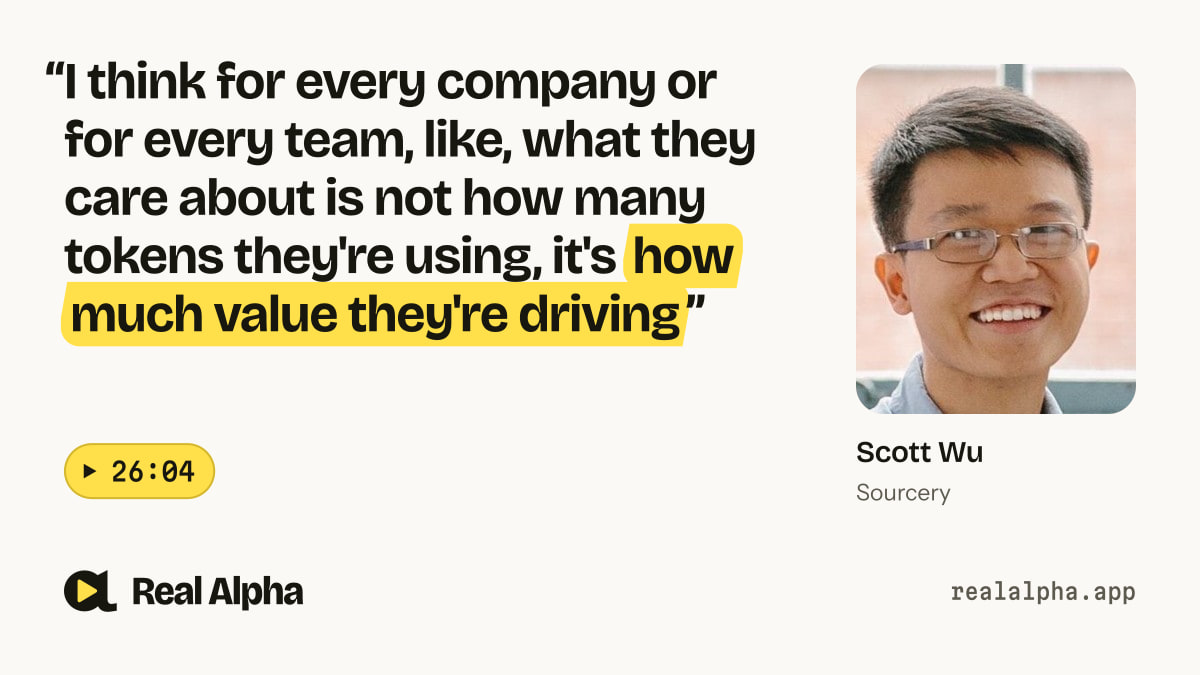
“I think for every company or for every team, like, what they care about is not how many tokens they're using, it's how much value they're driving”
 Scott Wuat 26:04 · Sourcery
Takeaways Pro pick
- Cognition works across model providers rather than choosing one lab.
- Enterprises want durable partnerships as model leaders change.
- AI adoption requires changes to how teams plan and build.
One of Pro's picks, open to you here. Try Pro free for 7 days
One of Pro's picks. The rest of the summary and the 3 takeaways are in Real Alpha Pro; the video, the quote and the transcript stay free.
Read it with Pro, 7 days freeAbout this segment
Scott Wu argues that Cognition’s independence lets it work across models, while enterprises need more than a coding tool. They need a partner to help adapt planning, design and team workflows to AI.

Scott Wu is cofounder and CEO of Cognition.
Co-founded Cognition, the company behind Devin, an autonomous software engineer; three-time IOI gold medalist.

Molly O'Shea, Host · Founder, Sourcery
Ex-Upfront Ventures investor; has interviewed Alex Karp and Palmer Luckey.
From “Inside the Fastest-Growing Category in AI: Scott Wu, CEO of $26B Cognition”, Jul 27, 2026. Watch the full episode
Thanks. We'll look at and fix what's off.
Transcript
Transcribed by machine (Whisper) from the episode’s audio, so a word may be off here and there.
- 20:21
So why were you guys in DC for Independence Day and what's the DC play here? Yeah, yeah, for sure. No, I mean, it's, look, I think it's like a really, obviously it's a really topical thing right now. And I think especially because code is, I think in some ways, like, you know, the most kind of like mature vertical. I think a lot of folks look to code as kind of like an expectation of what's going to happen in the rest of the industry and all these verticals.
- 20:47
And yeah, I think there's been a narrative out there that, oh, like in order to win, you have to be a lab yourself or you have to go sell to a lab. And obviously, like, we've just always believed that because there's a lot of value and a lot of power in being independent. And you see that in how we work. Like, you know, we're completely model neutral. Like, we work with all the different providers.
- 21:08
We work with OpenAI, Anthropic, you know, Google, so on and so forth. But also just, like, in our approach with companies and so – or with all the orgs that we work with. So DC is really exciting for us for a couple reasons. I think, one, because, frankly, it's like you talk about places that need software and that have, you know, things that they want to build but not enough software engineers to build them.
- 21:35
You see, and government in general might perhaps be the single biggest kind of point of that, right? All of these orgs have so many things that, you know, I mean, I feel like the one-liner is like, imagine going to the DMV and it actually worked. And why doesn't it work? You know, it's because there's all this archaic software. It's all these crazy processes. it's because the website kind of doesn't really you know work and or you're not able to kind of see these things and track all these things in advance and like government software doesn't have to be that you know all these things can be good um and and i think it's like i think it's like a really important thing um for for us to work towards i think the other thing and the other reason why why it's so important to us is frankly i think ai itself is just going to be a pretty
- 22:22
fundamental um policy issue over the next few years and like you think about the early days of the internet for example and there were all these discussions about okay what's going to happen is there are there going to be a handful of corporations that control the entire internet or they can be whatever um obviously we ended up with the open internet and now you know all the businesses of the world are built on the internet but there will come a day where all the businesses of the world are built on ai you know and i think it's something that we should be thinking about sooner rather than later and um and and so like we we wanted to to to to to to give our thoughts to that conversation as well it's awesome to see the new admin just embrace technology so much the amount that they've done in the last year has been incredible but from your standpoint of being
- 23:09
independent like you mentioned a couple reasons but why do you think in the long run it's it's more important for you to build this company as big as you can independently than under another umbrella yeah yeah no i mean i think the um i guess a few things i'd say i i think there's a world that folks sometimes talk about where there's the full recursive super intelligence and then everything is all owned by like a single entity you know or maybe there's two entities or something that they're you know but then they have the um and it's like um you know everything all collapses once you've solved AGI you just take over the entire world and then there's just like one entity that pulls the world I mean I just don't think that's the right the right future for us and and I think AI will get to this level of that to that
- 24:00
level of capabilities and I think we'll see it do even crazier and crazier things like I've I've always felt that there's in terms of just pure knowledge work there's there is nothing that humans do that AIs can't do you know partly because humans are humans you know our brains are just computers you know like like like like the AIs are too right and it's like I mean they're literally called neural networks because they were inspired by how our brains operate and so like I think we will solve all these problems, but I think we want that to be done in a way that people can control their own intelligence, can have access to all these things, and so on.
- 24:36
And I think more than that, too, I think that it can be done, which is obviously an important part of any mission that you want to bet on. But like I think there is a lot of room and I think there is a lot of appetite from everyone out there, you know, individuals and businesses and so on for, you know, truly like independent tools that they can use and, you know, for things that really innovate at the product and the value layer rather than just the pure intelligence layer.
- 25:09
I mean, so on this topic, Christian Garrett, I asked him for some questions. 137, they're big fans. They talked about you in their interview we just did with them, with Justin Fishner-Wolfson. Justin and Christian also. They're great. So Christian asks, why do enterprises want third-party providers or open source and won't solely rely on the labs, thus their coding tools? Yeah. Yeah, I mean, I think several reasons.
- 25:36
I think first of all obviously the way enterprises work is they want to have long term partnerships and frankly it's just hard to know what's going to happen in the long term right like who even is going to have the best model in 6 months or 12 months or whatever and I mean I think that's very reasonable you know like you don't want to teach all of your engineers or your entire team how to use one particular suite and one particular product and then find out oh actually it turns out people aren't using this one anymore because everyone says this other one is better or something right But I think the other reason that it's important, too, is because, as we said, you know, I think for every company or for every team, like, what they care about is not how many tokens they're using, it's how much value they're driving, right?
- 26:16
And I think it's very important for there to be a player that is going and helping them drive all that value and, like, turning that into reality, right? And I think in practice, it's, you know, how you organize your teams, how you think about planning, how you think about specs or design, how you do user research. All of these things should be different in the era of AI, right? It's not as simple as, like, you know, throw the tool over the wall.
- 26:45
Here's your chatbot. Try that out. Hopefully, it's good for you, right? It's like there's a lot of fundamental questions that you have to think through and work through. And these obviously, like, require organizational change, right? And so I think from their perspective, they want to work with somebody who's thinking a lot about that, who really understands that, and is excited to go help them with all those details.