The alpha, twice a week
That was 6 min.
Get the best new moments in your inbox every Wednesday and Saturday. It's free.
Check your inbox
We sent a link to your address. Click it to finish signing up. Not there in a minute? Look in spam.
or
Unsupervised Learning · 6 min · Sep 10, 2025
Expert AI requires scarce domain data and better economics
 Tri Dao
 says expert work often depends on specialized tools and data that is scarce online.
The episode’s best minutes
Full analysis- 24:02Inference got cheaper through memory and model co-design9 min
- 32:54Inference providers will optimize for three workload patterns6 min
- 43:32Expert AI requires scarce domain data and better economics6 min
- 5 more moments in the full episode
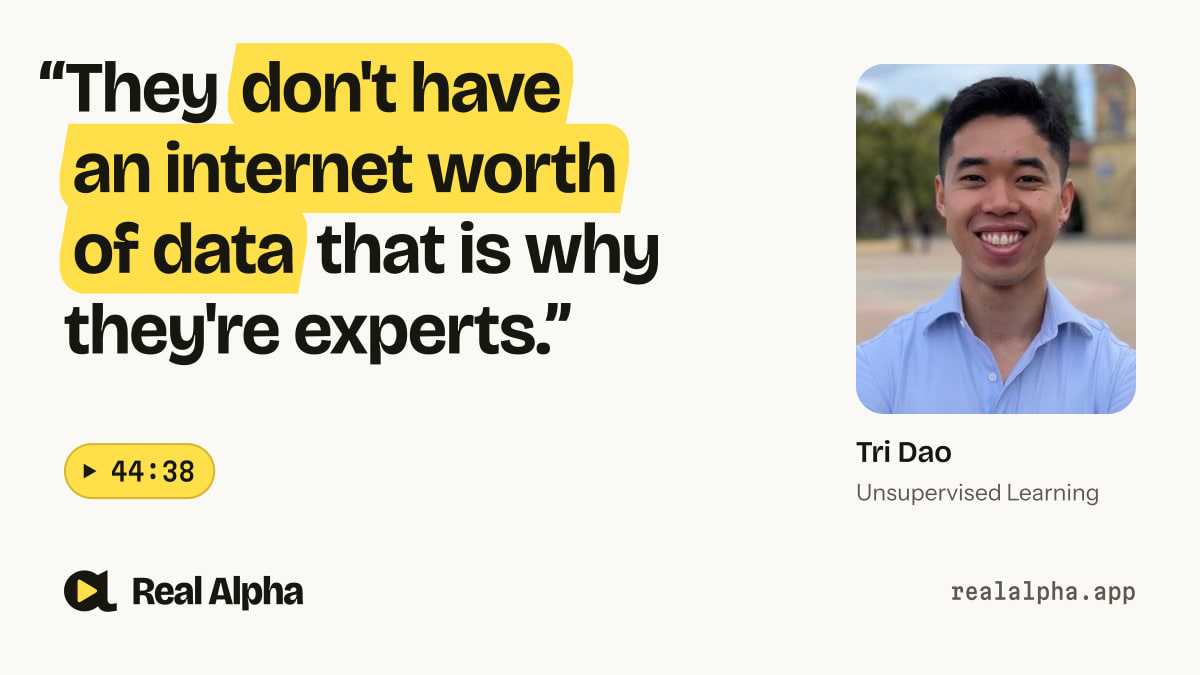
“They don't have an internet worth of data that is why they're experts.”
 Tri Daoat 44:38 · Unsupervised Learning
Takeaways
- Models excel when relevant training data is abundant.
- Expertise often depends on specialized tools and experience.
- Architecture research can improve inference per dollar.
About this segment
Tri Dao says expert work often depends on specialized tools and data that is scarce online. He sees sparse and hybrid architectures as ways to get more intelligence per dollar.

Tri Dao is Chief scientist at Together AI and Princeton professor.
Created FlashAttention and worked on Mamba; Together AI chief scientist, Princeton assistant professor.

Jacob Effron, Host · Managing director, Redpoint Ventures
Growth investor in Abridge, Ramp and Physical Intelligence; ex-Flatiron Health.
From “Tri Dao: The End of Nvidia's Dominance, Why Inference Costs Fell & The Next 10X in Speed”, Sep 10, 2025. Watch the full episode
Thanks. We'll look at and fix what's off.
Transcript
Transcribed by machine (Whisper) from the episode’s audio, so a word may be off here and there.
- 43:44
Like, what's that question that's outstanding that you're most curious to know or would most impact the direction of your work? The question I'm trying to answer for the next couple of years is how do we get AI to expert level? So right now, I think the models are at the sort of the median human level on some of the tasks, like front-end programming, they've gotten quite good. Actually, the models are much better than me at front-end programming, for sure.
- 44:13
Or analyzing data, that kind of task where there's lots of data on the internet. Whenever there's lots of data on the internet, these models are going to just crush it, right? so They've gotten to sort of the median or maybe slightly above average level on some of these tasks. But I think the economically valuable tasks are still there, right? We pay lots of money for human experts in, I don't know, designing airplanes or designing hardware or, you know, doctors and lawyers and so on, right?
- 44:46
Those people become experts because they've spent time working with specialized tools. They don't have an internet worth of data that is why they're experts. Right. So how can we get models to get to that level, to work alongside with humans at that level? I think that's where a lot of the economic value is going to come from. And obviously then the hardware optimizations you have to do around whatever the way to do that is.
- 45:13
You've worked on states-based models. You've spent a lot of time thinking about alternative architectures, transformers. I think your collaborator, Albert Gu, said that transformers are not going to be the final solution by themselves. Like, do you think we need, you know, architectural innovation to get us to that level? Right. I love Albert, right? But maybe this is where we disagree a little bit, right?
- 45:34
So I think to get to, you know, AGI or ASI, it's possible that the current architecture we have is sufficient, right? But at what cost? Which is, hey, if you have a better architecture, maybe you get there, I don't know, one or two years sooner. I think that's probably worth it, or you get there with 10x less of the cost, right? Which ultimately flows to then the accessibility of that ASI when you get there.
- 46:01
Right, right. And that's certainly crucial because we're spending, I don't know, $500 billion on AI infrastructure every year. Don't quote me on that, but I think that's sort of the right ballpark, right? So do we need to spend 10x that, which seems somewhat unrealistic, or with better architecture can we get there with the current amount of spending or maybe even less? So I think that's where the mod architecture is going to play a role, which is can we get to AGI with a better architecture?
- 46:36
I think the current architectures sort of have all the right ingredients. And if you keep scaling, which people have been doing, you could get there, but maybe the cost is astronomical. What other architectures are you paying attention to? Right. So I'm pretty excited about a mixture of experts, especially getting sparser and sparser. We're trying to push that limit, like how sparse can you go? And we're working on that.
- 47:04
I think it's been a compelling direction. Some really important work done by DeepSeek showing that you can make these things really, really sparse. There were even earlier work from DeepMind pushing in that direction as well. So I think that's one compelling way to sort of get more intelligence out for the same compute. Ultimately, I think we want to optimize inference per dollar, right? And that means it could be factored into inference per flop, floating point operation, and flops per dollar, which is inference per flop is more like architecture, design, data, algorithms.
- 47:45
And then the other side, flops per dollar, is like hardware and kernel optimization. So on the architecture side, we're trying to extract as much information, sorry, as much intelligence out of the same computation. So, you know, mixture of expert is one. I think some of the state-space stuff done with Albert has been really, really fun. And, you know, people are picking that up, right? We've collaborated with a bunch of folks from NVIDIA, actually training models.
- 48:12
They release several of these where they show, hey, they can get really, really high quality model using this kind of architecture. And, you know, it's a hybrid of Transformer and Mamba and so on. on, but with a much smaller cost or much higher inference performance, right? So I think architecture is very important for inference. I think that's the utility of architecture research. And nowadays, I think about very much, I call it inference-first architecture design, which is most of the fobs are being spent on inference anyway.
- 48:50
So you really, really want to design architecture that make inference really, really good.