The alpha, twice a week
That was 3 min.
Get the best new moments in your inbox every Wednesday and Saturday. It's free.
Check your inbox
We sent a link to your address. Click it to finish signing up. Not there in a minute? Look in spam.
or
MTS · 3 min · Nov 7, 2026
Explosive growth depends on demand keeping prices high
 Alex Imas
 says the debate is less about AI capabilities than how they translate into growth.
The episode’s best minutes
Full analysis- 1:03Firms combine specialist skills into mosaic intelligence5 min
- 6:01Explosive growth depends on demand keeping prices high3 min
- 18:35AI lets Imas research beyond his trained fieldsPro pick 3 min
- 2 more moments in the full episode
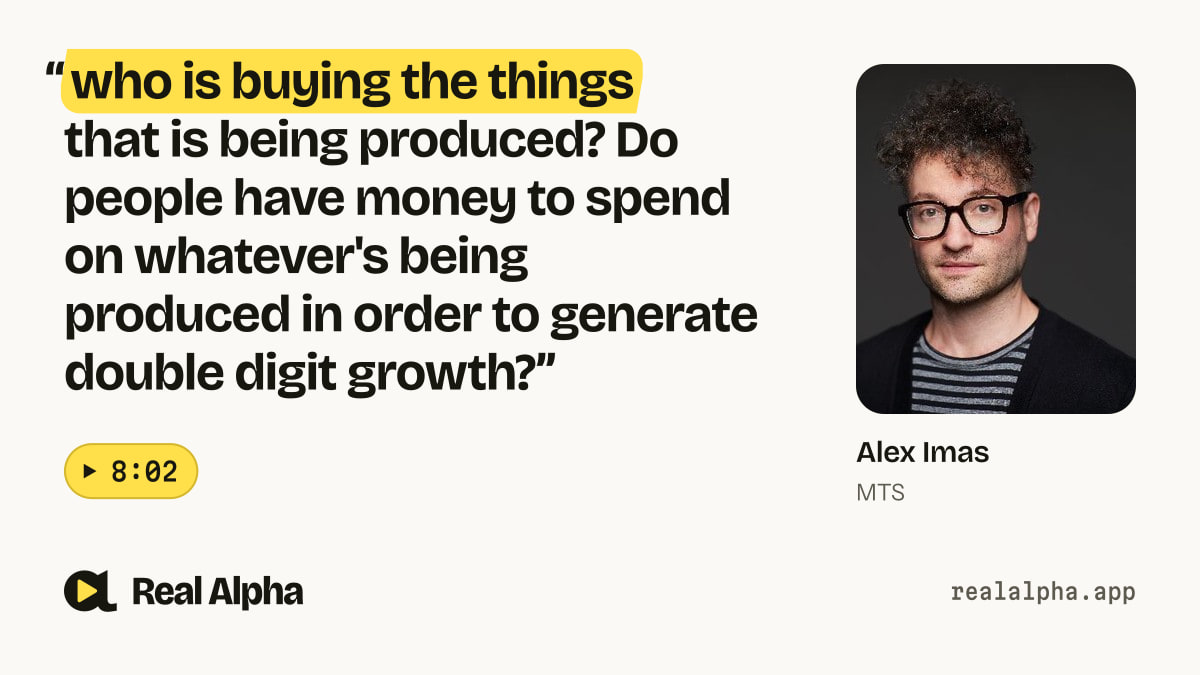
“who is buying the things that is being produced? Do people have money to spend on whatever's being produced in order to generate double digit growth?”
 Alex Imasat 8:02 · MTS
Takeaways
- The disagreement is about economic effects, not model progress.
- Competitive markets can push automated output prices down.
- Double-digit growth needs buyers with enough money to sustain demand.
About this segment
Alex Imas says the debate is less about AI capabilities than how they translate into growth. For double-digit growth, demand and purchasing power must keep pace with automated production.

Alex Imas is a director of AGI Economics at Google DeepMind and professor on leave at Chicago Booth.
Studies how AI reshapes productivity, labor markets and organizations, and leads Google DeepMind’s AGI economics research.

Theo Jaffee, Host · Co-founder & host, MTS
One of the first members of a16z's new media team; earlier hosted the Emergent Ventures-backed Theo Jaffee Podcast.

Sophia Dew, Host · Host, MTS
From “AI Swarms Won’t Cause Explosive Growth | Alex Imas”, Nov 7, 2026. Watch the full episode
Answers “Will AI boost economic growth?” See all 34 answers
Thanks. We'll look at and fix what's off.
Transcript
Transcribed by machine (Whisper) from the episode’s audio, so a word may be off here and there.
- 6:04
biggest cruxes then between you and, you know, like you just participated in this bet on explosive AI driven growth. It was you, Ben Moll, Thomas Wolfe from Hugging Face, Andrew Ho, Robin Hanson, uh philippe lamoire against the faster with people who are will mccaskill from forethought uh dwarkesh samuel albany yan kolvait uh what do you think are the biggest cruxes like what would cause you to change your mind and say oh we will actually will get explosive ai growth um i mean it would need to have so i think the the disagreement is not on the capabilities of the models. So I think I'm extremely bullish on the capabilities of them. It's like a lot of the kind of conversations that I have are like, oh, you're not imagining, you know, millions of agents producing all of this output. And my answer is I absolutely am imagining. But I also see all of that
- 7:04
generating kind of reasonable growth numbers because of the idea is that, look, if these agents and all all of this automated production is in a competitive market now there's a state of the world where look we don't have competitive markets anymore something else happens to the economy we're no longer in a in a competitive capitalist economy then i don't really know what this right i don't know how to put how to put a number on growth but if you're we're in a competitive economy then prices will decrease and i think the main kind of crux of the argument is like how fast do does production increase such that prices remain high still despite all of this output demand is able to support all of this new output people are getting richer from this fact so they're actually demanding the stuff that's being produced
- 8:00
A lot of the sort of conversations that I have with people on the other side, they don't really think about demand. Like who is buying the things that is being produced? Do people have money to spend on whatever's being produced in order to generate double digit growth? So all of these things kind of need to meet, like prices don't collapse, people have enough money to sustain double digit growth at the high prices, so on and so forth. And I think not to mention all of this potential like kind of political bottlenecks, political pressure, headwinds, all of these sorts of things. So I think as far as like timelines and technological capabilities, I don't think there's a much of a disagreement with me on the other side. It's more about how does that technological capabilities, how do they translate to growth numbers?