The alpha, twice a week
That was 3 min.
Get the best new moments in your inbox every Wednesday and Saturday. It's free.
Check your inbox
We sent a link to your address. Click it to finish signing up. Not there in a minute? Look in spam.
or
Latent Space · 3 min · Nov 3, 2026
Factories start to make sense around five to ten engineers
 Zach Lloyd
 says factories are overkill for tiny teams, but can pay off from roughly five to ten engineers onward.
The episode’s best minutes
Full episode- 12:59Agents can improve the factory that runs themPro pick 6 min
- 23:51Factory tuning cut Warp’s cost per PR by about 75%3 min
- 26:54Factories start to make sense around five to ten engineers3 min
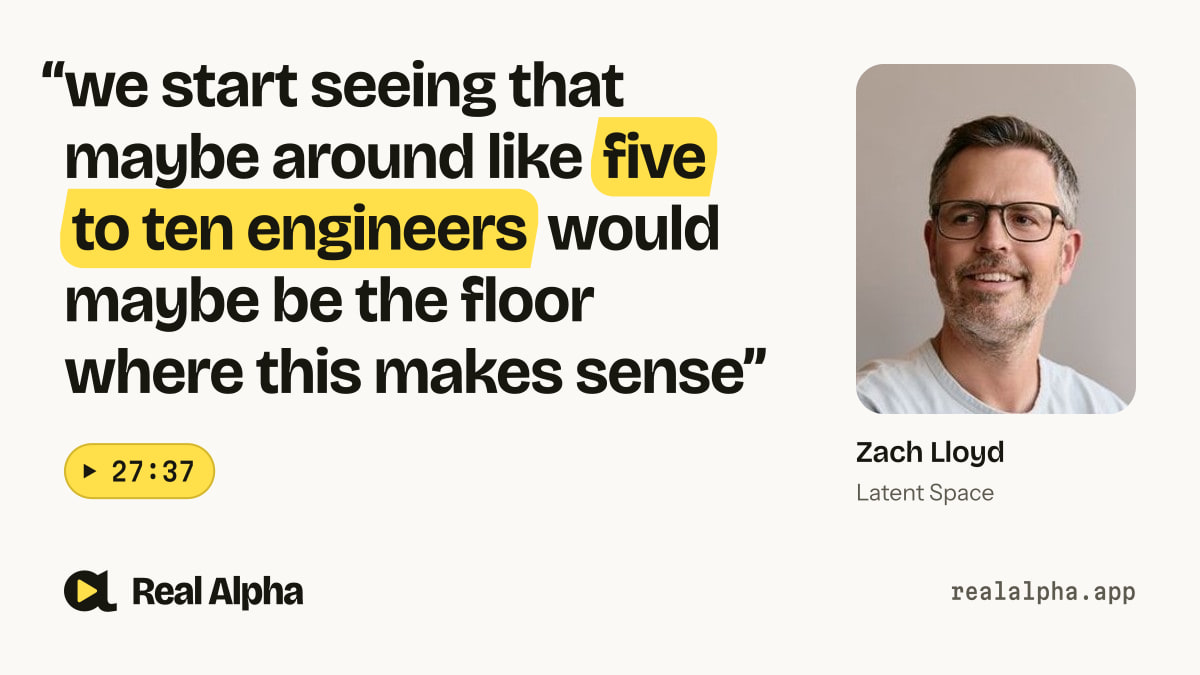
“we start seeing that maybe around like five to ten engineers would maybe be the floor where this makes sense”
 Zach Lloydat 27:37 · Latent Space
Takeaways
- Small teams can move faster with individual coding-agent subscriptions.
- Five to ten engineers may be the floor for a factory.
- Larger companies should expect more integration work.
About this segment
Zach Lloyd says factories are overkill for tiny teams, but can pay off from roughly five to ten engineers onward. A shared system helps teams scale their workflows as models change.

Founder & CEO, Warp
Founded Warp and led its April 2026 open-sourcing of its agentic development environment, built around cloud agents.

Shawn Wang (swyx), Host · Co-founder, AI Engineer
Wrote “The Rise of the AI Engineer” and founded Smol AI, maker of AI News.
From “⚡️ The 2026 Software Factory Infra Stack — Zach Lloyd, Warp.dev”, Nov 3, 2026. Watch the full episode
Thanks. We'll look at and fix what's off.
Transcript
Transcribed by machine (Whisper) from the episode’s audio, so a word may be off here and there.
- 27:00
all these like six layers i think it's like who's this for maybe is is the kind of the question so when we talk to companies that where this resonates the most is it has to be a company that has some some amount of scale like this is if you're like a few people honestly this is this is overkill yeah don't do this use the cloud code sub or the codex sub or whatever and just you'll go faster you probably don't need you could use this yeah same for like any like larger team stack right like you at some point you switch from like fire yolo whatever to we actually need a platforming system here to accelerate exactly yeah so you have to be a certain scale we start seeing that maybe around like five to ten engineers would maybe be the floor where this makes sense and then all the way up to to very large companies they want something like this
- 27:56
the bigger the company, the more that this requires, you know, implementation work. Like I'm sure if you're, you know, you're working with cognition or, or I don't know if kind of cursor does, but you know, to get something stood up like this within a company's own infrastructure, it's not going to be purely plug and play. There's like, you know, the sort of complexity of a team's internal developer setup just grows with size within like, but there's a bunch of companies where, you know, maybe like it's like a 10 to 100 engineers fast growing like growth stage startup where it is pretty self-serve actually where it's like you just if they're using like the happy stack of like slack you know linear jira hang on did you call it the happy stack i called it like yeah i that's like our i don't know uh no shade to teams or whatever like sure but like there's like uh you know like
- 28:50
a set of integrations that I find very common at startups where you can plug something like this in and get like immediate immediate value without too much setup I don't know if how much you're working like this but if you're working with like Devin or something you can kind of get some of the same experience where when you're working in a some environment that's natively multiplayer so like slack for instance or linear there's all these benefits that you might not realize just by having like this central system of record where you can have you know for like the slack integration for instance it's like you can get some flow of information coming in through like a server crash channel and some through a user feedback channel you can just feed that directly into the factory to have it do the work the factory can loop in multiple people on your team depending on who
- 29:39
knows the right part of the code base and so you know i don't think you have to be that big for this to make sense, but it definitely doesn't make sense for a small team. And it really makes the most sense for a company that's like, I want to put in place the right infrastructure so that as models and agents continue to change, we have a system that we're building upon. There's a lot to go on here. One