The alpha, twice a week
That was 3 min.
Get the best new moments in your inbox every Wednesday and Saturday. It's free.
Check your inbox
We sent a link to your address. Click it to finish signing up. Not there in a minute? Look in spam.
or
Bloomberg Surveillance · 3 min · Nov 20, 2026
Falling AI prices may expand usage, but open models compete
 Gene Munster
 argues cheaper tokens can increase usage, while Mortonson says lower-cost open models threaten frontier providers.
The episode’s best minutes
Full analysis- 5:34Falling AI prices may expand usage, but open models compete3 min
- 17:31AI returns are strong, but infrastructure supply is the constraint4 min
- 26:34AI financing may keep bond yields high into 20273 min
- 4 more moments in the full episode
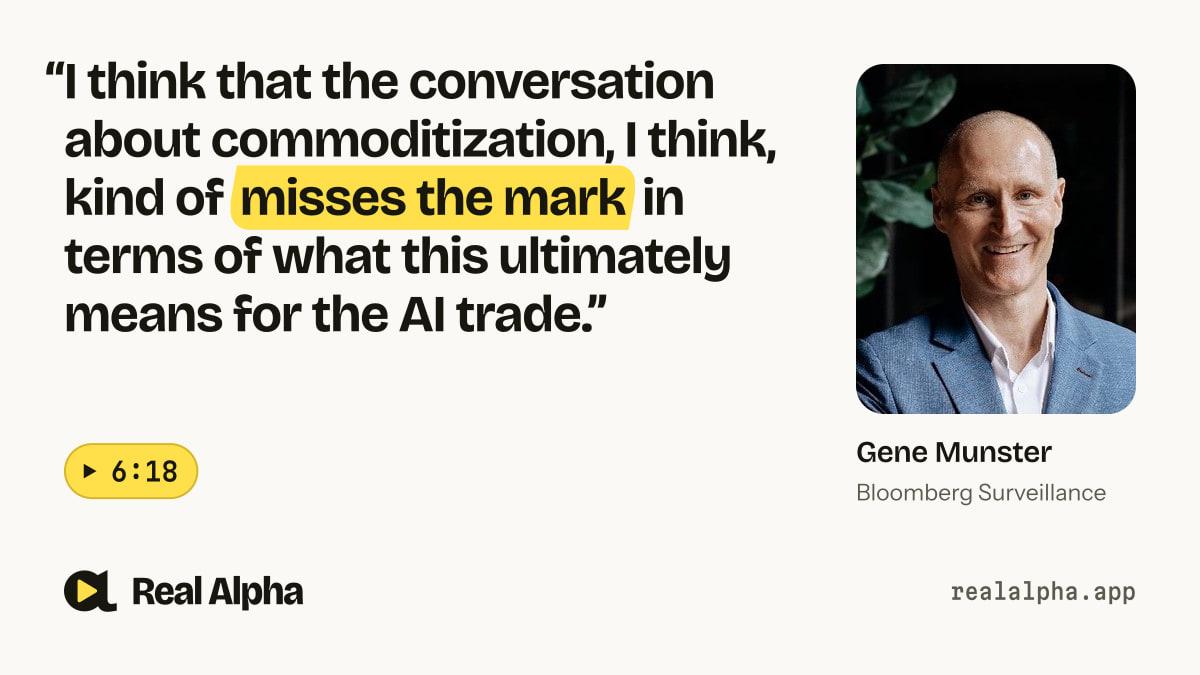
“I think that the conversation about commoditization, I think, kind of misses the mark in terms of what this ultimately means for the AI trade.”
 Gene Munsterat 6:18 · Bloomberg Surveillance
Takeaways
- Lower token prices can drive higher usage.
- Open models offer lower prices and about 80% of frontier functionality.
- Investors still lack clear answers about how the market will develop.
About this segment
Gene Munster argues cheaper tokens can increase usage, while Mortonson says lower-cost open models threaten frontier providers. Their disagreement shows why the AI trade is hard to price.

Managing Partner, Deepwater Asset Management
Spent 21 years covering Apple, Amazon, Google and Facebook before co-founding Deepwater Asset Management.
- TK
Tom Keene, Host
- PS
Paul Sweeney, Host
From “AI and the Equity Selloff | Bloomberg Surveillance”, Nov 20, 2026. Watch the full episode
Answers “Is open-source AI catching up?” See all 25 answers
Answers “How do AI companies make money?” See all 122 answers
Thanks. We'll look at and fix what's off.
Transcript
From the transcript Bloomberg Surveillance publishes with the episode.
- 5:37
fundamentals within the certitude of AI, and it isn't pretty. Am I right that the log convex chart of lower token prices means something?
- 5:50
Respectfully, you're wrong. I believe you're wrong when it comes to what it means for these stocks. And it's a well-traveled and understandable narrative that the token pricing is going to go down. Therefore, this is going to be profitless prosperity for your companies like Anthropic We talked about them doing things internally if, in fact, those token pricing goes down exponentially. The other piece is that there are, I mean, this whole Jevons paradox is talked a lot about as pricing goes down. Usage goes up, and we've seen that.
- 6:17
I mean, we've seen the fruits of that. So I think that the conversation about commoditization, I think, kind of misses the mark in terms of what this ultimately means for the AI trade.
- 6:30
And this is the dynamic, folks, of the price and the units at the revenue line. Ted Mortonson, would you like to tell me I'm wrong? No.
- 6:38
I would say I agree with Gene, but I think there's other forces at work here. Such as? Open source. When I listened to the Palo Alto call earlier this week, Nikesh Arora, who's I think one of the best managers in security, basically said that he's seeing roughly 60% of his client base adopt open source.
- 6:59
Let's translate this for me. Claude, Anthropic, they're closed systems. Proprietary. What's an example of an open system?
- 7:08
An open source model would be something that is more community and it's lower price and it's about 80% of the functionality. that's a headwind as it relates to frontier models. And I think if you go back and rewind the tech tape a little bit, both Jensen from NVIDIA and Alex Karp from Palantir were both basically saying open source is a very big alternative to frontier models. And if you go back and listen to the Alex Karp talk, interview on a competing network.
- 7:46
He basically went after frontier models. Excuse me, you mean the Death Star? The Death Star. Okay, thank you.
- 7:50
So I think there is a debate internally to the institutional investors on how this market actually pans out. And I don't think anybody really has the answers. It's too new. It's explosive growth. I think both will do well, but it's a talking point.