The alpha, twice a week
That was 5 min.
Get the best new moments in your inbox every Wednesday and Saturday. It's free.
Check your inbox
We sent a link to your address. Click it to finish signing up. Not there in a minute? Look in spam.
or
Prof G Markets · 5 min · Oct 15, 2026
Falling token prices make neocloud debt harder to service
 Paul Kedrosky
 explains how rising borrowing costs and steep token-price declines compound CoreWeave’s debt burden.
The episode’s best minutes
Full analysis- 3:03Falling token prices make neocloud debt harder to service5 min
- 11:54AI’s biggest bubble may be hidden in private marketsPro pick 4 min
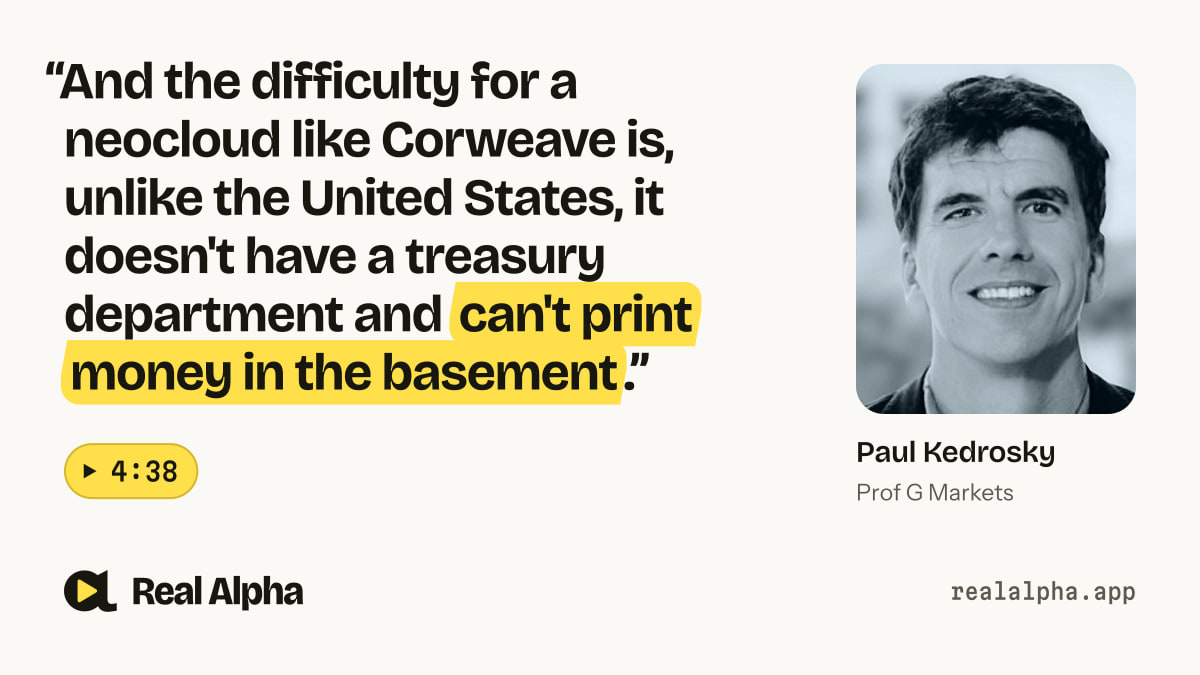
“And the difficulty for a neocloud like Corweave is, unlike the United States, it doesn't have a treasury department and can't print money in the basement.”
 Paul Kedroskyat 4:38 · Prof G Markets
Takeaways
- Refinancing gets harder as yields and credit spreads rise.
- Token prices have fallen about 13-fold annually, he says.
- CoreWeave debt trading below par signals restructuring risk.
About this segment
Paul Kedrosky explains how rising borrowing costs and steep token-price declines compound CoreWeave’s debt burden. He sees restructuring as more likely than full repayment.

Managing Partner, SK Ventures
Invests in science-driven startups and founded HSBC James Capel’s technology equity research practice.

Ed Elson, Host
From “CoreWeave Is Imploding — And Taking AI Stocks Down With It”, Oct 15, 2026. Watch the full episode
Thanks. We'll look at and fix what's off.
Transcript
Transcribed by machine (Whisper) from the episode’s audio, so a word may be off here and there.
- 3:15
What are the markets telling us? So the funny thing is, is this has taken so long to happen. And, I mean, the situation at Corweave hasn't really changed dramatically from eight months ago. It's just that it takes people a long time to notice. And the situation, of course, is that it's among the most indebted of the neoclouds. And as you pointed out, an incredibly high debt burden. And that debt burden either has to be refinanced or has to be paid for by selling tokens to people who rent space in the neoclouds.
- 3:43
And all of those get more difficult when you have exactly this kind of debt spiral going on. No different than the U.S. seeing the 10-year spiking, and then all of a sudden that has an effect on the deficit. As people look forward with the increasing cost of Corweave's debt, as the spreads blow out, they look forward and say, wait a minute, that has implications for the refinancing and future raises.
- 4:04
And so as a result, that becomes the same sort of debt-death spiral that you've seen in some sovereigns. And it's just playing out—it took a long time to play out inside of Corweave, but it's finally happening. And there's a whole bunch of reasons why probably among the largest is that in the same way that fundraising among the AI CapEx fundraising has squeezed sort of the mid-duration treasuries, the 10 years, for example, which is incredible and has never really happened before.
- 4:30
The reverse is also true, that as the 10-year and equivalent duration treasuries become more attractive, it becomes much more difficult for these highly indebted neoclouds to raise money. So this perverse relationship goes in both directions, and the net effect is both of them have much more consequential debt burdens and then interest rates going forward. And the difficulty for a neocloud like Corweave is, unlike the United States, it doesn't have a treasury department and can't print money in the basement.
- 4:57
The CEO of Corweave responded to the price move, and he said that the market is acting, quote, irrationally. He said that the problems at other companies are, quote, bleeding into the narrative around CoreWeave and that the market, quote, misunderstands the company. Do you agree with these comments? No, I mean, these are very typical. I mean, he has to say these things. I don't want to imply that there's any kind of, you know, criminal nefariousness in here, but you have to say these kinds of things to support the company and say that this is not company specific.
- 5:28
This is something broader in the AI marketplace, but it's not. It's very specific to the most indebted neoclouds because of these twinned phenomena of higher cost of debt, higher cost of debt servicing. So that's at the one end. And at the other end, and Epic AI had a great report about this, about the continuing staggering deflation in token prices. So Epic had a report out, I think it was earlier in the week, reporting out that we've had for the last four years roughly a 13-fold annual decrease in the cost of tokens.
- 6:01
So doing the math, it's pretty straightforward. It's price times volume, and I got debt that I have to service from that price times volume. That becomes astronomically more difficult given the increasing volumes required if I'm seeing an annual decline of around 13-fold in terms of the cost of tokens, to put it in context. context, that means you have to grow. To stand still, you have to grow your token sales, if you will. I think about it like copper or oil or anything else. 1,300% a year. That's what 1,300 fold means. Bringing it back even more, that means you have to double your token sales every 90 days.
- 6:33
This is very tough math made worse by the blowout in the rates and the increasing cost of servicing the debt. So these two feed on each other. So if you've got declining token prices, which essentially means that unless they explode their business, they've got less money coming in. At the same time, you've got rising yields, also rising yields across the board. I mean, you've got rising yields. And the rising spreads, too. It's important to say it's not just the yield, right? I mean, so the spread over treasuries is blowing out as well. So there's these two things happening at once, which makes it even more complicated. Right. Which I guess the question is, is there a scenario, if spreads remain this high and if yields remain this high, is there a scenario in which CoreWeave doesn't end up defaulting? I mean, I guess that is the question that investors are
- 7:24
trying to pass out right now. But it does seem that the likelihood that they will not be able to make their interest payments is extremely high. Do you see a world in which they do figure it out? No. So I see instead a world where at best you have fairly radical restructuring of their debt obligations, which is what the markets are telling you, right? When the debt's trading at, say, 80 odd cents on the dollar, when you do the default math, it's saying there's a significant likelihood I will not be repaid in full. And the reason, generally speaking, why you're not repaid in full is not because of an alien invasion. It's because the debt gets restructured.
- 7:58
If investors actually thought it was unlikely to be paid at all, obviously it would be trading at a much lower because we're talking about debt that matures in 2032. So it's not actually that far away. So when you see it trading at these levels with the market, the debt market is trying to tell you is this stuff gets restructured. You're not getting a dollar. Gartner came out with an analysis.