The alpha, twice a week
That was 3 min.
Get the best new moments in your inbox every Wednesday and Saturday. It's free.
Check your inbox
We sent a link to your address. Click it to finish signing up. Not there in a minute? Look in spam.
or
Big Take · 3 min · Nov 16, 2026
Family care accounts for half of dementia’s global costs
 Joanne Pike, DrPH
Kim and Cameron describe how dementia care strains families, while Joanne Pike, DrPH quantifies its global cost.
The episode’s best minutes
Full analysis- 13:58A family mutation linked amyloid to Alzheimer’s diseasePro pick 4 min
- 33:02Blood biomarkers could widen access to Alzheimer’s diagnosis3 min
- 29:40Family care accounts for half of dementia’s global costs3 min
- 3 more moments in the full episode
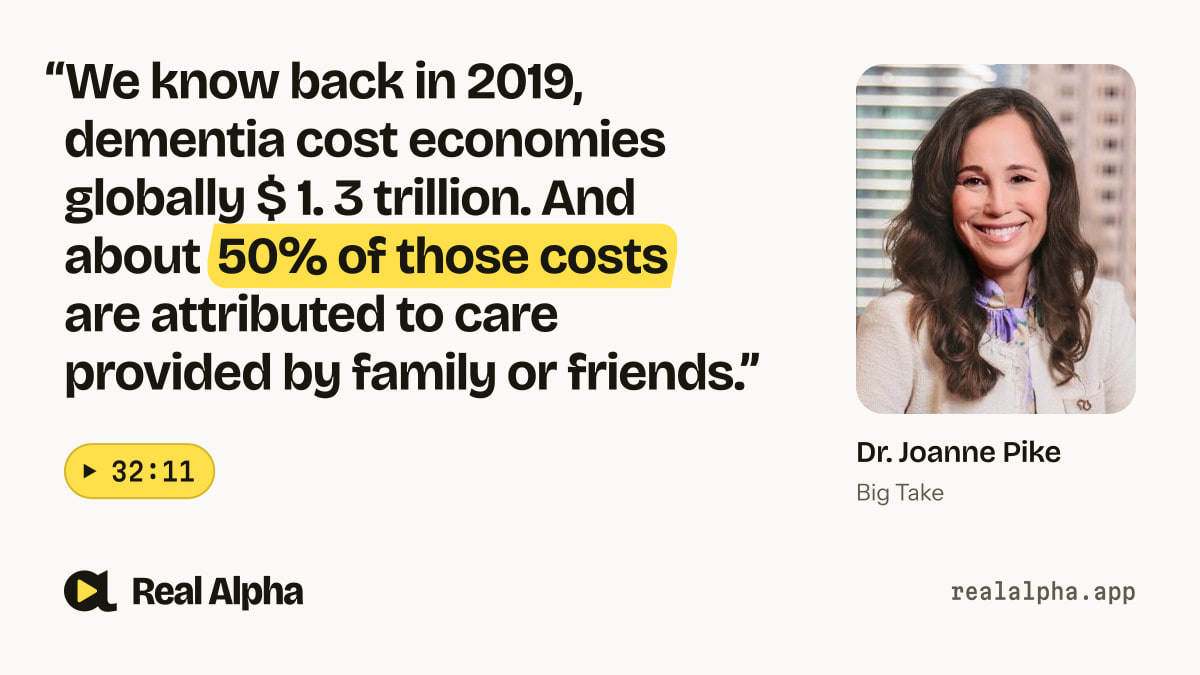
“We know back in 2019, dementia cost economies globally $ 1. 3 trillion. And about 50% of those costs are attributed to care provided by family or friends.”
 Dr. Joanne Pikeat 32:11 · Big Take
Takeaways
- Medicare does not cover long-term care, leaving families with major costs.
- Dementia cost the global economy $1.3 trillion in 2019.
- Family and friends provided about half of that care-related economic burden.
About this segment
Kim and Cameron describe how dementia care strains families, while Joanne Pike, DrPH quantifies its global cost. The discussion shows why unpaid caregiving and long-term care policy matter.

President & CEO, Alzheimer's Association
Led the Alzheimer's Association's record $112 million research investment and efforts to expand diagnosis, treatment and care access.

David Cameron, Host · President, Alzheimer’s Research UK
Made dementia research a political priority, helped double investment, and now champions the search for an Alzheimer’s cure.
From “How Close is a Cure for Alzheimer’s? | Ending Alzheimer's”, Nov 16, 2026. Watch the full episode
Thanks. We'll look at and fix what's off.
Transcript
From the transcript Big Take publishes with the episode.
- 29:42
This experience has shown Senator Kim the toll that the disease takes on families, something I greatly empathize with. Caring for an aging parent is already an emotionally and financially demanding endeavor. But when a parent has dementia, these costs add up exponentially especially as the dementia progresses. So along with the early diagnosis bill, Senator Kim is also pushing for legislation to support caregivers.
- 30:10
The costs are enormous to be able to bear. You know, if you do need some type of care, whether it's at home or in a residential nursing facility, Medicare doesn't cover it. And that's kind of the main problem that we have is that every family that's struggling with Alzheimer's seems to go down a similar path of constantly saying this one line, which is, I thought Medicare covered this and realizing that it doesn't.
- 30:38
Medicare being the health insurance program for Americans who are over the age of 65. It doesn't cover it because the debate we have in this country is it's seen as a sort of a long term care issue rather than a health issue. Is that the same issue in the United States?
- 30:54
Yeah, I mean, like the type of care, long-term care, is just not something that Medicare covers, regardless of what illness or disease or problem that you have.
- 31:05
Senator Kim, like me, is part of what's called the sandwich generation, a generation caring for both children and aging parents. He, like millions of others, is bearing the financial brunt of his father's care, while also needing to provide for the rest of his family.
- 31:22
I don't understand who can pay for this. It causes real generational financial harm. I hear about just how much it is impacting and taking the life savings of the kids, affecting it downstream. My family's feeling it right now, too.
- 31:37
In addition to paying for care, caregivers spend untold hours of unpaid work, and each individual caregiver, shouldering this weight, adds up to a massive cost globally.
- 31:49
We have to consider... What is this doing to the people around an individual? How is it changing their family dynamic? How is it changing their family workload? But also we have to think about the dollars and cents that it is changing within their household.
- 32:05
Dr. Joanne Pike is the CEO of the Alzheimer's Association, the largest non-profit funder of Alzheimer's research.
- 32:14
We know back in 2019, dementia cost economies globally $ 1. 3 trillion. And about 50% of those costs are attributed to care provided by family or friends. That is a significant economic burden. But in addition to that, we know that there is emotional burden with that as well, including depression. the high amount of stress that caregiving can cause within a family or within a primary caregiver.