The alpha, twice a week
That was 8 min.
Get the best new moments in your inbox every Wednesday and Saturday. It's free.
Check your inbox
We sent a link to your address. Click it to finish signing up. Not there in a minute? Look in spam.
or
The Playbook Podcast · 8 min · Oct 22, 2026
Farmers say short-term relief cannot repair broken promises
 Lance Lillibridge
Farmers cite diesel costs, tariffs and stalled policy priorities as reasons to reconsider GOP support.
The episode’s best minutes
Full analysis- 1:34Farmers say short-term relief cannot repair broken promises8 min
- 14:50Deluzio frames a possible Fetterman challenge as a populist fightPro pick 3 min
- 17:28Musk’s warning could draw scrutiny across party linesPro pick 3 min
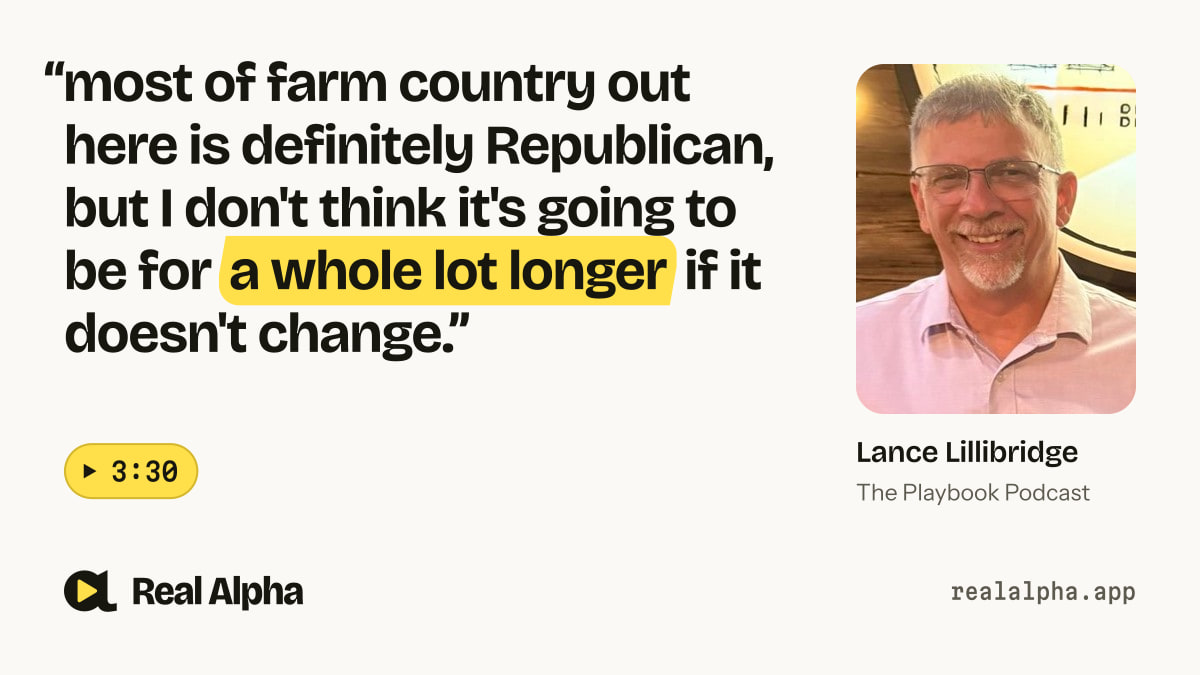
“most of farm country out here is definitely Republican, but I don't think it's going to be for a whole lot longer if it doesn't change.”
 Lance Lillibridgeat 3:30 · The Playbook Podcast
Takeaways
- Diesel prices, tariffs and input costs are squeezing farmers during harvest.
- Farmers want a farm bill, year-round E15 and fertilizer antitrust enforcement.
- Relief may help now, but broken promises could put GOP support at risk.
About this segment
Farmers cite diesel costs, tariffs and stalled policy priorities as reasons to reconsider GOP support. They welcome an $8 billion diesel program but see it as a short-term bandage.

Farmer & director, Lillibridge Land and Cattle Co.
Farms corn, alfalfa and Red Angus cattle in Iowa, and champions conservation and Iowa corn growers.
From “America’s Heartland sows doubt in the GOP”, Oct 22, 2026. Watch the full episode
Thanks. We'll look at and fix what's off.
Transcript
Transcribed by machine (Whisper) from the episode’s audio, so a word may be off here and there.
- 1:41
And part of this comes down to the fact that there are so many farmers in these key Midwestern states, Great Plains states, that are really feeling the pinch of several of the president's policies at the same time, right? I don't know how many times in this podcast we've talked about the economic consequences of the Iran War. farmers are feeling that pinch even more keenly, especially in the form of diesel prices. They are grappling with that in the middle of harvest season right now. They're also feeling the pinch from the president's tariffs. And that's on top of all the other frustrations that they have of policies. They say the administration has not gotten done. There hasn't been a new farm bill in over a decade. The administration has yet to approve legislation allowing year-round use of
- 2:22
E15. Of course, that's made with ethanol. So corn farmers really would want to see that happen. And so ultimately where they're at right now is they're just really, really mad, right? They're getting squeezed from all sides. And these, we should say, are reliably Republican voters. They overwhelmingly as a group voted for the president in the past three elections. They are part of the reason why these three states are so red right now and why Iowa in particular is so red, voted for President Trump three times after voting for President Obama twice before that. And these farmers now are really rethinking whether they can continue to support the Republican Party moving forward. Is it like a, I might not vote in this election or I'm going to vote Dem? Are they swinging or are they just frustrated and pulling out altogether? It's a little bit of both. You
- 3:13
have folks that are saying like, no, I can't vote for the Dems. They're just far too progressive. like I'm just going to stay home. But then you have Republicans that are either in this cycle or they say in 2028, seriously thinking about voting for the Democrats. And that includes one farmer I spoke with, his name's Lance Lillibridge. He's also an informal ag advisor to Iowa. Senate nominee Ashley Hinson. And he told me, quote, most of farm country out here is definitely Republican, but I don't think it's going to be for a whole lot longer if it doesn't change.
- 3:44
And by it there, he meant the administration's policy. And it's not just the war, but he's long been frustrated that the administration isn't doing more in his eyes to prosecute antitrust laws against fertilizer companies. That's his biggest complaint. So it goes far beyond sort of the big flashy headlines that we've all been focused on. Well, what about daylight savings time? Oh, yes, I know. I know. I will say that was not one of the top priorities in all of my conversations with farmers. So Trump put Tom Cotton on blast with that cell phone number for nothing, huh? I know. No, just for the golfers, not for the not for the farmers. So how is the administration? How are Republicans that are trying to shore up candidates in these places responding to this? A couple of things. So one, we've actually seen the administration
- 4:35
take some policy steps to try to mitigate some of the damage. So the president, while rallying with Senator Roger Marshall this week in Kansas, announced an $8 billion program that's intended to offset diesel costs. On the other hand, right after that policy came out, I called around to a bunch of the farmers I'd been talking to and said, hey, how much does this help? Does this help a lot, a little, like how big of a deal is this? And the word that kept coming up time and time again in my conversations was bandaid. These farmers told me that they're really appreciative of this move, but they literally all use that same word. They were like, this is a helpful short-term thing. It does not fix the longer term problems we're feeling. And then the second part is the president and vice president are showing up to these states. So today we actually have the
- 5:21
president in Iowa. This is his first trip to Iowa this month. We have vice president JD Vance in Nebraska. And again, this is just indicative of where we're at this cycle, that you have the top two Republicans in the country in these deep red farm states because they're worried about these folks not showing up to vote. And they need these reliable red Trump voters to show up to the polls to help out these Senate candidates. I mean, this is not just a 2026 issue for Republicans.
- 5:52
if this reliable constituency is suffering and is frustrated by stuff that is not necessarily going to go away quickly, like they're not seeing the light at the end of the tunnel for relief here. Did you get into like what this would mean for, you know, if J.D. Vance runs for president? Yeah, I mean, and that is the big concern that I'm hearing from Republicans in these states. And of course, you know, 2028 is a lifetime away.
- 6:23
Who knows what's going to happen? But the big thing I was asking these farmers is, okay, once it's November 4th, what do you need to see from the Trump administration for them to win your support back and win the support of your fellow farmers back? And they told me a few things. This is not an exhaustive list, but top of the list, of course, is ending the war in Iran that would help things significantly.
- 6:44
Also, they told me, you know, passing a comprehensive farm bill for the first time in nearly a decade would be super helpful. Also, we mentioned those year-round sales of E15, and then also enforcing antitrust laws against these fertilizer companies. And so this is, again, a non-exhaustive list, but folks just feel like there have been these promises that Republicans, including the president, have made over the years and have not followed through on them.
- 7:09
So I spoke with another farmer, Kevin Ross. He's a sixth generation farmer from southwestern Iowa. And he told me it's not enough if someone like a J.D. Vance comes out on the campaign trail and is still promising in the year 2028 to pass E15. He's like, that needs to be done by then. But saying that you're going to do these things is no longer enough. I mean, this is how parties get, you know, voted out of office. People want change because they feel like— you know, they haven't been delivering on promises. And across the board, everyone that I talk to that is frustrated with Washington right now, and particularly with President Trump and this administration, all the issues that are constantly showing up at the polls, you know, inflation, cost of living, health care, whatever, it goes back to broken promises or promises made and not
- 7:58
kept, right, across the board. And that's, you know, that's something that both parties have been guilty of. And that's, you know, a large part why like Democrats lost a lot of voters and in 2024. But now this president and this administration are really feeling it and it is going to the heart of their, you know, the sort of traditional Republican base. It is. And obviously the big question here is, are these farmers, you know, going to be voting for Democrats in 2028? And a lot of folks I talked to on both sides of the aisle said, you know, it really depends who Democrats nominate, right? Like surprise, surprise. But you know, they're like someone like a more moderate, like a Pete Buttigieg or an Andy Beshear, someone like that might be a little bit more palatable to farmers than, you know,
- 8:44
someone who they just consider too far to the left. And so, you know, time will tell what exactly happens, but folks are saying like, hey, look, Iowa has had a history of divided government. It was not that long ago. It was just the pre-Trump era that they actually voted for a Democrat and Barack Obama. So it's not unthinkable that we could see Iowa again in play in 2028. That's why the stakes are so high and it's so fascinating for us as political reporters.
- 9:12
It is always, always, always.