The alpha, twice a week
That was 3 min.
Get the best new moments in your inbox every Wednesday and Saturday. It's free.
Check your inbox
We sent a link to your address. Click it to finish signing up. Not there in a minute? Look in spam.
or
AI & I · 3 min · Sep 30, 2026
Fast AI makes iteration feel fundamentally different
 Sam Altman
 says near-instant responses change his thinking and building loops.
The episode’s best minutes
Full analysis- 8:46Dot protects Altman’s mornings and helps him build8 min
- 26:34AI changes how much a small startup team can build3 min
- 29:51Fast AI makes iteration feel fundamentally differentPro pick 3 min
- 3 more moments in the full episode
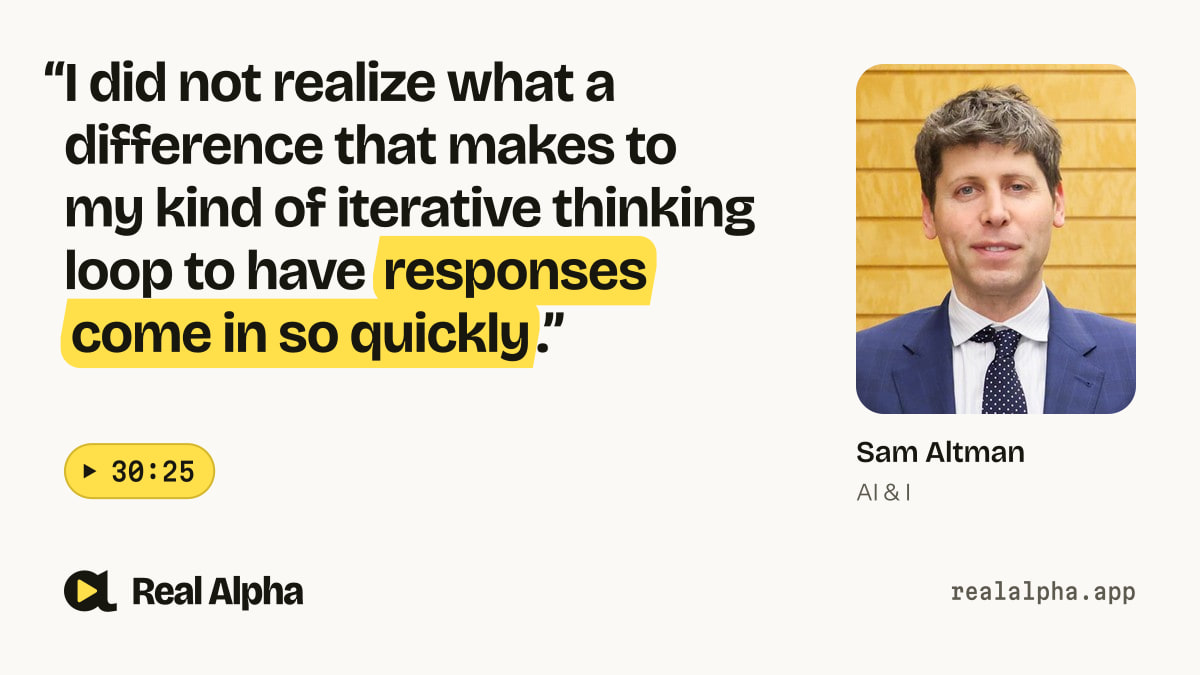
“I did not realize what a difference that makes to my kind of iterative thinking loop to have responses come in so quickly.”
 Sam Altmanat 30:25 · AI & I
Takeaways Pro pick
- Fast feedback changes how creators iterate.
- AI progress is about speed as well as intelligence.
- Altman expects value per dollar to keep rising.
One of Pro's picks, open to you here. Try Pro free for 7 days
One of Pro's picks. The rest of the summary and the 3 takeaways are in Real Alpha Pro; the video, the quote and the transcript stay free.
Read it with Pro, 7 days freeAbout this segment
Sam Altman says near-instant responses change his thinking and building loops. He expects speed to become a new dimension of AI access, with faster inference becoming more affordable over time.

Sam Altman is CEO of OpenAI.
Co-founded OpenAI and has led it since 2019, overseeing ChatGPT's launch; formerly president of Y Combinator.

Dan Shipper, Host · Co-founder & CEO, Every
Sold his first startup, Firefly, to Pegasystems; writes Every's Chain of Thought.
From “How Sam Altman Actually Uses Dots to Run OpenAI and His Life”, Sep 30, 2026. Watch the full episode
Thanks. We'll look at and fix what's off.
Transcript
From the transcript AI & I publishes with the episode.
- 30:03
Given that you're living in that future, that I think all of us can experience a little taste of it, what is different about the Ultrafast world in terms of how you can use these tools? There was an amazing talk, I don't know, 15, 20 years ago from Brett Victor about kind of the principles that he thought people... how he did his work. And one of the things, I'm gonna get this a little bit wrong, but it was something like creators should have an immediate connection to what they're creating.
- 30:33
And how speed and the feedback loop was so important. And I did not realize what a difference that makes to my kind of iterative thinking loop to have responses come in so quickly. But in terms of trying to build something, trying to think through a problem, it's like a wild difference. I know you've been thinking for a long time about AI as a democratizing force to allow anyone to build stuff. And in the sort of ultra-fast world or in the Astros and more expensive model world, I know you're also thinking about that means something, that people can pay more for better intelligence.
- 31:10
So what are you thinking there? So historically, what we have mostly focused on and I think done a great job of is bringing down the price of IQ. And we have made hugely more capable models that get dramatically, dramatically cheaper every few months or every year. Now, there's this new vector that is clearly going to be very important of speed. And we are putting the investments in place. Like our own chip is going to be an incredible contributor to letting us get very fast inference in the hands of everybody to say nothing of what the models will do to improve research and our inference stack and everything else.
- 31:47
And I think we now realize that we've got to go invest in the democratization of this like we have for model intelligence. So when can I expect to use Ultrafast for all my prompts? you can pay us for it and do it now. I don't think I can afford it. I think we can deliver 8X at a great price in the not distant future, but then we'll have 100X faster. And they'll also be like GPT-7 galaxy or whatever.
- 32:19
So I think the right way to think about this is as far as I can see, There will always be a real frontier in terms of intelligence or speed or whatever else at a higher price. But I think you can also bet that we will keep doing what we've done of just a ridiculous, like put Moore's law to shame, relentless focus on driving value per dollar up and up and up kind of in this big compounding way.