The alpha, twice a week
That was 3 min.
Get the best new moments in your inbox every Wednesday and Saturday. It's free.
Check your inbox
We sent a link to your address. Click it to finish signing up. Not there in a minute? Look in spam.
or
Bloomberg Tech · 3 min · Nov 13, 2026
Fast inference can command a premium when AI tasks matter
 Andrew Feldman
 argues fast inference earns a premium for demanding tasks, while token budgets should be deliberate.
The episode’s best minutes
Full analysis- 24:14Nvidia’s near-term demand looks firm, but 2028 is less certainPro pick 3 min
- 31:23Fast inference can command a premium when AI tasks matterPro pick 3 min
- 35:04Cerebras plans to build most of its data centers outside the US3 min
- 5 more moments in the full episode
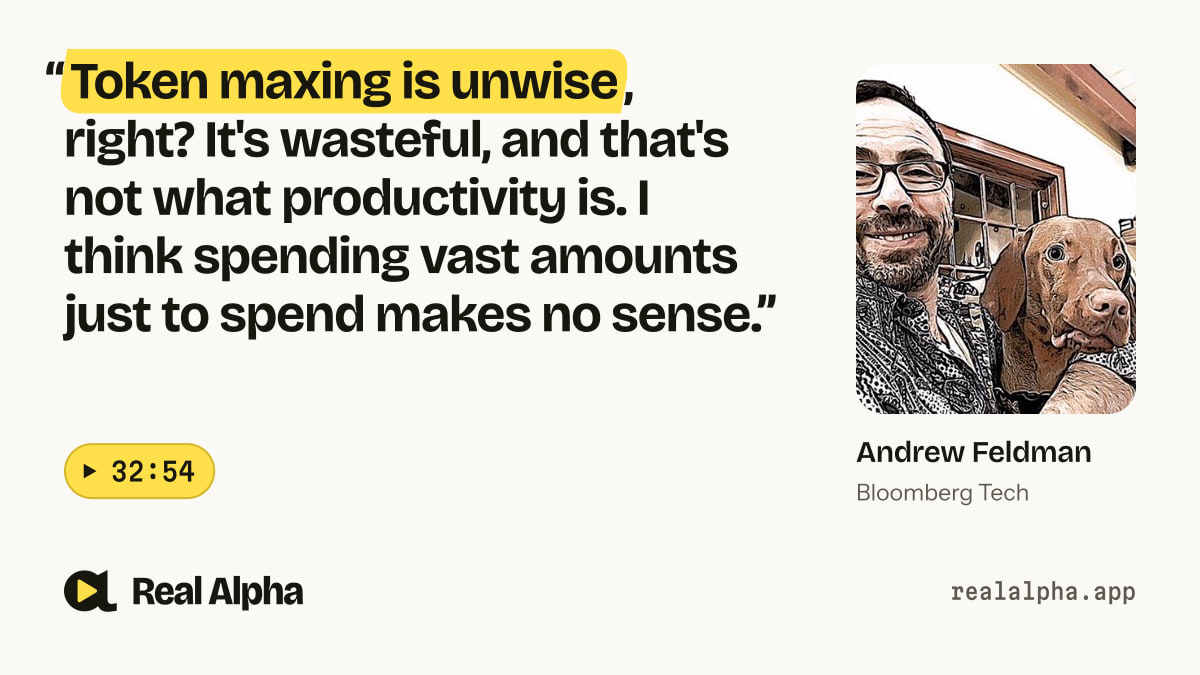
“Token maxing is unwise, right? It's wasteful, and that's not what productivity is. I think spending vast amounts just to spend makes no sense.”
 Andrew Feldmanat 32:54 · Bloomberg Tech
Takeaways Pro pick
- Fast inference can support higher prices for tokens.
- Use tokens on difficult, productive tasks—not just to spend.
- Hyperscalers give Cerebras broad enterprise distribution.
One of Pro's picks, open to you here. Try Pro free for 7 days
One of Pro's picks. The rest of the summary and the 3 takeaways are in Real Alpha Pro; the video, the quote and the transcript stay free.
Read it with Pro, 7 days freeAbout this segment
Andrew Feldman argues fast inference earns a premium for demanding tasks, while token budgets should be deliberate. AWS, Oracle and Microsoft give Cerebras immediate reach into global enterprise customers.

Co-founder & CEO, Cerebras
Co-founded and leads Cerebras Systems, whose wafer-scale engine is the largest processor in computing history.

Ed Ludlow, Host · Host & correspondent, Bloomberg
Hosts Bloomberg Tech and reports on technology, supply chains, deals and finance for Bloomberg News.
From “Nvidia Reels From Huang Exit as Microsoft Battles Outage | Bloomberg Tech”, Nov 13, 2026. Watch the full episode
Answers “How do AI companies make money?” See all 122 answers
Thanks. We'll look at and fix what's off.
Transcript
From the transcript Bloomberg Tech publishes with the episode.
- 31:25
now with the latest is co-founder and CEO Andrew Feldman. Andrew, it's great to have you back on Bloomberg Tech. That guide for the fourth quarter, I think a lot of people are interested in what that reflects. Improving supply, things. That you couldn't do in the quarter before things seem to have loosened up.
- 31:43
Well, first, thanks for having me back. It's always fun to talk to you. I think we had a really good quarter and a quarter we're proud of. I think we have good momentum both within the company and in the market in general. I think there's tremendous demand for inference and a growing understanding of how powerful fast inference is. And that's what we specialize in. And so what you're seeing is that fast inference has pricing support. We can charge more for fast tokens than you can for slow tokens.
- 32:21
And I think we are both selling more hardware and we're bringing more cloud capacity online. And those are some of the constraints right now. So we're removing constraints, making good progress.
- 32:37
So interesting because on the show very recently, we've talked about this sort of CFO's nightmare of token budgeting, token maxing. It's a real consideration for companies big and small. Does that pricing power continue then if the demand is quite clearly there for funds? Give me a lens to the future for that.
- 32:56
Token maxing is unwise, right? It's wasteful, and that's not what productivity is. I think spending vast amounts just to spend makes no sense. I think allocating tokens to really hard problems and using AI for what it's really good at is enormously efficient. And in those domains, delivering tokens more quickly, getting answers in less time is enormously valuable. And so I think just like early in the cloud, there was uncertainty about how to budget for it. I think the CFOs are working with their business leaders across the enterprise landscape in order to understand how to budget for this new spend. And obviously, it's not willy-nilly. It needs to be thoughtful and planned. And it can be enormously productive.
- 33:52
Andrew, Microsoft appears to be a big customer for you. Talk about the onboarding process of that, why they're important and what that business will look like with them going forward.
- 34:05
Months, we've signed three hyperscale customers. We signed AWS. We signed Oracle. And yesterday we announced Microsoft. What these customers give us is reach into the enterprise. They allow us to deliver our compute services to customers large and small anywhere in the world. Between these three, you reach just about every enterprise worldwide. And so it's sort of extraordinary. And immediate global distribution.
- 34:40
At a scale that we couldn't have done by ourselves.