The alpha, twice a week
That was 3 min.
Get the best new moments in your inbox every Wednesday and Saturday. It's free.
Check your inbox
We sent a link to your address. Click it to finish signing up. Not there in a minute? Look in spam.
or
Bloomberg Law · 3 min · Nov 13, 2026
Federal tort claims offer weaker remedies than Bivens
 Leon Fresco
 explains why a Federal Tort Claims Act case may not replace a Bivens claim for a detained person denied medical care.
The episode’s best minutes
Full analysis- 7:21A ruling could weaken immigration enforcement and worker protections4 min
- 16:15Federal tort claims offer weaker remedies than BivensPro pick 3 min
- 27:53Texas gives blue-state AGs a major boost in legal firepower3 min
- 3 more moments in the full episode
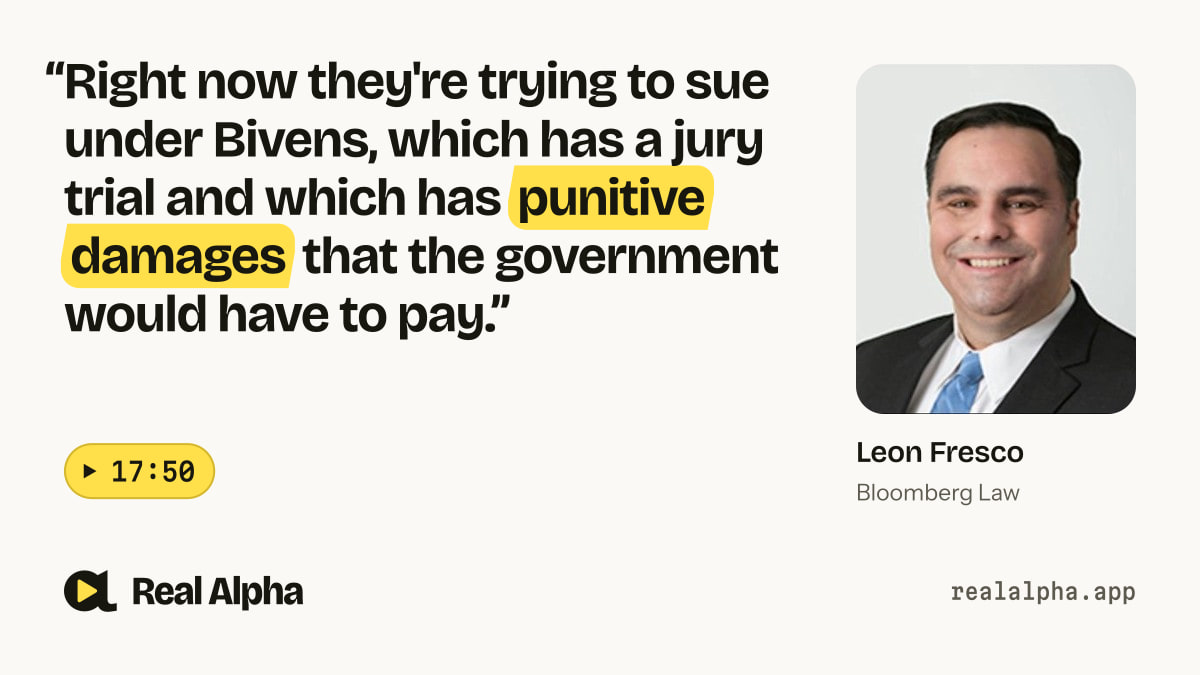
“Right now they're trying to sue under Bivens, which has a jury trial and which has punitive damages that the government would have to pay.”
 Leon Frescoat 17:50 · Bloomberg Law
Takeaways Pro pick
- Bivens claims can include a jury trial and punitive damages.
- The Federal Tort Claims Act requires an administrative claim first.
- Exceptions can block recovery for discretionary decisions or some torts.
One of Pro's picks, open to you here. Try Pro free for 7 days
One of Pro's picks. The rest of the summary and the 3 takeaways are in Real Alpha Pro; the video, the quote and the transcript stay free.
Read it with Pro, 7 days freeAbout this segment
Leon Fresco explains why a Federal Tort Claims Act case may not replace a Bivens claim for a detained person denied medical care. The alternatives can mean fewer remedies and a longer path to compensation.

Partner, Holland & Knight
Drafted the Senate’s 2013 immigration reform bill and oversaw federal civil immigration litigation at DOJ.
- JG
June Grasso, Host
From “SCOTUS Takes On Administrative State & Blue AGs To Take Control | Bloomberg Law”, Nov 13, 2026. Watch the full episode
Thanks. We'll look at and fix what's off.
Transcript
From the transcript Bloomberg Law publishes with the episode.
- 16:17
Justices Clarence Thomas and Neil Gorsuch have pushed for reconsidering Bivens. Could the court just get rid of Bivens?
- 16:27
I don't think they're going to outright get rid of Bivens because the Solicitor General did not ask for it. And Justice Roberts and Justice Kavanaugh signaled caution of not getting rid of Bivens. But I think they will say that this issue of federal detainees suing under Bivens for medical care is gone, that that's finished. And if you can manage to get a federal tort claims act case, then do that. But if you lose that under what's called the discretionary function exception, meaning that, you know, there was an element of judgment or choice in the decision, and here the nurse probably would have one because she's the nurse and She's trying to figure out which injuries determine certain different kinds of care. Then he'd probably lose there too. And he'd have no option of what to sue for getting bad medical care in a nice facility.
- 17:18
And so this is why you have already the new Congress talking about putting a federal Bivens claim into statute so that you would have this ability to sue because otherwise then you could get any disastrous medical care case or any kind of like the Alex Pretty situation, an ICE agent shooting you, essentially, and you'd have no recourse to move forward.
- 17:40
Some of the justices talked about the Federal Tort Claims Act. Why isn't suing under the Federal Tort Claims Act just as good as suing for constitutional violations in federal court?
- 17:53
Right now they're trying to sue under Bivens, which has a jury trial and which has punitive damages that the government would have to pay. And if you sue under the Federal Tort Claims Act, there's no punitive damages. There's no jury trial. There's a six-month first administrative thing you have to go through where you present the claim to the agency. And they can either decide to pay you or say, nope, you get nothing. And only then do you have to sue. So you have this exhaustion period as well. And then also.
- 18:24
If there's an intentional tort or law enforcement proviso, the U.S. is generally immune from those kind of assault, battery, and false arrest claims. And also, if there was a person exercising their discretionary function, then you can't really sue if they're saying that you're second-guessing someone who was doing the job that they were supposed to do, and there's a bit of judgment there. And so some people think that medical malpractice claims survived. those Federal Tort Claims Act discretionary function things, but others don't. And that would need to be a new issue that they'd have to resolve there because the medical malpractice can be viewed also as a Fourth Amendment cruel and unusual punishment thing that then would survive.
- 19:10
But if you want to say that that wasn't cruel and unusual punishment, you know, then it wouldn't survive. And so you'd have to look at that. And so the point is the Bivens route would be much cleaner and easier and faster and with more damages. So that's why they chose that. That's why they wanted it. But if not, then you've got to go through this legal maze that is the federal tort claims act all in order to just get compensatory damages, but no punitive damages.