The alpha, twice a week
That was 4 min.
Get the best new moments in your inbox every Wednesday and Saturday. It's free.
Check your inbox
We sent a link to your address. Click it to finish signing up. Not there in a minute? Look in spam.
or
MTS · 4 min · Nov 19, 2026
Finance agents need audit trails and a human learning loop
 Krish Subramanian
 explains how auditability, consistent decisions and human feedback can make finance agents reliable.
The episode’s best minutes
Full analysis- 5:17Finance agents need audit trails and a human learning loopPro pick 4 min
- 9:30Small finance teams can manage hundreds of millions with agents5 min
- 13:55Banks need agent identity before opening access3 min
- One more moment in the full episode
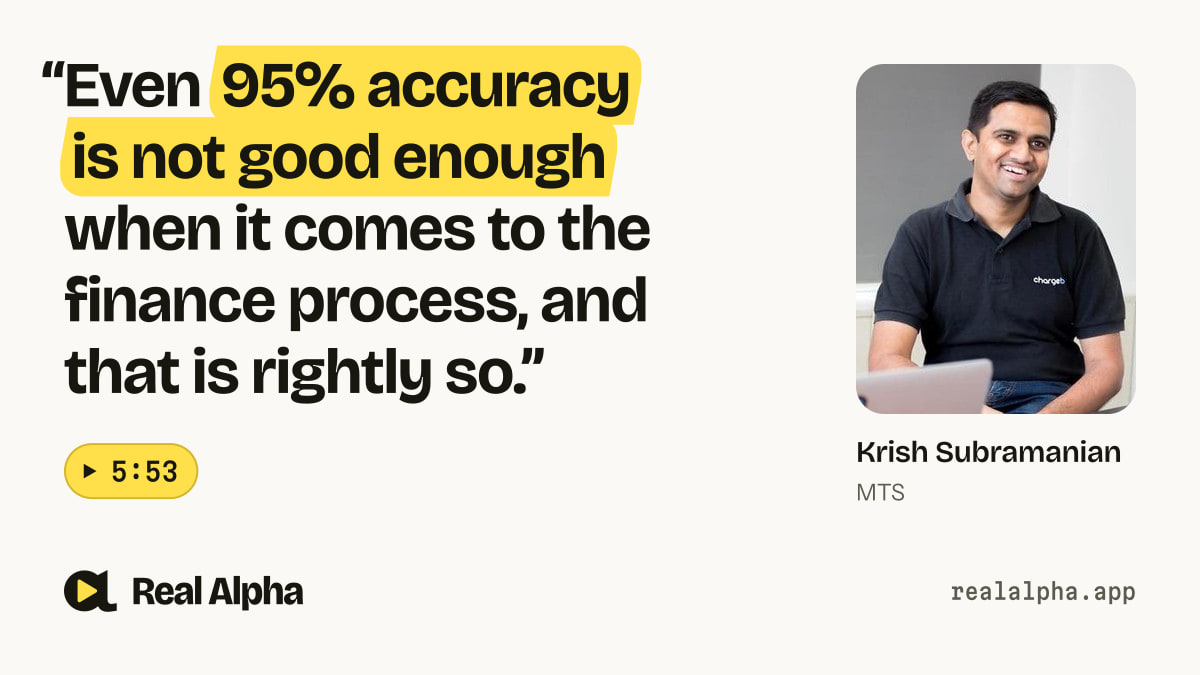
“Even 95% accuracy is not good enough when it comes to the finance process, and that is rightly so.”
 Krish Subramanianat 5:53 · MTS
Takeaways Pro pick
- Even 95% accuracy is not enough for finance processes.
- Auditors need traceable evidence of consistent decisions.
- Human judgment can teach agents how to handle similar cases.
One of Pro's picks, open to you here. Try Pro free for 7 days
One of Pro's picks. The rest of the summary and the 3 takeaways are in Real Alpha Pro; the video, the quote and the transcript stay free.
Read it with Pro, 7 days freeAbout this segment
Krish Subramanian explains how auditability, consistent decisions and human feedback can make finance agents reliable. The design aims to earn trust without giving up automation.

Krish Subramanian is co-founder and CEO of Chargebee.
Grew Chargebee into a global leader in revenue growth management, drawing on two decades of technology experience.

Sophia Dew, Host · Host, MTS
From “2-Person Finance Teams Can Manage $500M With AI | Chargebee”, Nov 19, 2026. Watch the full episode
Answers “Are AI agents ready for real work?” See all 210 answers
Thanks. We'll look at and fix what's off.
Transcript
Transcribed by machine (Whisper) from the episode’s audio, so a word may be off here and there.
- 5:20
Very exciting. When it comes to finance, all of these areas around ensuring it works 100% correctly or privacy and reliability, security, governance, all of those things that people argue is really important when using agents matter so much when it comes to finance. You can't get anything wrong. It's not like a little bug in code. It can ruin a company and ruin a system. And so how do you think about working on all of those very specific areas and ensuring 100% guarantees?
- 5:55
Absolutely. Even 95% accuracy is not good enough when it comes to the finance process, and that is rightly so. The way we think about this is now, in the last several months and quarters, there has been so much innovation. And we always say this, we all build on the shoulders of giants and on each other's innovation. And that is a typical cycle. And what we have been observing in the technological evolution on one side is there is agent, and then there is agent harnesses that are now making strong progress in terms of how to bring it together and how to bring more controls, governance, and all of that together.
- 6:31
So what we did, right, so there is, on the technology front, there is enough innovation happening in the market to know how to actually bring it together to make it happen. And then there is a second aspect that we, as having served finance teams for over a decade, we understood that is also needed what we call as primitives in software parlance, which is the primitives of what makes something traceable or auditable.
- 6:55
When you say this is how I recognize my revenue as an auditor or an accountant, you have to prove it to an auditor that this is how I consistently applied these decisions. And that is a citation or a consistency of how you do that. So what we decided was, over and above all of this, we built a bunch of primitives that makes auditability and traceability and earning the trust of the finance person possible over and above the agent and harnesses.
- 7:25
And that is what we bring together to bring that 100% accuracy. And then there is the other aspect, which is the agent harness itself gives you enough controls and context that you can continuously build, Plus, there is a learning loop that is needed, which is if you say, here as a human, and I am applying my judgment for making a decision. Example, if you have a customer, and the customer has some issue they have not been able to pay, and they notified you saying, hey, my credit card is blocked, I'm getting it again, so please don't cancel.
- 8:00
my subscription, and then they respond back, right? Something like that happens. Now, what you, as a human, would do is, like, your rule says if they don't pay after three or four or five times of reminders after 25 days, you are going to cancel it before the next renewal. That's your standard business rule, right? You can apply the rule straight away, or you can apply human judgment to say the customer has responded, and I'm going to trust this customer because they have been with us for more than three or five years or five years, I want to make sure that I give the benefit of doubt and allow them to do it. Now this judgment can be captured as a comment and provided as an input and now the agent has an opportunity to learn just like how a human learns when you teach them. This learning loop then becomes very powerful
- 8:45
because the next time similar judgment is applied again and again. These are all the little things that actually add up and then they compound to actually make something like that possible to be able to operate with 100% accuracy is how we are looking at it. I want to shout out our sponsor, Lovable.