The alpha, twice a week
That was 3 min.
Get the best new moments in your inbox every Wednesday and Saturday. It's free.
Check your inbox
We sent a link to your address. Click it to finish signing up. Not there in a minute? Look in spam.
or
Latent Space · 3 min · Nov 18, 2026
First-party apps can make revenue harder to replace
 Tanay Jaipuria
 contrasts channel-partner and API revenue with usage through Anthropic’s own apps.
The episode’s best minutes
Full analysis- 17:20Free inference costs less when a company has fewer free users3 min
- 33:24First-party apps can make revenue harder to replacePro pick 3 min
- 48:42Science could absorb compute if customer adoption slows3 min
- 4 more moments in the full episode
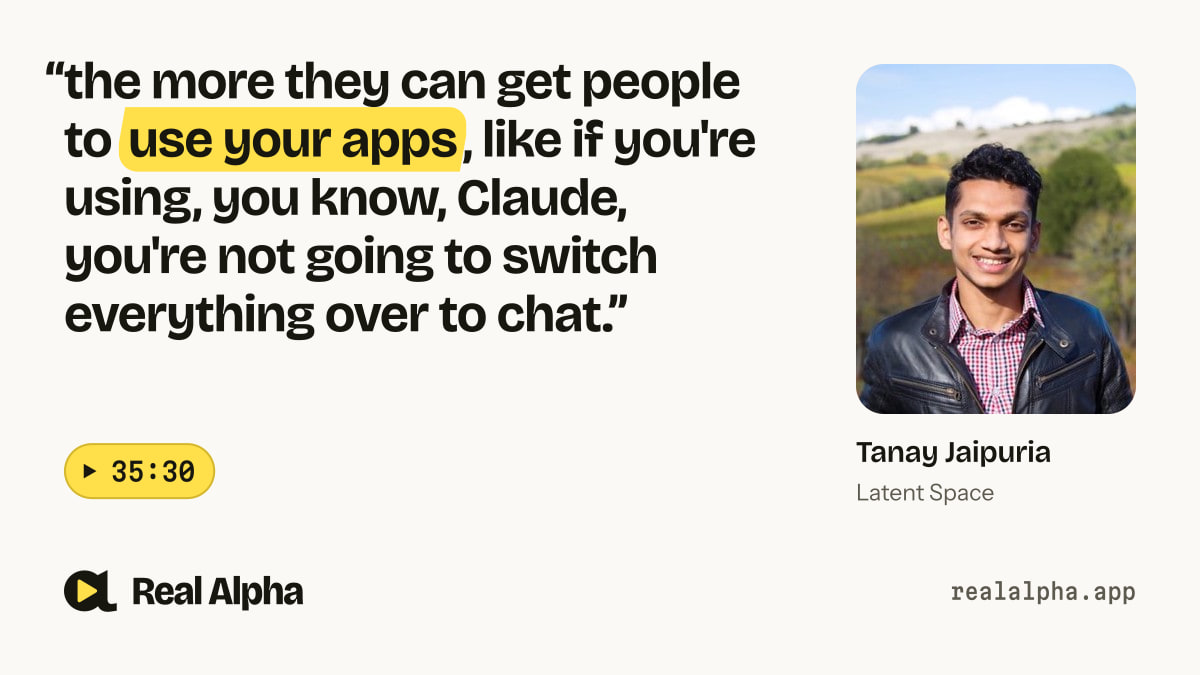
“the more they can get people to use your apps, like if you're using, you know, Claude, you're not going to switch everything over to chat.”
 Tanay Jaipuriaat 35:30 · Latent Space
Takeaways Pro pick
- About half of revenue comes through channel partners.
- Most usage comes from models released in the last six months.
- First-party apps may make customers less likely to switch.
One of Pro's picks, open to you here. Try Pro free for 7 days
One of Pro's picks. The rest of the summary and the 3 takeaways are in Real Alpha Pro; the video, the quote and the transcript stay free.
Read it with Pro, 7 days freeAbout this segment
Tanay Jaipuria contrasts channel-partner and API revenue with usage through Anthropic’s own apps. If customers can easily swap models, falling behind for even a few months could put revenue at risk.

Tanay Jaipuria is a partner at Wing Venture Capital.
Invests in AI-powered applications and infrastructure, after leading product teams at Meta for Facebook and Instagram.

Shawn Wang (swyx), Host · Co-founder, AI Engineer
Wrote “The Rise of the AI Engineer” and founded Smol AI, maker of AI News.
From “⚡️Anthropic: Know Before You IPO — Tanay Jaipuria, Wing VC”, Nov 18, 2026. Watch the full episode
Thanks. We'll look at and fix what's off.
Transcript
Transcribed by machine (Whisper) from the episode’s audio, so a word may be off here and there.
- 33:30
And the reason I say that is like a few things. So one is, so we do know, for example, that about half their revenue is coming from channel partners. I think that's actually now going down slightly. It was on the way up. I think it's now down to 44%. it's coming from these channel partners and that they roughly are paying. If you think about like the big costs, right? It's pretty much compute, which we've touched on people, which again is as a percent of revenue just keeps going down because they are getting more and more efficient.
- 33:56
I think the revenue per employee is now up to like 6 million per year from like a, from a million or something. And then the third is this kind of the sales and marketing, but most of it is not like, you know, brand building sales and marketing. It's like these, the fees that paying these channel partners, which is about 30% of the revenue, 30 to 35% of the revenue that those channel partners are getting for them.
- 34:19
But I think the other reason this is important is that they disclose that about 80% of their, most of the model usage or most of their revenue comes from models that were released in the last, 80% of the usage comes from models released in the last six months. And I think what that, the dynamic that kind of ends up creating, especially when you add to that fact that most of their revenue comes from usage-based plans or from usage-based pricing, as opposed to like, you know, subscriptions is that you can't fall behind at all, or you, you, you kind of are putting like a large percent of your revenue at risk.
- 34:53
So like, if like, and I think it would be hard for this to happen, but imagine like for whatever reason, like they just fall behind for three months. And, you know, there's like, you know, Gemini's new model is very good. but OpenAI's new model is very good. And Anthropics is just like slightly behind for a reason. And it's like, you're still using Opus 455 is the best that they have and the others are further ahead.
- 35:16
You could find yourself in a scenario where because people are just kind of using you at the API layer in some system where they can easily just swap you out, that you have lost a lot of share suddenly and lost a lot of revenue. And so I think that's like a tricky place to be in. So from a company strategy perspective, I think, you know, the more they can get people to use your apps, like if you're using, you know, Claude, you're not going to switch everything over to chat.
- 35:44
You might have a bunch of scheduled tasks and everything. You won't do that switch if like, you know, it's behind for a few months or something. But if it's true, the more it's just API driven usage, the more risk there is of just people, you know, just like the revenue can go away more quickly as well. And so I do think that that is one of the things where you're in this game where you just always have to stay, and not necessarily at the front deal, but also just at every point of the price performance globe