The alpha, twice a week
That was 3 min.
Get the best new moments in your inbox every Wednesday and Saturday. It's free.
Check your inbox
We sent a link to your address. Click it to finish signing up. Not there in a minute? Look in spam.
or
Unsupervised Learning · 3 min · Jun 4, 2025
Foundation models may split between APIs and custom applications
 Brendan Foody
 expects general model APIs to commoditize, while value shifts to customer-specific applications and verticals.
The episode’s best minutes
Full analysis- 13:51AI labs are shifting from crowdsourcing to expert dataPro pick 3 min
- 18:55Mercor followed demand signals into AI data work4 min
- 35:00Foundation models may split between APIs and custom applications3 min
- 5 more moments in the full episode
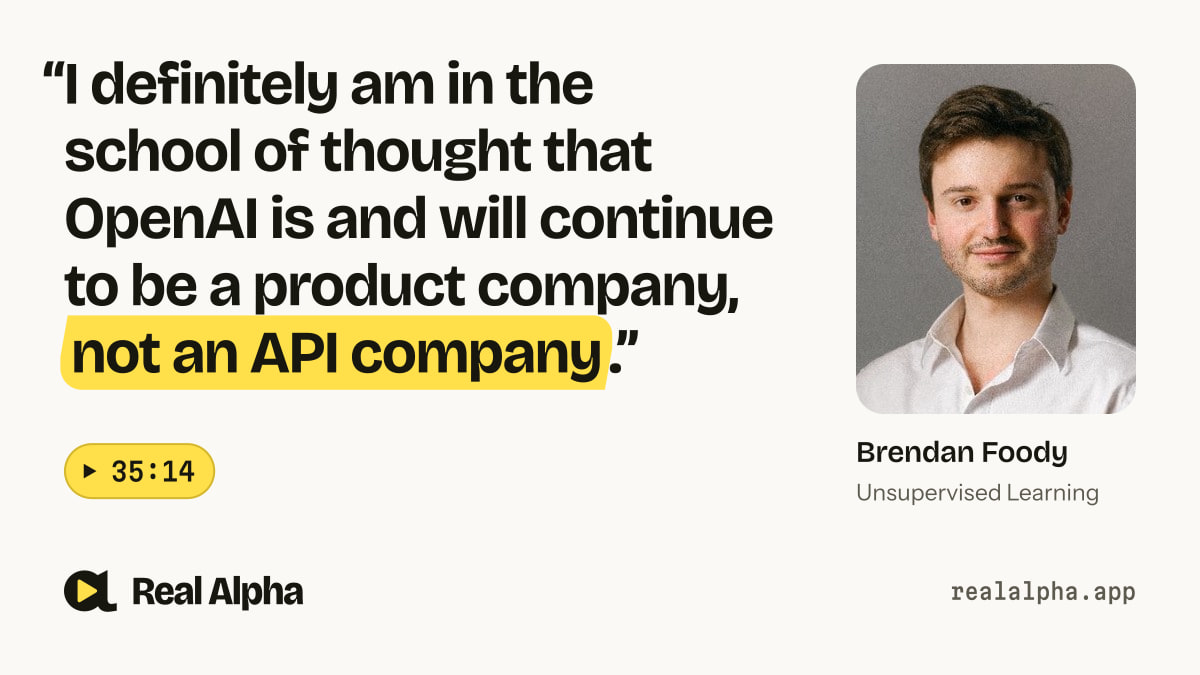
“I definitely am in the school of thought that OpenAI is and will continue to be a product company, not an API company.”
 Brendan Foodyat 35:14 · Unsupervised Learning
Takeaways
- Brendan expects one dominant general API provider.
- Customization at the application layer can create vertical value.
- Custom evals can tie model performance to real business outcomes.
About this segment
Brendan Foody expects general model APIs to commoditize, while value shifts to customer-specific applications and verticals. He points to tailored evals and post-training as ways labs could build differentiated businesses.

Brendan Foody is co-founder and CEO of Mercor.
Co-founded Mercor, a labor marketplace supplying AI companies with expert data, paying tens of millions weekly.
- JS
Jordan Segall, Host · Partner, Redpoint
From “Mercor CEO: Evals Will Replace Knowledge Work, AI x Hiring Today & the Future of Data Labeling”, Jun 4, 2025. Watch the full episode
Answers “Are AI wrappers a real business?” See all 13 answers
Answers “How do AI companies make money?” See all 42 answers
Thanks. We'll look at and fix what's off.
Transcript
Transcribed by machine (Whisper) from the episode’s audio, so a word may be off here and there.
- 35:06
You have a kind of customer base of a lot of foundation model companies. Like, what do you think happens to that landscape over time? I mean, some people are like, you know, it will consolidate to two or three, maybe we'll see more. You know, how many different players do you think we end up with and how do they ultimately differentiate? It's a very good question. I definitely am in the school of thought that OpenAI is and will continue to be a product company, not an API company.
- 35:27
I think that so many of the API capabilities will get commoditized, and it's really how you integrate with all the customers' context and that over time where they're able to generate a lot of pricing power. But I think that the market is going to be so large that I could see each of them leading into a given segment that they're able to absorb a lot of value in. Like even if one of these labs were just go all in on building a hedge fund, I bet they could make a ridiculous amount of money. Right. And so I yeah, I think it's easy to like pattern match and say these companies are overvalued. But if you really approach the problem of like automating knowledge work and like what that opportunity is from first principles, it's like it's hard to justify that these companies with such exceptional teams making.
- 36:11
so much progress won't be able to build really incredible businesses. Yeah. I mean, obviously, to date, it feels like there's been so much just like cross-domain generalization that it feels like it's trended toward more of a winner-take-all or the top-take-most versus like, hey, we'll have one that's really good in this place and one that's good in that. Though I guess your hedge fund example is interesting insofar as you could obviously, there's a lot more to build around the scaffolding of the model to make that work. Yeah. I mean, there are a lot of value. There's a lot of value to focus. I think that But having a general API is probably not a great business for multiple companies.
- 36:41
And so I think that there's going to be one player in that, likely one of the top two labs right now. And then there is going to be just a huge amount of customization that happens at the application layer for every vertical and every customer use case. Yeah. And you think for a lot of those custom models that require some sophisticated labeling? Oh, certainly. I mean, there is, like, so much. I mean, imagine if every trading firm could have evals over, like, the particular parts of their, like, trading analysis that were accurate conclusions versus inaccurate conclusions that translated to trade doing well or not.
- 37:19
And, like, you had one of the top post-training teams that was just focused on, like, how do we optimize having the right trading analysis for sort of mid-frequency faster than our human traders are able to get to it? I think there is a huge amount of opportunity. I'm starting by talking to you. It feels like some trading firm's optimal strategy should just be stop trading, spend nine months just like laser focused on post-training a model.
- 37:40
Maybe. I actually have been sort of surprised that a lot of the trading firms are less sophisticated in post-training than one would have anticipated. I think that part of it is just the geographic separation of all of them being in New York or having a good chunk of their core teams in New York versus the labs being in San Francisco and a lot of the top researchers wanting to work on AGI rather than making money.
- 38:01
And so, yeah, but I think that they're going to invest vast amounts in it. And there's just going to be these sort of like nine figure, 10 figure partnerships with Frontier Labs to help customize their specific use case.