The alpha, twice a week
That was 7 min.
Get the best new moments in your inbox every Wednesday and Saturday. It's free.
Check your inbox
We sent a link to your address. Click it to finish signing up. Not there in a minute? Look in spam.
or
a16z Podcast · 7 min · Nov 11, 2026
Founder conviction and 10x potential guide sale decisions
 Mike Volpi
 separates strong companies from distressed sales, then weighs founder appetite and whether an uncertain business can 10x.
In this episode
Full analysis- 3:11AI infrastructure may stay useful after a market correctionPro pick 6 min
- 14:21Frequent, modest acquisitions created outsized Cisco returnsPro pick 5 min
- 46:01AI traffic may need a different data center network architecturePro pick 7 min
- 9:16AI software gains are extending GPU useful lives5 min
- 43:30Customer cancellations turned Cisco’s shortage into a steep miss3 min
- 25:24Founder conviction and 10x potential guide sale decisions7 min
- 32:15Fab limits and full-system design shape AI infrastructure6 min
- 22:12Cisco used a dedicated team to make acquisition integration repeatable3 min
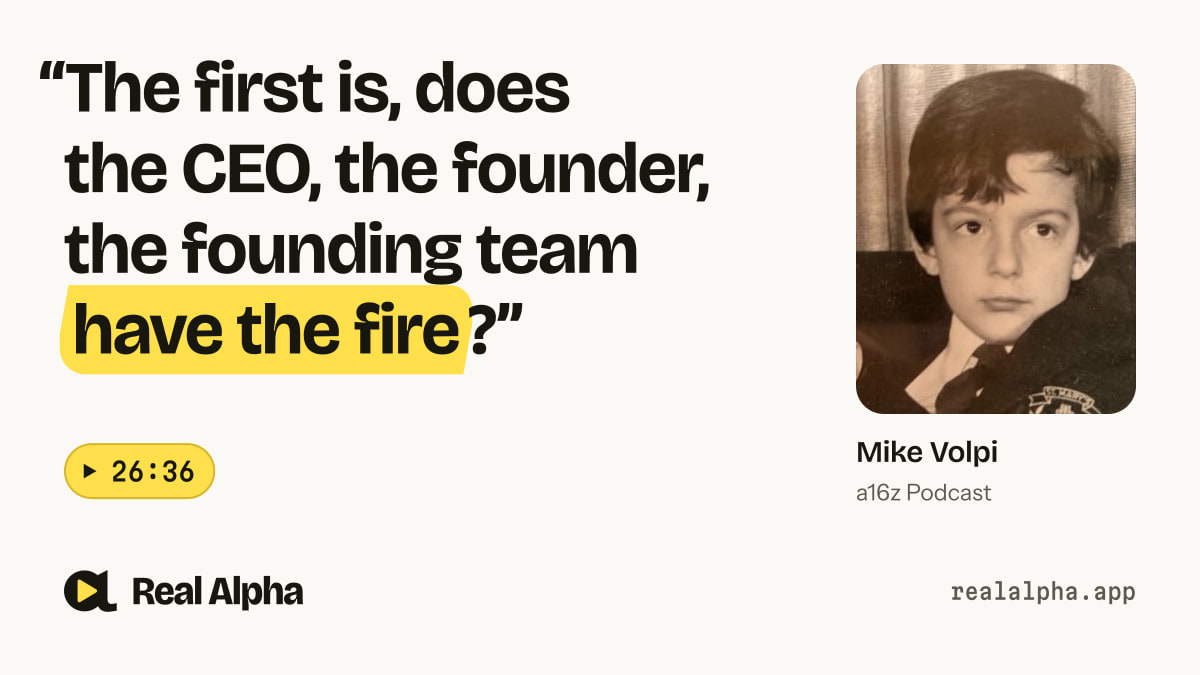
“The first is, does the CEO, the founder, the founding team have the fire?”
 Mike Volpiat 26:36 · a16z Podcast
Takeaways
- Do not sell a strong company simply because an offer arrives.
- Ask whether the founder wants to push through the next phase.
- Judge the upside by 10x potential, not whether it can double.
About this segment
Mike Volpi separates strong companies from distressed sales, then weighs founder appetite and whether an uncertain business can 10x. He recommends regular conversations with potential acquirers so relationships exist before a sale.

Mike Volpi is general partner at Hanabi Capital and former Cisco executive.
Led Cisco’s strategy and more than 70 acquisitions, and invests in AI, infrastructure and open-source companies.

Erik Torenberg, Host · General partner, Andreessen Horowitz
Helped build Product Hunt; founded On Deck, Village Global and Turpentine.
From “Mike Volpi on Why AI Infrastructure Will Outlast the Hype Cycle”, Nov 11, 2026. Watch the full episode
Thanks. We'll look at and fix what's off.
Transcript
Transcribed by machine (Whisper) from the episode’s audio, so a word may be off here and there.
- 25:31
at least in recent memory, we have had some exits into being other large companies buying them. Two questions there. One is, if you're a portfolio company CEO, what would you watch out for, right? And then sitting on the boards of these companies, how do you advise for your companies these days? About exits. About exits in general? Look, when you're in our business of being on boards and you're facing a situation where you need to sell, you know, there's an opportunity to sell a business, it's one of three outcomes.
- 26:13
One, your company's doing great and it's a really bad idea to try to sell it. So then you try to convince the CEO, no, don't do it. Two, the company's struggling. We don't have a lot of finances. It's a nice way to get out. Everybody's happy. Then you just help the deal happen. You sort of manage a process. Then you have the tweeners. We're not totally sure. And I think that there are a couple of important indicators that help you determine what to do in that moment.
- 26:44
The first is, does the CEO, the founder, the founding team have the fire? Like, do they want to do this? Do they believe they can get through this sort of intermediary period and bust open into the next phase? Do they want it? Because if you have a CEO or a leader that's kind of like, man, you know, maybe I should consider this. I'm a little tired. It's been a long haul. then let's just sell this thing and and kind of move on um and then the second factor is you have to be pretty cold and objective about like is this going to be a interesting enough business not like will it double from here because at the end of the day if it's double i'll take the money today but will it 10x from here and that i would say gets to be a really hard decision because it's a little bit emotional also for you like you're you know you're not a founder but you know you've
- 27:45
been working with this company for four five six years your heart's in it you've you've told your good friends to go work there and and yet you have to step step away from it and go like objectively this is not 10x from here and then and you help steer the ship. But I think the most important parameter is where's the founder's head at? Yeah. Yeah. And so there is a certain element of mystery or unknown for a lot of the portfolio company founders on how do these things actually happen, right?
- 28:21
People think one day somebody calls another company and say, hey, I want to buy you versus, and then there's other thing where people have built relationships for a long time. How did you approach it at Cisco, and how do you advise your portfolio companies, even if they're expecting a 10x? Did you just call them up and say, hi, I want to buy you? No, well, obviously, you do as good a job as you can building a network and knowing what's going on.
- 28:49
It's basically cataloging the inventory is the way we used to think about it. But every company in the market is a potential acquisition, so you catalog them. and, you know, where are they in their growth rate? What kind of founders they have? Who are the backers? What are their aspirations? Who are their customers? Just, like, be informed. So, and the, you know, the business, the corporate development group had to do that, but I kind of considered it everybody's job at the company to be constantly informed about what's happening around them.
- 29:20
So, and then essentially we, at the company, we would try to weave, at Cisco, we would try to weave in the inventory against a strategy statement that was there. For example, we're a router company, but there are going to be more switches than routers. Therefore, we need to have a switch. What are the switching companies that are available, right? Or optical networking is becoming important because of bandwidth, blah, blah, blah.
- 29:49
ah, what are the companies that are available? You often have the other way where companies come to you and say, hi, I'd like to get bought. I think it's broadly a bad idea, right? Because there's either an auction going on or you should have thought about it earlier if you were interested in it. But basically, you almost never pay attention. We never tried to pay attention to inbound. Flip side, you're now a small company or a startup.
- 30:15
And how do you think about that? I always encourage always the founders of our companies to talk to big companies, to talk to competitors, and to always be in dialogue. Some people will say like, well, are you shopping yourself? No, it's an inverse intelligence gathering mechanism. I even encourage my CEOs to talk to their direct competitors. Go to coffee. All right. Like, yeah, if you're clueless, you might leak some information towards them.
- 30:43
Hopefully you're not clueless. And they might tell something to you that's interesting. or they might shape your view on an industry or something. So I encourage people to be out there always talking and seeing what's happening in the market. And usually you kind of have a pretty good idea of like, okay, my company is struggling a little bit. I think I'd like to sell. I kind of already know them because I've been in conversations with who's where.
- 31:12
So I would say, you know, don't, A CEO of a startup shouldn't spend their entire day talking, but going on one or two coffees a week with, you know, the powers that be at NVIDIA, the powers that be at Amazon and OpenAI, et cetera, et cetera, when the right people are talking, do it. It's fine. The information exchange, you don't lose that much in that. They're already thinking about it. But you gain a lot by having that relationship.
- 31:38
I think this is really good advice. I keep telling my portfolio CEOs the same thing. If you don't have the cell phone number of the CEOs So for each of your competitors, that's a problem. There will be a day when you need it. Absolutely. So it's a network you need to build. Yeah, yeah. Now, enough of this M&A stuff. Let's get back to actual technology.