The alpha, twice a week
That was 3 min.
Get the best new moments in your inbox every Wednesday and Saturday. It's free.
Check your inbox
We sent a link to your address. Click it to finish signing up. Not there in a minute? Look in spam.
or
Bloomberg Daybreak: US Edition · 3 min · Nov 6, 2026
France's debt matters because its size raises EU-wide stakes
 Suzanne Lynch
 says France's debt is not yet at crisis levels, but its scale and the possibility of a Le Pen victory make it a Europe-wide concern.
In this episode
Full analysis- 31:00Chinese brands are gaining ground as shopping moves online5 min
- 4:39Producer prices point to more inflation in the pipeline2 min
- 35:53Chinese shoppers are finding ways to resist impulse buyingPro pick 3 min
- 20:25France's debt matters because its size raises EU-wide stakes3 min
- 18:13EU leaders see a short window to settle budget priorities2 min
- 6:59Skydance's first earnings will test its integration and debt plan2 min
- 14:53Ireland wants to keep EU enlargement on the agenda2 min
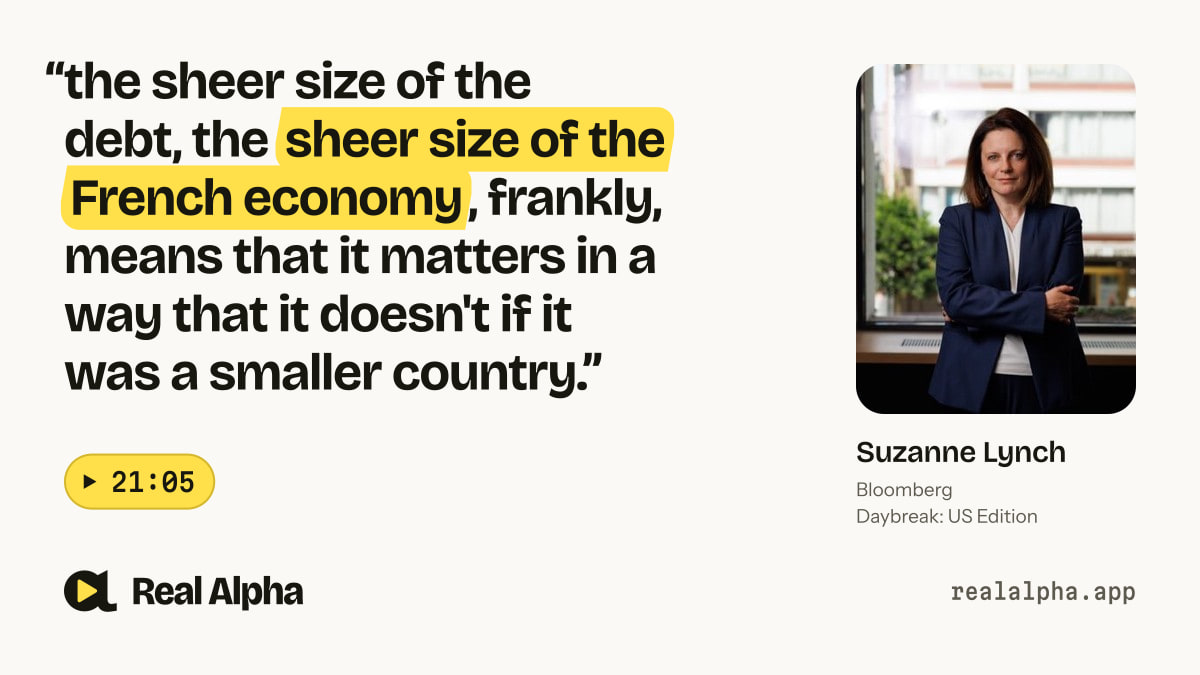
“the sheer size of the debt, the sheer size of the French economy, frankly, means that it matters in a way that it doesn't if it was a smaller country.”
 Suzanne Lynchat 21:05 · Bloomberg Daybreak: US Edition
Takeaways
- France's economic scale makes debt concerns harder to contain.
- There is little political impetus to make market-demanded changes.
- Leaders use summit sidelines for budget and Ukraine discussions.
About this segment
Suzanne Lynch says France's debt is not yet at crisis levels, but its scale and the possibility of a Le Pen victory make it a Europe-wide concern. She also describes the private dealmaking around the Dublin summit.

Brussels bureau chief, Bloomberg
Leads Bloomberg’s expanded EU coverage and writes the Brussels Edition newsletter on politics and policy across the continent.
- JT
John Tucker, Host · Bloomberg
From “Daybreak Weekend: US CPI, Ireland Summit, China's Singles Day | Bloomberg Daybreak: US Edition”, Nov 6, 2026. Watch the full episode
Thanks. We'll look at and fix what's off.
Transcript
From the transcript Bloomberg Daybreak: US Edition publishes with the episode.
- 20:27
Can you talk a bit more about France, the debt issue there? As you mentioned, you've got the presidential election coming up next year. And it's been pretty fraught in France in recent weeks with thousands of people demonstrating some of those demonstrations turning violent. I mean, France is such a pivotal part of the European Union that, you know, the political turmoil there, does that bleed into this gathering?
- 20:54
Look, it's definitely a worry. I mean, the message from across national capitals here, sources I've been speaking to, is that they're not too worried. I mean, the bond yields have not reached the heights that we saw during the Greek crisis, for example. However, the sheer size of the debt, the sheer size of the French economy, frankly, means that it matters in a way that it doesn't if it was a smaller country. And so that is a concern.
- 21:18
And I think the real concern here is that while we might not be at a crisis point at the moment, that there is no sign that this is going to be resolved anytime soon. I mean, the budget is going to take some time. There doesn't seem to be much political impetus by any of the parties to make the changes that the markets want them to make, essentially, ahead of an election to make those unpopular decisions. So, you know, this is not going to go away anytime soon, even though we may avoid a crisis point at this moment.
- 21:44
But I do think the political reality now of Marine Le Pen, I think, is weighing on minds. There's a sense that she really could win this election. And even though, you know, we had the AfD in Germany and it was a real blow to Merz when that far-right party did so well in regional elections, there's not a sense that that, you know, the AfD is near power, federal power in Germany. The same way is that this could very easily, very, could happen early next year in April or May after the elections. What France does in the European Union has always been important. The Franco-German engine is at the centre of so many discussions and And frankly, even this week, we will have the meeting on Thursday and on Friday, it's officially an informal meeting. But I can tell you what will really be happening is that
- 22:27
leaders will be having bilateral meetings, talking about all these things, maybe talking about the next ECB president, for example, about what they can give in terms of concessions with the budget, about what next for Ukraine. Those kinds of conversations will be happening all the time on the fringes of this meeting in Dublin. And in fact, as journalists, that's sometimes where the more interesting stories lie. You don't get the 27 leaders in a room saying, that often. And that's what's going to be happening next Friday when the other leaders leave. So we expect a lot of decisions to be made, even if not publicised.