The alpha, twice a week
That was 3 min.
Get the best new moments in your inbox every Wednesday and Saturday. It's free.
Check your inbox
We sent a link to your address. Click it to finish signing up. Not there in a minute? Look in spam.
or
Bloomberg Surveillance · 3 min · Nov 10, 2026
Fuel market risks can persist despite diplomatic optimism
 Amrita Sen
 says markets have priced out geopolitical risk without evidence of a deal, leaving a stalemate possible.
The episode’s best minutes
Full analysis- 0:55Semiconductor valuations point to an earlier earnings peak3 min
- 8:00Fuel market risks can persist despite diplomatic optimism3 min
- 12:07The Fed may hike to stop energy inflation from spreadingPro pick 4 min
- 2 more moments in the full episode
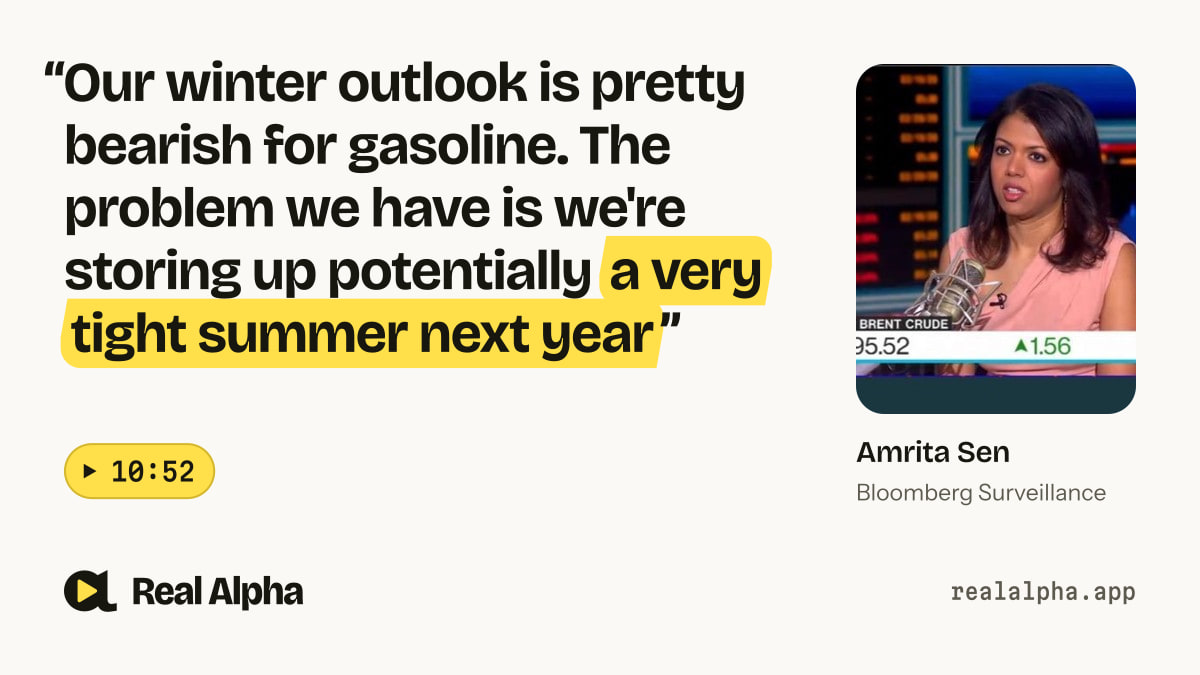
“Our winter outlook is pretty bearish for gasoline. The problem we have is we're storing up potentially a very tight summer next year”
 Amrita Senat 10:52 · Bloomberg Surveillance
Takeaways
- Reduced risk of an attack does not mean a diplomatic deal is near.
- Winter gasoline prices usually ease with seasonal specifications.
- High refinery runs build gasoline stocks but may leave summer supply tight.
About this segment
Amrita Sen says markets have priced out geopolitical risk without evidence of a deal, leaving a stalemate possible. Seasonal gasoline weakness may mask a tight summer outlook as diesel remains constrained.

Director of Market Intelligence & Founder, Energy Aspects
Founded Energy Aspects and leads its oil, gas and carbon market analysis and forecasting.
- TK
Tom Keene, Host
- PS
Paul Sweeney, Host
- LM
Lisa Mateo, Host
- MB
Michael Barr, Host
From “Bloomberg Surveillance TV: November 10th, 2026 | Bloomberg Surveillance”, Nov 10, 2026. Watch the full episode
Thanks. We'll look at and fix what's off.
Transcript
From the transcript Bloomberg Surveillance publishes with the episode.
- 8:02
I think you guys were talking about this already, right? Yes, we do think immediate chances of an attack or an escalation has definitely eased a little bit for sure. But that doesn't mean the status quo is changing. And I think that's the bit I do feel the market had started to price in a definitive deal. That hasn't shifted. And the impasse is really around there are demands that Iran has made, particularly around frozen funds, whether it's about the nuclear enrichment. And clearly, and you saw that from what President Trump said yesterday, those are not conditions the U.S.
- 8:40
is willing to accept. And I think that's why the current status quo where, yes, oil is getting out, but at what cost? Freight still remains extremely high. You're still doing ship-to-ship. None of that changes. And by the way, attacks on ships also continue.
- 8:53
Amrita, at this price with WTI around $ 85 a barrel and Brent at $ 91, how much geopolitical risk is actually priced in or have we erased it all in the past 48 hours?
- 9:04
I would say we have erased it all. I mean, probably not just the 48 hours, pretty much ever since the midterm elections came out. Obviously, the market had positioned itself and you saw it like in our quant data, we saw it heavily in the options market. People were positioning for an imminent strike. When that didn't happen, you definitely started to see the sell-off. I think what's been interesting to note is because of the way the midterm elections played out, the market is now sanguine that the war will end no matter what. from the U.S. side because it's not just the Democrats, but also the Republicans don't want the war to continue. And I think that's where the little bit of a mismatch is that not saying there's escalation, but that doesn't also mean there is a deal. I think the current status quo of, quote, unquote,
- 9:47
what I would call a stalemate can continue for longer. We've heard time and time again that the tightness in this market is really under the hood when it comes to jet fuel, diesel, gasoline. But this morning, a welcome depreciation when it comes to gasoline across the United States, a little bit of pressure coming off at the pump in terms of lower than $ 4 a gallon. How is that happening?
- 10:10
Look, gasoline of all the products, particularly the clean products, I would say, is the weakest because it's also winter. Remember, we have summer-winter gasoline spec, so we always do get that seasonal correction. I wouldn't put too much into it in terms of the price that's fallen. Winter gasoline requires very different spec to summer gasoline. You should still look at the year-on-year increases or changes. So I do think that's worth considering. Having said that, gasoline stocks are building.
- 10:39
They do build this time of the year. And the thing what's happened is the diesel tightness has meant that every refinery, wherever possible, is running as hard as possible. And most of the refineries that are running tend to produce more gasoline. And that's why we are building in stocks. Our winter outlook is pretty bearish for gasoline. The problem we have is we're storing up potentially a very tight summer next year because we're not storing enough of the summer material. Diesel tightness, as you've just showed on the prices, hasn't really eased off and we're not expecting that to ease off.
- 11:10
Stay with us. More Bloomberg surveillance coming up after this.