The alpha, twice a week
That was 2 min.
Get the best new moments in your inbox every Wednesday and Saturday. It's free.
Check your inbox
We sent a link to your address. Click it to finish signing up. Not there in a minute? Look in spam.
or
All-In · 2 min · Sep 30, 2025
Funding cuts are limiting astronomy labs and telescope work
 Alex Filippenko
 says NSF graduate fellowships and NASA funding were cut roughly in half, constraining hiring and research.
In this episode
Full analysis- 17:25Basic research pays off in ways we cannot predictPro pick 5 min
- 46:05Zipline is growing faster than its marketing can explainPro pick 5 min
- 57:58Smaller electric aircraft could reshape instant delivery3 min
- 53:23Rwanda told Zipline to prove blood delivery before expanding3 min
- 1:02:52Reliable drone delivery requires a purpose-built system2 min
- 34:52Funding cuts are limiting astronomy labs and telescope work2 min
- 32:25Filippenko thinks the great filter lies ahead of us2 min
- 25:04Webb's early galaxies don't overturn the Big Bang3 min
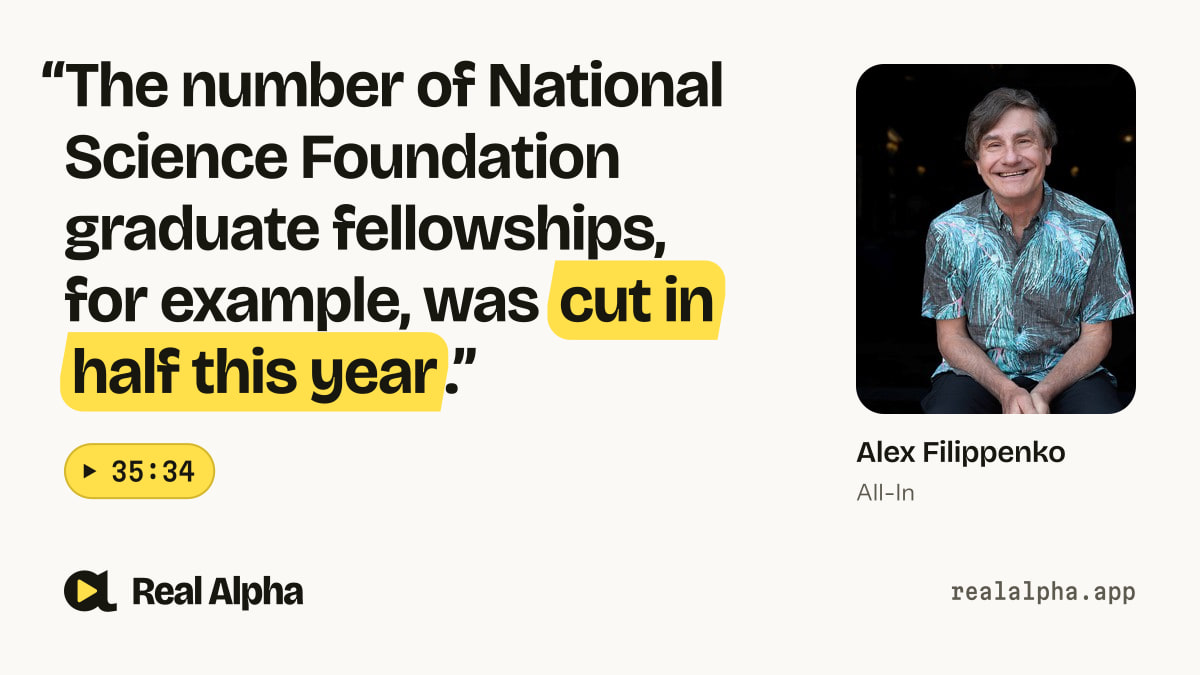
“The number of National Science Foundation graduate fellowships, for example, was cut in half this year.”
 Alex Filippenkoat 35:34 · All-In
Takeaways
- NSF graduate fellowships were cut in half this year.
- NASA funding was also cut in half, he says.
- Filippenko is prioritizing funding his existing research group.
About this segment
Alex Filippenko says NSF graduate fellowships and NASA funding were cut roughly in half, constraining hiring and research. He is not adding researchers until he can fund his current group.

Distinguished professor of astronomy & Class of 1954 Chair, UC Berkeley
Co-discovered the universe’s accelerating expansion and uses supernovae to measure cosmic distances.

David Friedberg, Host · CEO, Ohalo
Founded The Climate Corporation, sold to Monsanto for about $1.1B in 2013.
From “Science Corner Special! David Friedberg, Cleo Abram, Alex Filippenko, and Keller Rinaudo Cliffton”, Sep 30, 2025. Watch the full episode
Thanks. We'll look at and fix what's off.
Transcript
Transcribed by machine (Whisper) from the episode’s audio, so a word may be off here and there.
- 34:59
I want to give you an opportunity to share with us what's going on with respect to hiring graduate students and funding research right now. Yeah. I've heard from lots of scientists that NIH grants have been cut. Yeah. And it's affecting their ability to hire and build out their labs and do some of their research. Are you seeing the same today? And maybe just give us a sense of on the ground what's going on with respect to what you're seeing in funding.
- 35:26
Yeah, the issue is a very serious one. In a sense, you know, science is under attack to some degree, intentionally or unintentionally, maybe part of a broader thing. But it's having an enormous effect. The number of National Science Foundation graduate fellowships, for example, was cut in half this year. NASA funding has been cut in half, and I'm all for going to the moon and Mars, but if all of the remaining NASA funding goes toward those ideals, then nothing will be left for professors and their students and postdocs to analyze the great data that the Hubble and Webb and all that are giving us and various space telescopes are now in jeopardy of not being launched, the Nancy Grace Roman telescope and stuff. So graduate schools are now reluctant to accept new graduate students and to hire new postdocs because frankly we don't have the funding with which to do so and I'm
- 36:24
personally very worried about my own research group. I'm not taking on any new researchers until I personally can fund my existing group. That's got to be my primary concern right now. And I don't know how I'm going to do it, you know. And others throughout my field, and even in a sense you could say more immediately useful fields, like NIH, you said, right? Cutting the funding there. These are researchers who are doing things that are going to be good for humanity soon, not these unanticipated spinoffs.
- 36:56
but the kind of stuff I do should be supported as well.