The alpha, twice a week
That was 3 min.
Get the best new moments in your inbox every Wednesday and Saturday. It's free.
Check your inbox
We sent a link to your address. Click it to finish signing up. Not there in a minute? Look in spam.
or
In Good Company with Nicolai Tangen · 3 min · Nov 4, 2026
Gas fills the gap when data centers need round-the-clock power
John Ketchum says current batteries cannot yet cover data centers' 24/7 demand, so gas supplies firm power despite higher costs.
In this episode
Full analysis- 7:13NextEra chose to build power rather than own data centers6 min
- 21:12SMRs need shared risk before they can scale4 min
- 30:58NextEra turns employee ideas into savings and ownership3 min
- 2:34Scale gives NextEra leverage in rates and procurement5 min
- 12:48Gas fills the gap when data centers need round-the-clock power3 min
- 17:34Ketchum sees AI investment as a competitiveness and ratepayer issue4 min
- 33:35NextEra limits new-market risk with small initial investments3 min
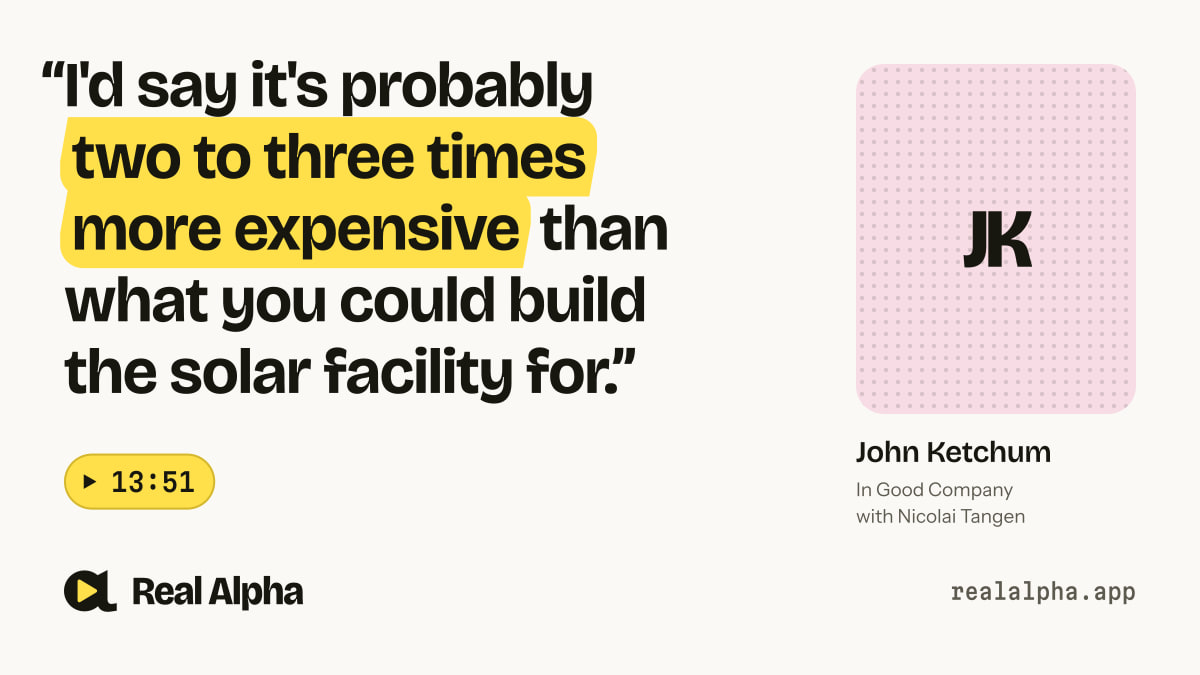
“I'd say it's probably two to three times more expensive than what you could build the solar facility for.”
Takeaways
- Current storage is four hours, with eight hours possible by stacking.
- Gas plants cost two to three times as much as solar to build.
- Hyperscalers want matched generation rather than drawing from existing grid supply.
About this segment
John Ketchum says current batteries cannot yet cover data centers' 24/7 demand, so gas supplies firm power despite higher costs. Hyperscalers seek dedicated generation to protect grid customers.
John Ketchum is president and CEO of NextEra Energy.

Nicolai Tangen, Host · CEO, Norges Bank Investment Management
From “NextEra Energy CEO: Powering AI and Nuclear's Comeback | Podcast | In Good Company”, Nov 4, 2026. Watch the full episode
Answers “Is there enough power for AI?” See all 61 answers
Thanks. We'll look at and fix what's off.
Transcript
Transcribed by machine (Whisper) from the episode’s audio, so a word may be off here and there.
- 13:01
are of a data center, they need round-the-clock generation. And so while storage has made a lot of advancements, we have today, you know, four-hour storage capability, which we think we could stack at the eight hours together with our solar generation facilities as well. But it's just not enough 24-7 baseload generation to be able to power these AI training models that they have out there today, the agentic AI models as well. And so you need to have that 24-hour generation capability, which requires more baseload. And that baseload is coming from gas fire generation.
- 13:44
it's coming from. It could potentially someday come from nuclear fire generation. I think battery storage is going to continue to make improvements where we can combine that together with what we see from solar. And gas is roughly twice as expensive as solar, for instance? Yeah, it's actually even more expensive than that. I'd say it's probably two to three times more expensive than what you could build the solar facility for.
- 14:08
Now, you do deals directly with the hyperscalers, right? With the Googles and the meters of the world. Why do they want to contract directly with you rather than just buying electricity off the grid? Well, I mean, a few reasons. But one of the most important reasons is, first of all, they are looking to buy electricity off the grid, but a lot of that excess supply of electricity is gone, right? And second, the hyperscaler is very sensitive about taking electrons off the grid that could drive up prices for retail customers.
- 14:46
They've all come out. They've all signed the ratepayer protection pledge where they've said, we're going to bring our own generation and match that generation with our data center. And so the hyperscalers that we deal with, that's their model. So if they say, hey, I'm going to build a data center in state X, I want to make sure I have generation that can power that so I'm not having to take away from capacity or energy that could otherwise go serve another customer and chase up their power prices.
- 15:19
And so they're very sensitive to that today. They want to bring their own generation to make sure they're paying their own way. And we think our business model fits perfectly with that. And you see government policy shifting, too. It doesn't matter what state you're in, look at what the FERC is doing as they analyze PJM and MISO and SPP and all the different models that we have around the country.
- 15:42
They're all based on the and predicated on the same thing, which is if you're going to build a data center, you have to make sure you pay for the power that goes along with it to power that data center.