The alpha, twice a week
That was 2 min.
Get the best new moments in your inbox every Wednesday and Saturday. It's free.
Check your inbox
We sent a link to your address. Click it to finish signing up. Not there in a minute? Look in spam.
or
Bloomberg Businessweek · 2 min · Nov 11, 2026
Gene editing could solve simple genetic diseases in our lifetime
 Jenny Rooke
 says fixing a single genetic mutation in a living patient has already been done, though it was expensive.
The episode’s best minutes
Full analysis- 13:17Biotech AI gains value from data, not just compute4 min
- 19:18Delayed research funding can weaken US biotech leadershipPro pick 5 min
- 24:18Gene editing could solve simple genetic diseases in our lifetime2 min
- 3 more moments in the full episode
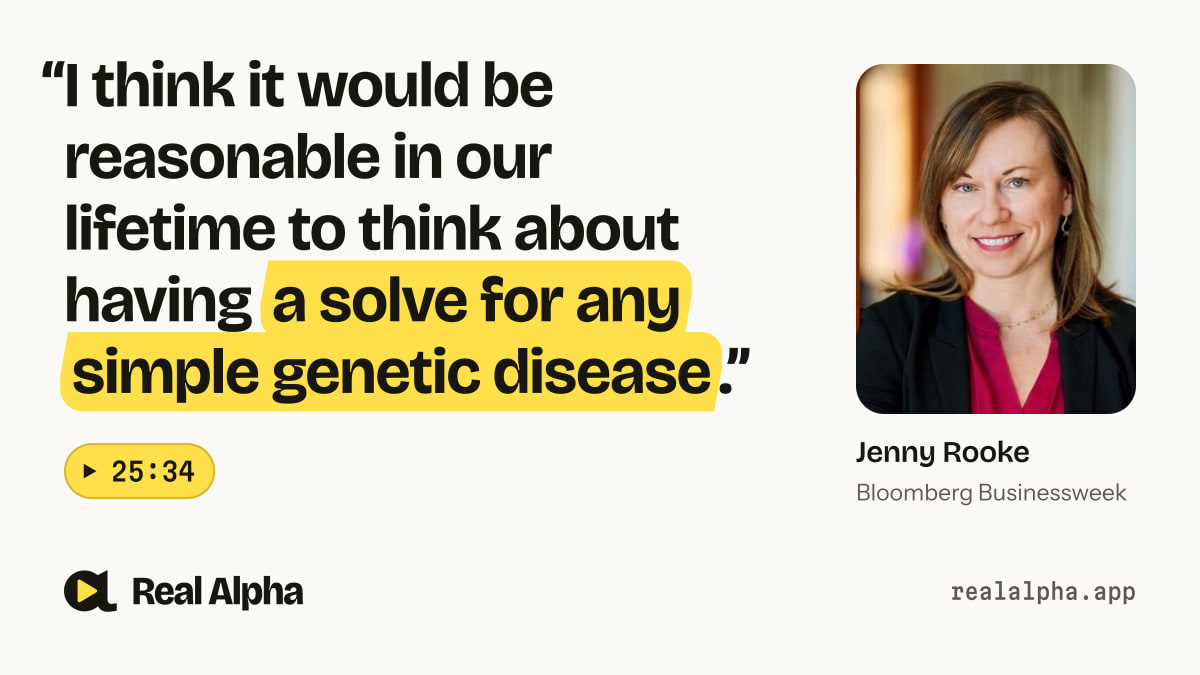
“I think it would be reasonable in our lifetime to think about having a solve for any simple genetic disease.”
 Jenny Rookeat 25:34 · Bloomberg Businessweek
Takeaways
- A baby’s single mutation was corrected in six months.
- Jenny sees a path to treating simple genetic diseases.
- Scaling the treatment is the next challenge.
About this segment
Jenny Rooke says fixing a single genetic mutation in a living patient has already been done, though it was expensive. She expects scaling and earlier treatment to be the next challenges.

Founder & Managing Director, Genoa Ventures
Founded Genoa Ventures and backed biotech innovators including Zymergen, Caribou Biosciences and Intabio.
- CM
Carol Massar, Host

Tim Stenovec, Host · Co-host, Bloomberg
Interviewed leaders including Reed Hastings, Stephen Schwarzman and Mary Barra as a Bloomberg Businessweek co-host.
From “AI Rally Sets Emerging Stocks Up for Best Streak Since September | Bloomberg Businessweek”, Nov 11, 2026. Watch the full episode
Thanks. We'll look at and fix what's off.
Transcript
From the transcript Bloomberg Businessweek publishes with the episode.
- 24:20
One thing that I always like to talk to you about and kind of end with is optimism about our own futures. When you look at life expectancy trends here in the United States, and generally over the last century, they've certainly gone up. They dipped in the pandemic. They've kind of gone back up again. Within our lifetimes, do you think we're going to see serious advancements when it comes to the treatment of cancers, heart disease? Or am I asking a question that we're already seeing serious advancements right now?
- 24:47
The good news is we're already seeing. We're already seeing, and it can be easy to- But.
- 24:51
We're also seeing more people get these things, and younger people get these things.
- 24:55
That can be true, and we have to watch out for why that is, but sometimes that's driven by better detection, and better detection leads to better treatment, certainly if it's earlier. So that is a really important part of Again, using different kinds of technologies, including AI, to get better insights out of patient data that, yes, may drive up our detection of diseases, but if it allows us to know what's going on sooner and what a patient might respond to better, that's going to, in general, lead to better outcomes.
- 25:25
What about when it comes to CRISPR and gene editing technology? Can we get rid of genetic diseases within our lifetimes?
- 25:33
It would be reasonable, making predictions like this, but I think it would be reasonable in our lifetime to think about having a solve for any simple genetic disease. A simple, let's say a single genetic mutation, the ability to go in and fix it. We've already seen that, right? In the last couple of years, the ability to, in a living human, a baby, to go in and fix a single mutation. Very expensive, but very fast. It happened in six months, which was astonishing. And so now it's just a question of scaling.
- 26:04
Do these things have to start at the beginning of life? Or can an adult have a genetic disease that shows itself in his or her 50s or 60s and that be fixed?
- 26:16
Eventually, I think we'll have that online. There's some challenges that arise once you talk about a more advanced organism and some things that have set in there. We need this to happen sooner. Which means more research and more funding.