The alpha, twice a week
That was 5 min.
Get the best new moments in your inbox every Wednesday and Saturday. It's free.
Check your inbox
We sent a link to your address. Click it to finish signing up. Not there in a minute? Look in spam.
or
Silicon Valley Girl · 5 min · Oct 1, 2026
Generate many ideas, then let the strongest ones stand out
 Brian Chesky
 shares a system for capturing ideas, bolding the promising ones and using AI to spot patterns.
The episode’s best minutes
Full analysis- 10:04Airbnb can give local service businesses a global audiencePro pick 7 min
- 20:04Generate many ideas, then let the strongest ones stand outPro pick 5 min
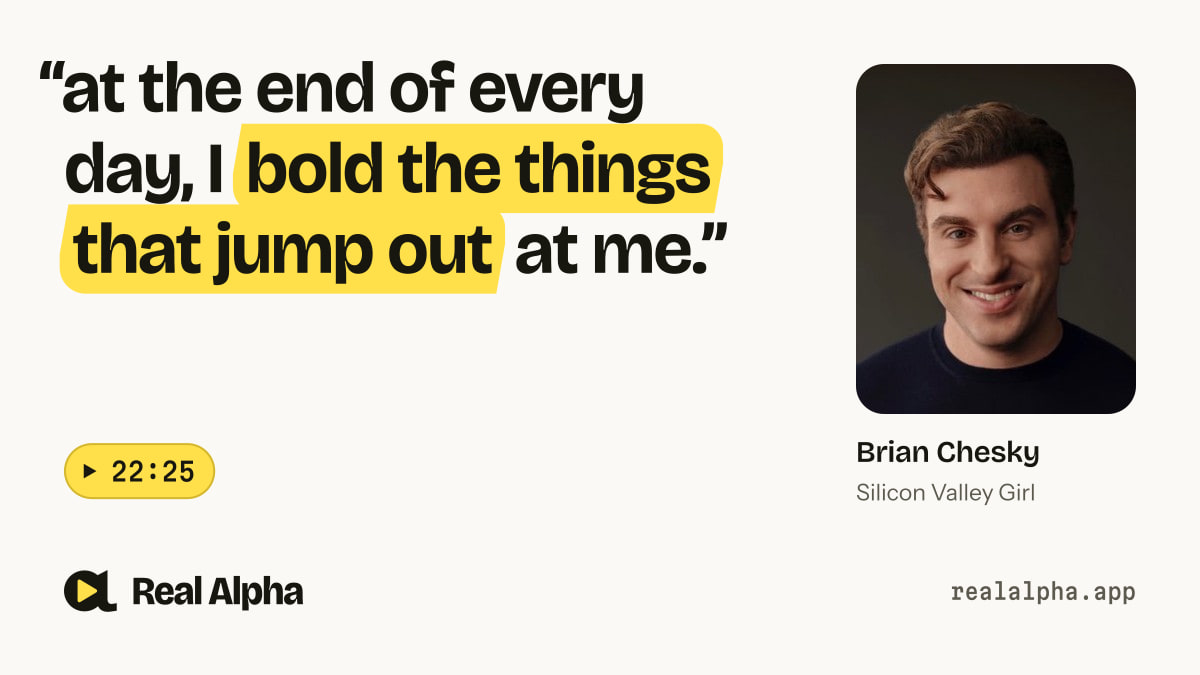
“at the end of every day, I bold the things that jump out at me.”
 Brian Cheskyat 22:25 · Silicon Valley Girl
Takeaways Pro pick
- Capture ideas freely before judging them.
- Review and bold the ideas that stand out.
- Good ideas often return and keep demanding attention.
One of Pro's picks, open to you here. Try Pro free for 7 days
One of Pro's picks. The rest of the summary and the 3 takeaways are in Real Alpha Pro; the video, the quote and the transcript stay free.
Read it with Pro, 7 days freeAbout this segment
Brian Chesky shares a system for capturing ideas, bolding the promising ones and using AI to spot patterns. The process makes room for weak ideas while helping the few persistent ones surface.

Brian Chesky is cofounder and CEO of Airbnb.
Built Airbnb from its first hosted stays into a global community with over five million hosts.

Marina Mogilko, Host · Host, Silicon Valley Girl
Co-founded LinguaTrip and built Linguamarina, an English-learning YouTube channel with almost 9M subscribers.
From “Brian Chesky: People Who Know What to Build With AI Will Pull Ahead”, Oct 1, 2026. Watch the full episode
Thanks. We'll look at and fix what's off.
Transcript
Transcribed by machine (Whisper) from the episode’s audio, so a word may be off here and there.
- 20:16
You were describing people who are at the edge of productivity and generating ideas and being curious. I think there was a saying by this Nobel Prize winning maybe chemist, Linus Pauling. He said, the best way to have a good idea is to have a lot of ideas. Like Airbnb seemed like a good idea, right? It was one of many ideas. We had a lot of bad ideas. I think it's about like sheer output. The best way to have a good idea is to have a lot of ideas.
- 20:29
The best way to create a good drawing is to create a lot of drawings. The best way to do anything is to create a lot of it, just throughout sheer output. I mean, you're really good now at what you've done. You probably did it through a lot of repetition, right? There wasn't one moment where you got good. Similar to exercise. You don't get in shape in one workout. It's through repetition. So what I found is that the very best people are the ones that just practice more than anyone else, and they put in the repetitions.
- 20:57
Working out is actually a good metaphor. It's repetition. And so idea repetition matters. You know, I know at IDEO, they're a very famous design firm. They used to do this exercise where the way you generate ideas, they give everyone post-it notes. And you have to write an idea down, put a post-it note on the wall, another idea on a wall. And they had a rule. You can never critique ideas initially.
- 21:23
No devil's advocates. No critiquing ideas. Because when you critique your ideas, you edit your thinking and you're afraid. And bad ideas sometimes are one step away from a good idea. And so I think it's all about volume of ideas. I probably, not exaggerating, have 100,000 ideas a year. And I think 99,000 are really bad. Out of all the ideas, how do you know which ones not to work on? It's more the good ideas jump off the page.
- 22:02
So for example, I basically have a notebook and every thought is like a sentence or a couple sentences. and I probably write maybe a thousand words a day. So that's probably 300,000 words a year. And maybe each line is a sentence. It was like 10 words. So maybe that's a hundred ideas a day. So that's maybe 30,000 ideas a year. And so then what I do is say I have 30,000 thoughts a year. 99% of them are not useful, right?
- 22:33
Just something, you write something down, anything that comes to your mind. I just keep writing it down. at the end of every day, I bold the things that jump out at me. And so if I wrote down like a hundred things, a hundred lines, I bolded five to 10. And then at each day I bold them at the end of every month, I look and my AI now can just read the bold ideas. I used to have to manually like pull out the ideas and read them. Now the AI can pull out the bolded ideas. The AI can also read and find ideas I thought were stupid and it can tell me really good ideas. It can see patterns and then those become my short list.
- 23:08
And then I iterate them, iterate them, iterate them. You know, I think like Catching the Rise 70,000 words and I probably have like four times that output in words and my writing is a thousand times worse. It's really bad writing. It's not high quality. I'm not writing, like if you were to read it, you'd be like, this is borderline nonsensical. It's understandable to me, not to someone else. And I think that's the point is that most of my words are bad.
- 23:33
Most of my ideas are bad. And it doesn't matter because no one knows about the bad ideas. They only need to know about the good ideas. And here's the lesson. Good ideas don't die. If you write something down, you write a good idea down, a month later, you're going to write the same idea down again. And you won't realize it comes back. So I find that good ideas, they don't want to die. They kind of stay alive.
- 23:54
And everything else just kind of falls by the wayside. And these good ideas, they kind of haunt you like ghosts. And you're like, okay, this thing's not going away. I don't know if that's useful. I never said this before, but I think it's about like just total output, just constantly. I remember hearing about Eminem. He would just write all day. He had a notebook and he'd write lyrics and rhymes all day. Bob Dylan was just writing songs all the time, just writing and writing and writing and writing.
- 24:24
Now, not everyone's like that. Jay-Z apparently doesn't do that. He just thinks in his own head. That's a very unique prodigious skill that he has. Leonardo da Vinci, he left behind so many notebooks. And he was just drawing and writing and drawing and writing. By the way, most of da Vinci did was write, not draw. If you look at his notebooks, it's 80% writing, 20% drawing. And he is the most famous painter of all time.
- 24:51
He had like 12 paintings ever. Mona Lisa is one of 12 or 15 paintings he ever painted. So think about the sheer volume of stuff he created.