The alpha, twice a week
That was 4 min.
Get the best new moments in your inbox every Wednesday and Saturday. It's free.
Check your inbox
We sent a link to your address. Click it to finish signing up. Not there in a minute? Look in spam.
or
Bloomberg Intelligence · 4 min · Oct 29, 2026
Google faces AI monetization and market-share problems
Matthew Bloxham says AI search changes how Google monetizes ads, while rivals threaten its share.
The episode’s best minutes
Full analysis- 1:31Google faces AI monetization and market-share problems4 min
- 11:16AI is pushing tech firms to consolidate around systems and supplyPro pick 3 min
- 15:42Caterpillar's AI boom brings long orders and later capacity risk3 min
- 3 more moments in the full episode
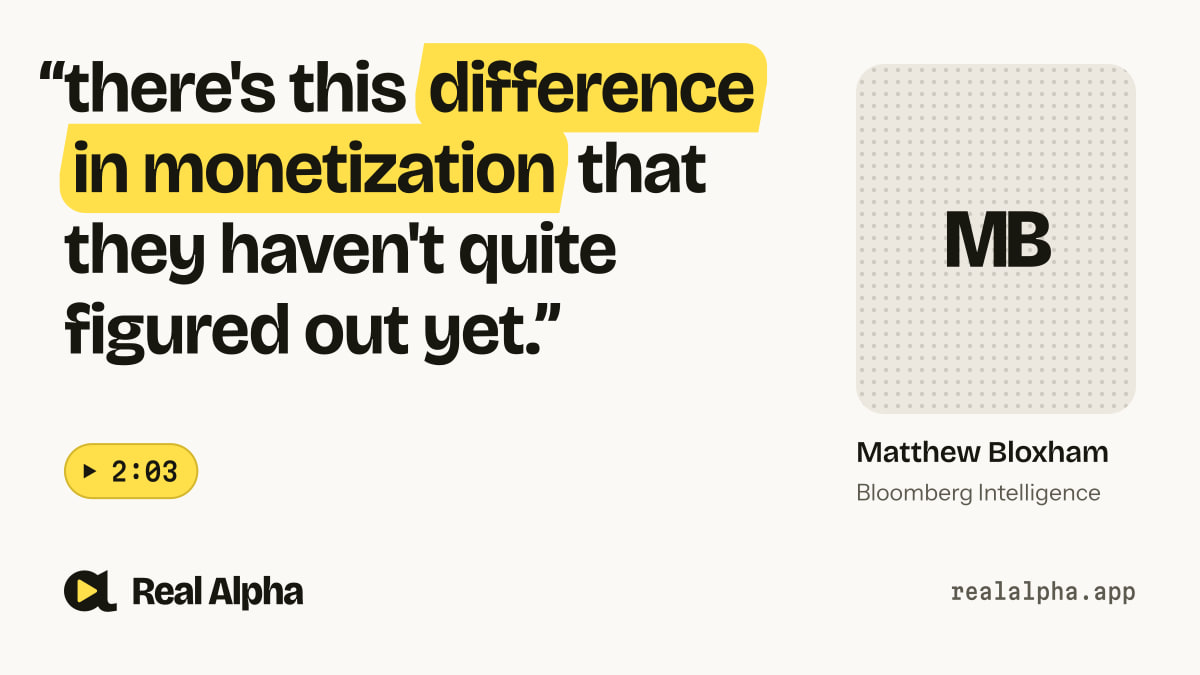
“there's this difference in monetization that they haven't quite figured out yet.”
Takeaways
- AI search shifts ad monetization beyond familiar click-through models.
- Gemini engagement is growing, but rivals pose a separate market-share risk.
- Cloud growth cannot yet offset weaker search profits and rising AI spending.
About this segment
Matthew Bloxham says AI search changes how Google monetizes ads, while rivals threaten its share. Gemini engagement offers promise, but cloud growth cannot yet offset pressure on search profits and heavy AI spending.
Senior Media & Tech Analyst, Bloomberg Intelligence
- PS
Paul Sweeney, Host · Bloomberg Intelligence
- SF
Scarlet Fu, Host · Bloomberg Intelligence
From “Google Erases a Record $500 Billion as AI Eats Into Sales | Bloomberg Intelligence”, Oct 29, 2026. Watch the full episode
Thanks. We'll look at and fix what's off.
Transcript
From the transcript Bloomberg Intelligence publishes with the episode.
- 1:34
thinking about what Alphabet told us? Do you get a sense that folks within that company as well are regarding this kind of as a turning point?
- 1:44
I think we've been in this kind of transition period for a couple of years with Google. As you've been talking about then, that there is this big change in how people are interacting with Google's products and potentially using different products. And so there are two things that they're grappling with here. One is that as people move from just regular Google search to AI mode, there's this difference in monetization that they haven't quite figured out yet. And we've seen that time and time again across Google and particularly with meta as new products have been introduced. Initially, the monetization isn't that strong and they have to figure it out. And brands and media partners have to figure out how they're going to spend money against that and make it work. So I think to some degree, that's
- 2:32
just going to take some time, but they will figure it out. And I guess what's reassuring, if you're a Google investor right now, is that Gemini has gone through a billion users. Engagement is going up. So hopefully it is a monetization opportunity. challenge that they can address. Obviously, the other big threat there is you've got the likes of Muse coming in from Meta, which is a rival to Gemini and another tool people might use rather than Google to search for things and to buy things. And so even if they figure out the monetization problem, you've got a market share problem. And so that, for me, is the kind of twin challenges that they've got and the slowdown in ad sales growth. It's still growing, but there was quite a big slowdown in this quarter is starting to make people feel a bit more that they're
- 3:21
not fully on top of that. And even though their cloud business is growing and grow arguably a little bit faster than expected, it's nowhere near enough to compensate for the kind of the profit slowdown at their core ads business. And at the same time, they're investing $ 200 billion in capital spending this year, potentially $ 300 billion next year. So the sums don't quite add up yet.
- 3:45
So Matthew, kind of at its core, most basic level, the advertising business for Google is clicks times cost per click, what they can charge an advertiser for me clicking on an ad. And simply put, I am clicking materially less often.
- 4:03
So now the question is, okay, how do you solve for that issue? Has the company identified any kind of strategy there?
- 4:11
Yeah, you know, I mean, the whole industry is moving away from search engine optimization to kind of engine optimization. And so both sides of the equation are trying to figure out the best way to kind of. Replicate that kind of monetization flow into a new environment. And, you know, we're not fully there yet. But certainly the industry is kind of on its way to kind of working that out. And also, you know, sponsored links has been a big, big part of it. So not only are they kind of getting revenue from click-through, they're getting revenue from people wanting to be at the top of that list. And again, that same concept applies in a a genitive engine optimization world, but the commercials of it are still a bit fluid.