The alpha, twice a week
That was 4 min.
Get the best new moments in your inbox every Wednesday and Saturday. It's free.
Check your inbox
We sent a link to your address. Click it to finish signing up. Not there in a minute? Look in spam.
or
The Information's TITV · 4 min · Oct 29, 2026
Google says data-center growth should bring new power
 Amanda Peterson Corio
 says Google has added 35 gigawatts of new generation and that aging infrastructure—not AI alone—is pushing power costs up.
In this episode
Full analysis- 59:42Compute demand is real, but financing new capacity is harder4 min
- 26:43Biology AI needs shared datasets, not just better models4 min
- 40:29Peak-hour flexibility can unlock power for data centersPro pick 4 min
- 1:08:02AI coding security needs rules before agents get tasks4 min
- 53:00Headline AI valuations can overstate what investors pay3 min
- 9:1323andMe's nonprofit model opens research to academics3 min
- 19:59Genetic chatbot results still need scientific curation3 min
- 46:04Google says data-center growth should bring new power4 min
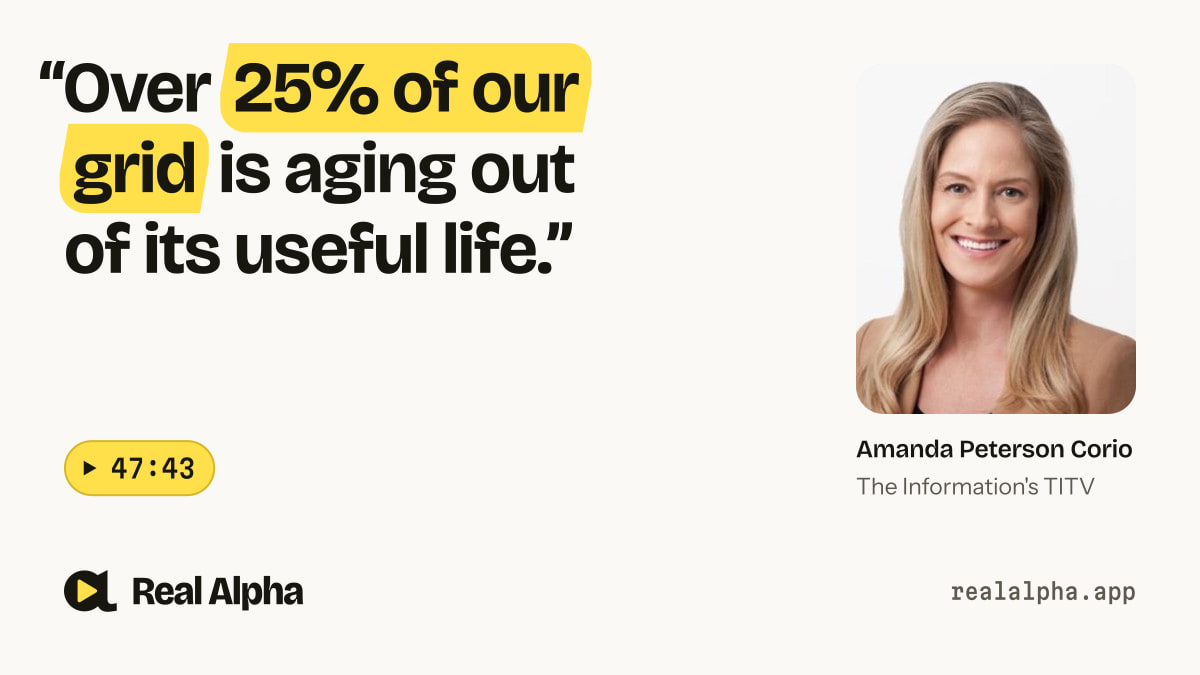
“Over 25% of our grid is aging out of its useful life.”
 Amanda Peterson Corioat 47:43 · The Information's TITV
Takeaways
- Google says it has added over 35 gigawatts of generation.
- Corio attributes some cost increases to aging grid infrastructure.
- Google says it engages communities early and avoids local-government NDAs.
About this segment
Amanda Peterson Corio says Google has added 35 gigawatts of new generation and that aging infrastructure—not AI alone—is pushing power costs up. She says transparent engagement with local communities helps address data-center opposition.

Global head of data center energy, Google
Leads Google’s energy team, securing power and developing infrastructure for its global data centers.

Akash Pasricha, Host · Host, TITV
Led The Information's Pro subscription and co-wrote its flagship newsletter, The Briefing.
From “The Information’s Women in Tech, Media and Finance Summit 2026”, Oct 29, 2026. Watch the full episode
Thanks. We'll look at and fix what's off.
Transcript
Transcribed by machine (Whisper) from the episode’s audio, so a word may be off here and there.
- 46:08
do to make sure that we don't see this huge spike in electricity prices by, you know, paying homes and businesses, for instance, to stop using power during peak times. But I think there very much is still this concern from consumers and just everyday people that they're going to see electricity prices spike as there's just so much demand on the grid. I mean, how do you kind of respond to those concerns? And how worried do people need to be that they might see their prices go up in the upcoming years? I think to be completely clear, first of all, Google always pays 100% of our energy bills for what we consume. Where we're working really hard is to make sure people know that we are committed to bringing our what we call bring our own generation. And what's really important is bring our own new generation. So it's not just contracting with the grid for power,
- 46:54
but ensuring that we're constantly adding new power to the grid, which will help the supply demand match and not increase power prices. We've brought over 35 gigawatts of new generation since operation. This is something that we have always done, but are committed to continuing to doing it so that affordability is first or foremost. And AI and the increase of AI should never be a question of putting costs on others. We should always pay for it. These are things like our models where we ensure we are committing to paying up front, paying our electricity the right way and bringing our own generation is the way that we're going to ensure power remains affordable.
- 47:34
But it's important to know that you are seeing energy costs go up independent of AI. And that's And that's because we have an aging infrastructure and grid. Over 25% of our grid is aging out of its useful life. And that infrastructure needs to be built up and more robust. Costs are higher. Inflation is a real thing. And so it's actually serendipitous that you're having all of these companies invest in the grid right at the time that it needs it.
- 48:10
I think to your point, though, there's a lot of misinformation or just lack of information out there about what is going on with these data centers. And I think a lot of people, if they see the prices going up, even if part of it is what you're saying, just the fact that the infrastructure is aging and it needs to be replaced or revamped in some way, they're going to kind of just associate that with the data centers.
- 48:32
And I think you yourself have said that data centers are becoming, you know, politically unpopular on both the left and the right. I mean, are you afraid at all that public opposition to data centers is going to become a bigger obstacle to them getting built than even technological limits? Public opposition is a real challenge. And what we have learned and what we know is you can read about things in the news, you can hear things, but you're...
- 49:00
own lived experience is going to override anything that you read and hear in the news. And so for us, it's really, really important that when we show up to local communities, that we get the facts straight, that we listen, that we answer questions, and that they really understand what they're getting and the investment they're getting when they get a Google data center in their town. Have there been cases where you maybe you want to build a data center in a town and it just doesn't happen because there's just so much pushback?
- 49:27
We continue to look at a lot of options. I think the more that we have come in earlier, we're committed not to having NDAs with local governments. And really, that's that transparency that starts the dialogue right away. And we found that once we do that and we start really answering questions, that people recognize that, hey, Google's committed to building this the right way, paying for their energy bills, not using water or replenishing water, committing to local jobs in our community.
- 49:58
People really turn the page and get excited about having us in their community. And, you know, at the beginning of the conversation, we talked a bit about how right now you're planning for the power needs, you know, two to three years from now.