The alpha, twice a week
That was 3 min.
Get the best new moments in your inbox every Wednesday and Saturday. It's free.
Check your inbox
We sent a link to your address. Click it to finish signing up. Not there in a minute? Look in spam.
or
Bloomberg Tech · 3 min · Nov 23, 2026
Government involvement leaves questions for the AI trade
 JoAnne Feeney
Joanne Feeney calls government influence in corporate decisions unusual and prefers private-sector judgment on governance.
In this episode
Full analysis- 22:11Nvidia’s leadership risk mattered more over time5 min
- 13:51Neocloud financing faces more pressure than hyperscaler spendingPro pick 3 min
- 18:03Inference workloads may need more than one kind of chip3 min
- 31:23Congressional and agency probes into Nvidia remain open3 min
- 28:18Government involvement leaves questions for the AI trade3 min
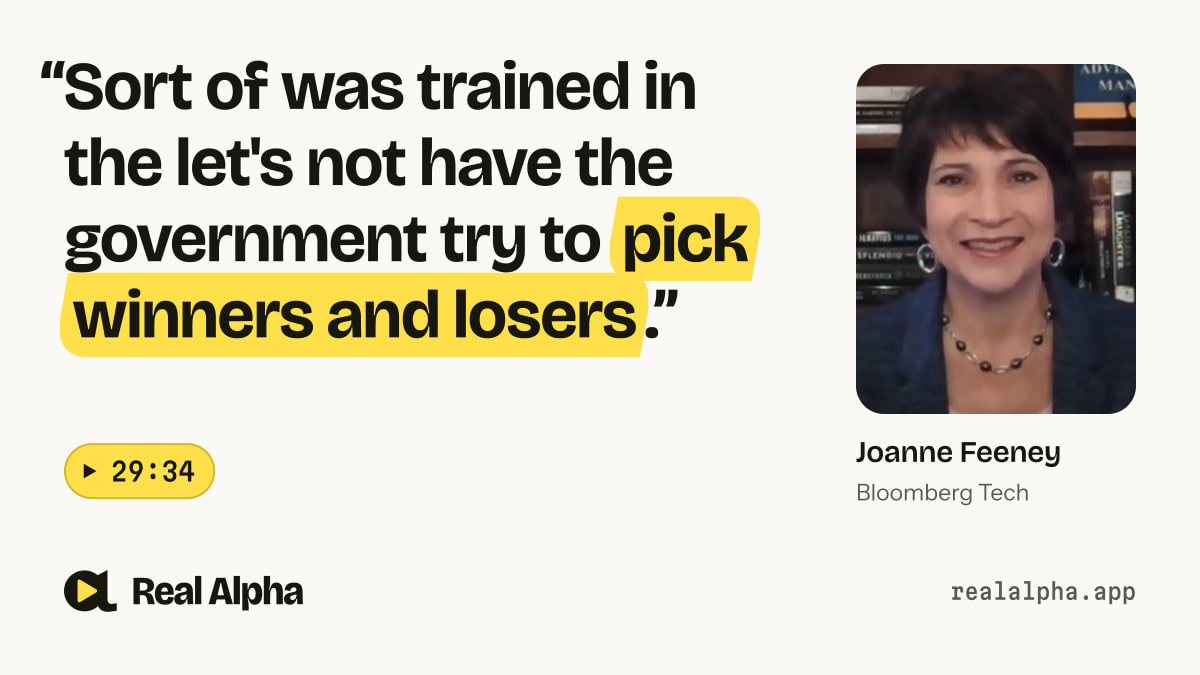
“Sort of was trained in the let's not have the government try to pick winners and losers.”
 Joanne Feeneyat 29:34 · Bloomberg Tech
Takeaways
- Feeney prefers corporate governance stay with people closest to the technology.
- Data-center build timelines and hyperscaler spending remain uncertain.
- Chip, memory and CPU supply could constrain growth despite strong demand.
About this segment
Joanne Feeney calls government influence in corporate decisions unusual and prefers private-sector judgment on governance. She also says data-center timelines and chip supply keep uncertainty in the AI trade.

Portfolio manager, Advisors Capital Management
Valued semiconductor and nanotechnology companies as an equity analyst, and now manages ACM's Growth and Balanced portfolios.

Ed Ludlow, Host · Host & correspondent, Bloomberg
Hosts Bloomberg Tech and reports on technology, supply chains, deals and finance for Bloomberg News.
From “Jensen Huang Returns to Nvidia, Reigniting the AI Trade | Bloomberg Tech”, Nov 23, 2026. Watch the full episode
Answers “Is there still a GPU shortage?” See all 95 answers
Thanks. We'll look at and fix what's off.
Transcript
From the transcript Bloomberg Tech publishes with the episode.
- 28:20
I want to go back to the President of the United States. He outlined in an interview with CNBC that he had made an intervention as recently as yesterday, phoning directly into NVIDIA's board. How unusual is that? It's a strange thing to say, but in your experience in financial markets and in this industry, the role that President Trump has played in different ways, but specifically advocating to NVIDIA's board for gentleman's return and giving reassurances that this does not present a national security risk.
- 28:54
How do you reflect on that? Well, this president has taken an unusual path towards the line between private and public sector activities. There's no question. This isn't the first personnel decision that he has attempted to influence. If you remember, he at one point threatened the Intel CEO. He threatened an employee at Goldman Sachs. So, you know, for him to weigh in is not totally unusual. We don't know whether such relationships between the private and the public sector will continue indefinitely or whether this is a one administration thing and then we'll go back to normal.
- 29:34
You know, as an economist, I. Sort of was trained in the let's not have the government try to pick winners and losers.
- 29:41
They're not generally as good at it as the private sector is. And so generally, I prefer the private sector to sort out these things. And corporate governance is one of those things that I think really belongs in the hand of the folks that know the technology and know the people the best.
- 30:00
The AI trade, is it back intact, JoAnne Feeney? I think there's still some real concerns, right?
- 30:07
We still have the question about how quickly will the data center build take place. And we are still going to be watching very carefully each quarter that goes by and whether those CapEx numbers are maintained by the hyperscalers and by other players. So I think the risk premium that's come into the AI trade sort of before the whole Jensen drama and now after the Jensen drama will be maintained.
- 30:31
We are still down from those early summer highs. And that reflects that uncertainty. And plus, of course, the election has created now more scrutiny on new data center builds.
- 30:41
And that will have to be factored into how quickly can capital be spent to build these new data centers, which then translates to purchases of chips and equipment and optical equipment and software, et cetera.
- 30:53
So it's gotten more complicated. And a slowdown wouldn't necessarily be such a bad thing. They can't keep up anyway.
- 30:59
The supply isn't there from the chip side, whether it's memories or CPUs or GPUs.
- 31:05
So I think that we still have plenty of growth. It looks to us like there's still plenty of growth ahead.
- 31:12
We continue to see NVIDIA, Broadcom, AMD as key players here and sharing in a growing pie.