The alpha, twice a week
That was 3 min.
Get the best new moments in your inbox every Wednesday and Saturday. It's free.
Check your inbox
We sent a link to your address. Click it to finish signing up. Not there in a minute? Look in spam.
or
Balance of Power · 3 min · Nov 11, 2026
Haley argues against negotiating with Iran
 Nikki Haley
 argues that negotiations have failed and says sanctions and targeted strikes on nuclear facilities should have come sooner.
The episode’s best minutes
Full analysis- 38:19Nvidia's reliance on Huang creates a key-person risk2 min
- 8:07Haley argues against negotiating with IranPro pick 3 min
- 17:23Haley says Republicans lost by failing to deliver for votersPro pick 3 min
- 3 more moments in the full episode
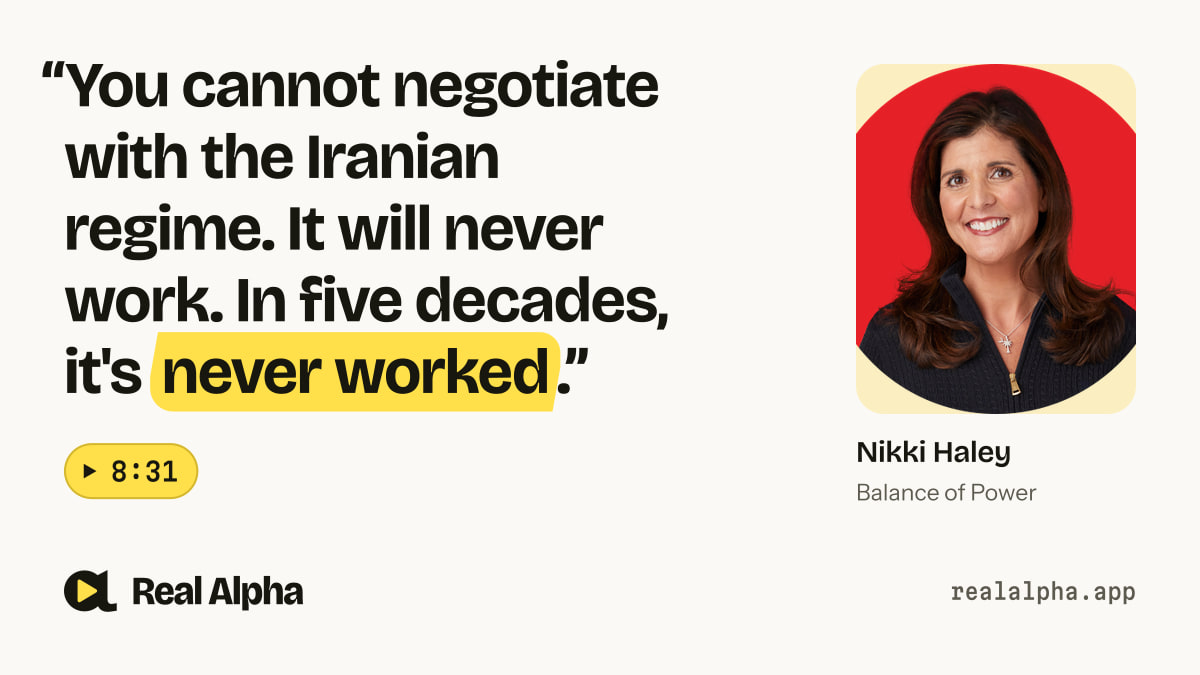
“You cannot negotiate with the Iranian regime. It will never work. In five decades, it's never worked.”
 Nikki Haleyat 8:31 · Balance of Power
Takeaways Pro pick
- Haley says negotiations with Iran have never worked.
- She calls for closing shadow-banking routes and economic pathways.
- She argues delay let Iran gain leverage in the Strait.
One of Pro's picks, open to you here. Try Pro free for 7 days
One of Pro's picks. The rest of the summary and the 3 takeaways are in Real Alpha Pro; the video, the quote and the transcript stay free.
Read it with Pro, 7 days freeAbout this segment
Nikki Haley argues that negotiations have failed and says sanctions and targeted strikes on nuclear facilities should have come sooner. She links delay to higher costs and Iran gaining leverage in the Strait of Hormuz.

Walter P. Stern chair, Hudson Institute
Negotiated over $1.3 billion in UN savings and sanctions on North Korea as U.S. ambassador.

Joe Mathieu, Host · Washington Correspondent, Bloomberg
Co-anchors Bloomberg’s Balance of Power and covers Washington; founded and hosted SiriusXM’s POTUS political news channel.

Kailey Leinz, Host · Washington Correspondent, Bloomberg
Co-anchors Bloomberg’s Balance of Power, interviewing presidential candidates, administration officials, lawmakers and regulators on policy.
From “Huang’s Trump Ties Face Scrutiny | Balance of Power”, Nov 11, 2026. Watch the full episode
Thanks. We'll look at and fix what's off.
Transcript
From the transcript Balance of Power publishes with the episode.
- 8:10
The problem in the process, and the reason this has cost Americans so much for so long, is because key decisions weren't made. A strategy wasn't followed. This should not take this long. If you look at the amount of time of strikes, it's actually very short. The amount of stalling, attempting to get a negotiation, is what's taken so long that's driven up the prices of gas. You cannot negotiate with the Iranian regime. It will never work. In five decades, it's never worked. You have to know— So you.
- 8:41
Would encourage the administration not to pursue— a negotiation here to make a different decision, to your point.
- 8:48
There is no negotiation that will ever work. We know that. It has never worked. You can't negotiate with a terrorist regime that says death to America. What they have done right is to, and they didn't do it soon enough, was to restrict all of the economic pathways for them to get more money to be able to fuel their ballistic missiles, to be able to fuel their nuclear production, and to be able to do more harm in the Strait of Hormuz. And so now that they've done that, they need to hold the line, and they need to look at what else do you need to do to totally take away any power that they have. This is not about regime change.
- 9:25
But this isn't dragging it out and just waiting. It's not okay that the U.S. is just sitting in the Strait holding it. We have to make sure. That the regime has no power. And the longer we wait, the more you're allowing the regime to rearm, resupply, reprepare.
- 9:43
For the next fight that they're going to have. This should have been done back in June of 2025 when we had the opportunity. We should have gone in. We should have taken care of it. We should have gotten out. This waiting and negotiating is a waste of time, and it's only going to prolong the situation. Further.
- 10:01
Well, this economic D-Day, as the administration called it, has no timeline, Ambassador. This could go on for months or years if that's the point. So how would you finish it? If we can put a finer point on that, what should have been done in June? Should we have been carpet bombing? How would you finish it now?
- 10:19
Well, do the economic sanctions at that time. Close off the shadow banking that was going through the UAE at that time. And make sure we go and disable any ability for them to have nuclear production. We know where it is. We know how they get it. We know what their fuel sources are. To be able to go in and surgically strike those so that they can't go back, that is what needed to happen. Instead of all of this back and forth when they don't even have a government.
- 10:48
When you're dealing with people in the regime where the IRGC is really the ones calling the shot, it is a waste of time. And even now to sit there. And say we can get a deal, we can't. We should have. Gone pickaxe mountain. We should have made sure that we finished the job. We had the ability to do it. And by doing that, they wouldn't have been able to get leverage at the Strait of Hormuz. They wouldn't have been able to gather this kind of leverage now economically that they have. And the American people wouldn't have suffered. Now, there is a way to fix this. There is a way forward. But it is to go back to a