The alpha, twice a week
That was 2 min.
Get the best new moments in your inbox every Wednesday and Saturday. It's free.
Check your inbox
We sent a link to your address. Click it to finish signing up. Not there in a minute? Look in spam.
or
Bloomberg Surveillance · 2 min · Nov 17, 2026
Hedge funds own more Treasuries than three foreign holders combined
Robin Wigglesworth says hedge funds own more of the Treasury market than China, Japan and Saudi Arabia combined.
In this episode
Full analysis- 25:23AI investment is shifting from cash flow to debt6 min
- 31:46Hidden AI commitments add to a chronic debt problemPro pick 2 min
- 37:05Aging homeowners are keeping housing supply tight4 min
- 5:00Anthropic plans to spend its IPO proceeds after a cash-flow push2 min
- 17:05Belski waits two quarters before investing in IPOs3 min
- 23:23Hedge funds own more Treasuries than three foreign holders combined2 min
- 10:06Haass says all three leaders arrive at the summit weakened3 min
- 13:31Aerial attacks are outpacing defenses in the Russia-Ukraine war2 min
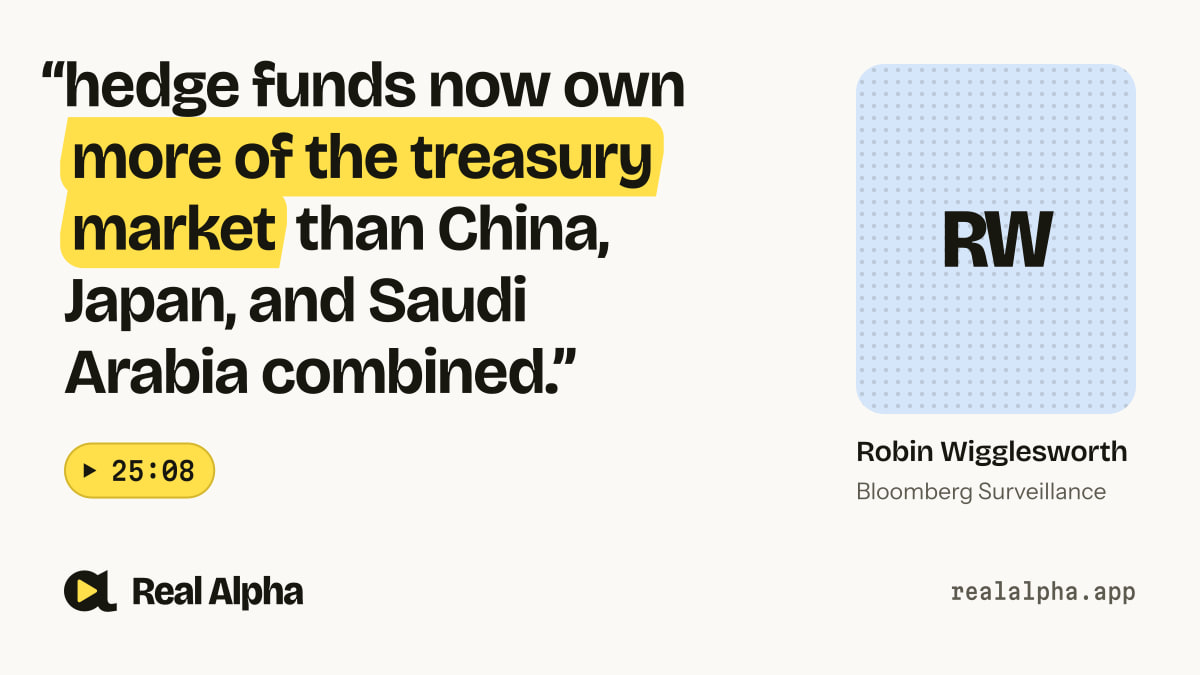
“hedge funds now own more of the treasury market than China, Japan, and Saudi Arabia combined.”
Takeaways
- Hedge-fund Treasury holdings exceed those of China, Japan and Saudi Arabia combined.
- Wigglesworth sees structural change in the Treasury market.
- He says fiscal excess could make the market more volatile.
About this segment
Robin Wigglesworth says hedge funds own more of the Treasury market than China, Japan and Saudi Arabia combined. Against US fiscal excess, that shift may make the market more volatile.
Columnist, The Financial Times
- TK
Tom Keene, Host
- PS
Paul Sweeney, Host
From “Nvidia Reports as Trump Heads to Asia | Bloomberg Surveillance”, Nov 17, 2026. Watch the full episode
Thanks. We'll look at and fix what's off.
Transcript
From the transcript Bloomberg Surveillance publishes with the episode.
- 23:25
enough about my book of the autumn as well. Why did you write this book? I mean, it's so thickly researched, almost in a Daniel Yergin way. What was the genesis of A Fabulous Debt?
- 23:38
Well, I think the Urgans of the Prize is a great model, really. I love books that tell a history of the world from a different perspective. And he used oil, for example. And for me, the bond market was my first love as a financial journalist. And as Cat Stevens said, the first cut is the deepest. So I always wanted to write a book on the history of the bond market because it's so much more vivid and fascinating and important than even people in the bond market often realize.
- 24:04
So this was my attempt at doing so. Barry Eichengreen was my book of the summer on financialization. It was about foreign exchange and all that. But the heart of your book and the shock dragging the bond market into the modern age is everything is financialized. Are we doing it again, Robin?
- 24:22
I think so. And look, financialization gets a bad name. It's one of the reasons why we're not living in caves anymore. We're not doing subsistence farming. Finance, to quote one of my other heroes, Willem Goetzmann at Yale, money changes everything. But there is always a danger that we take things too far. We humans, we take everything too far.
- 24:43
Are we doing that right now? Possibly. Toby's working a real job at the FT. But are we doing it right now?
- 24:51
Look, there are all sorts of things I worry about. Like the treasury market is a great example. The treasury market is the bedrock. It's really, the bond market is a bedrock to the world, but the treasury market is like the molten core of the entire financial planet. And I do worry about structural changes happening there, given the fiscal excesses in the US government. hedge funds now own more of the treasury market than China, Japan, and Saudi Arabia combined. And I think that just means, you know, I think financialization is a positive thing in the long run, but it can be a very volatile ride in the long run as well.