The alpha, twice a week
That was 3 min.
Get the best new moments in your inbox every Wednesday and Saturday. It's free.
Check your inbox
We sent a link to your address. Click it to finish signing up. Not there in a minute? Look in spam.
or
Prof G Markets · 3 min · May 20, 2026
Higher minimum wages could expand the customer base
 Jason Calacanis
 cites studies from other countries that found limited price increases after minimum-wage hikes.
The episode’s best minutes
Full analysis- 13:53Tax hikes can shrink the revenue base that funds services3 min
- 18:13Higher minimum wages could expand the customer basePro pick 3 min
- 3 more moments in the full episode
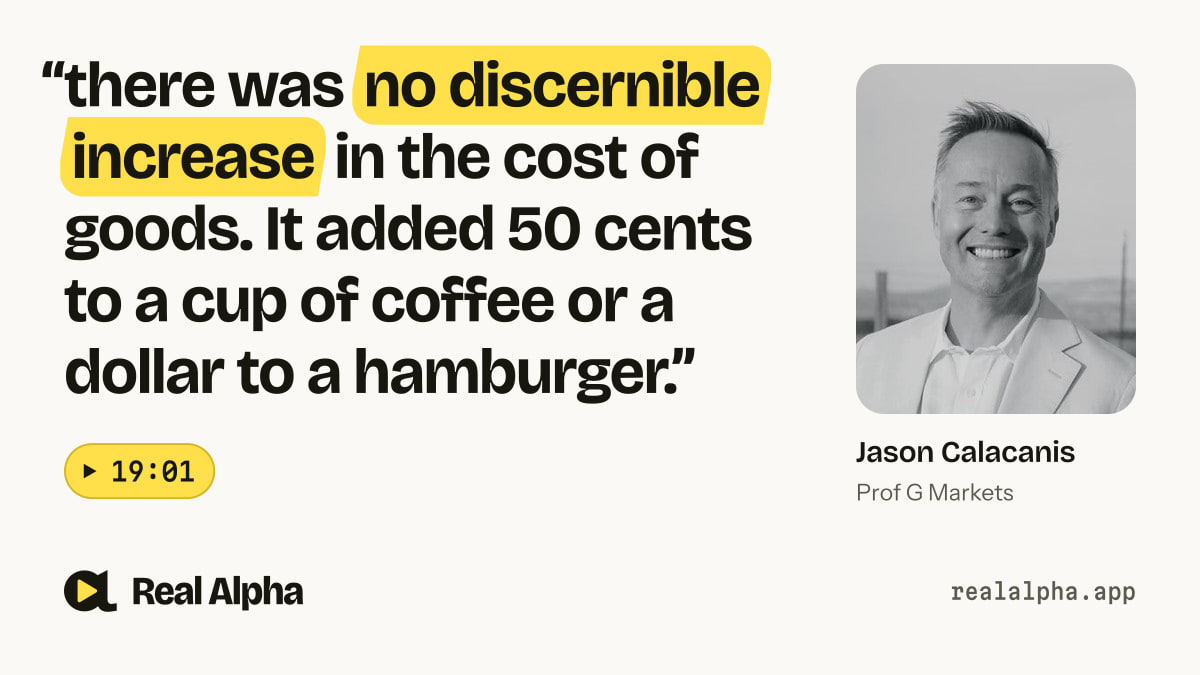
“there was no discernible increase in the cost of goods. It added 50 cents to a cup of coffee or a dollar to a hamburger.”
 Jason Calacanisat 19:01 · Prof G Markets
Takeaways Pro pick
- He cites international minimum wages of roughly $15 to $25 an hour.
- He says studies found little discernible price impact from increases.
- Higher wages could give more people money to spend at businesses.
One of Pro's picks, open to you here. Try Pro free for 7 days
One of Pro's picks. The rest of the summary and the 3 takeaways are in Real Alpha Pro; the video, the quote and the transcript stay free.
Read it with Pro, 7 days freeAbout this segment
Jason Calacanis cites studies from other countries that found limited price increases after minimum-wage hikes. He argues higher pay could boost consumer spending, while noting the comparisons aren’t perfect.

Host, All-In Podcast
Early Uber angel; sold Weblogs Inc. to AOL; hosts This Week in Startups.

Ed Elson, Host
From “Silicon Valley’s Case Against The Wealth Tax”, May 20, 2026. Watch the full episode
Thanks. We'll look at and fix what's off.
Transcript
Transcribed by machine (Whisper) from the episode’s audio, so a word may be off here and there.
- 18:25
I've been studying minimum wage. And, you know, I travel all over the world and in New Zealand, Australia, the Nordics, it's 15 to 20 bucks, you know, in US dollars as high as 20 to 25 dollars. I think Switzerland or Norway might be the leader right now in the low 20s. In America, it's still federally seven and in different locations, it's 15 to 18 dollars, you know, Portland, Seattle, San Francisco, New York, et cetera. We really should be looking at that because when they raised the rates in those other countries, there was a lot of hand-wringing that it would have a negative impact on employment and it would have a negative impact on the economy.
- 19:05
And what the studies showed in those markets, and they're not perfectly analogous, but they're worth studying and considering, and I'm not finalized in my thoughts on this, but it turned out there was no discernible increase in the cost of goods. It added 50 cents to a cup of coffee or a dollar to a hamburger. In other words, it was no big deal. You got rid of tipping because people had a livable wage.
- 19:28
And then what happened for the companies, because everybody did it in unison, they were forced to do it because of regulations, we had more customers who could afford to go to Starbucks and buy a $5 coffee or could afford to buy the next pair of Nikes. So you actually take the—if you were in the bottom half of society, if you may go under $100,000 a year, you're probably saving zero, except for mandatory savings like social security. You're saving zero. So you spend it all. So then you just make more consumers, which is good for the rich people. And you get the virtuous cycle going. And it's really like, if I say on all in, I'm for, you know, reassessing the minimum wage, all your libtard, whatever. I'm a moderate independent. Every time I bring this up, rich people have, you know, a very dogmatic
- 20:12
approach to this. Minimum wage has to be free market. It doesn't. It doesn't. It isn't right now. And so what would it kill society to try raising it $1 a year for five years to go from $7 to $12? I can tell you, none of these motherfuckers would last a week making $7 an hour or $15 an hour. because they'd be taking Uber Black and ordering DoorDash and spending $150 for their lunch and to commute.
- 20:39
So I think that's where we need to spend our cycles. Stay tuned for more of this panel right after the break.