The alpha, twice a week
That was 3 min.
Get the best new moments in your inbox every Wednesday and Saturday. It's free.
Check your inbox
We sent a link to your address. Click it to finish signing up. Not there in a minute? Look in spam.
or
Uncapped · 3 min · Nov 12, 2025
Home robots need user control over collected data
 Kyle Vogt
 says companies should make data collection transparent and let owners control how data is used.
In this episode
Full analysis- 0:32Language models are changing what robots can understand5 min
- 22:32A 100-person cap can preserve a startup’s output4 min
- 27:19Home robots should start with forgiving tasksPro pick 4 min
- 8:53Affordable robots can build a data flywheel3 min
- 12:05Humanoids make sense only when their flexibility pays off3 min
- 15:02Home robots need user control over collected data3 min
- 17:54Robotics companies still lack an internet-scale training corpus3 min
- 38:33Revenue during development can reduce reliance on capital markets2 min
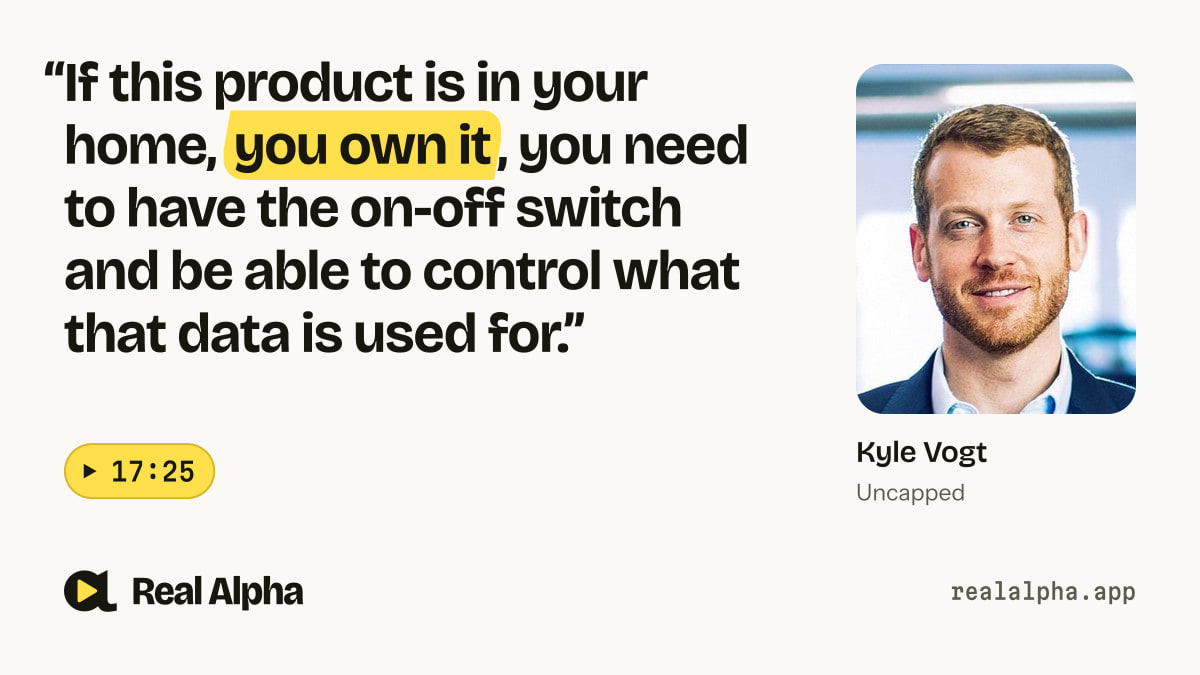
“If this product is in your home, you own it, you need to have the on-off switch and be able to control what that data is used for.”
 Kyle Vogtat 17:25 · Uncapped
Takeaways
- Show users what data is collected and where it goes.
- Give owners control over how their data is used.
- Trust and responsibility matter for devices in private spaces.
About this segment
Kyle Vogt says companies should make data collection transparent and let owners control how data is used. Those commitments can help establish trust in the home.

Kyle Vogt is CEO of the Bot Company.
Co-founded Cruise, a self-driving car company GM acquired, and now leads The Bot Company's household robots.

Jack Altman, Host · General partner, Benchmark
Co-founded Lattice and ran it until 2023, then started his fund, Alt Capital.
From “The Breakthrough For Home Robots with Kyle Vogt, CEO of the Bot Company | Ep. 32”, Nov 12, 2025. Watch the full episode
Thanks. We'll look at and fix what's off.
Transcript
Transcribed by machine (Whisper) from the episode’s audio, so a word may be off here and there.
- 15:07
Like, do you need to be like really involved with the government to like put these robots in a home or is part of what you're doing with the design like to avoid a lot of that stuff? Right now, you know, it's very different than some of the industries I've worked in or defense things or automotive things where they're very, very heavily regulated industries. And for good reason, I think you're going to see a lot of products in the home and it depends on your view. On one hand, we have these little robot vacuums going around today. You could make an argument that this is kind of just a step up from that, but you don't see for consumer products, a whole lot of targeted regulations for individual products. We have, you know, general product liability laws and other things that are generally applicable to everything's
- 15:40
from chainsaws to blenders or other things that you might have in your home that carry some risk associated with them. But I think there's an immense responsibility on the developers of these products to try to make them safe and to do everything possible following best practices, regardless of whether or not there's regulation. One thing that we may see more of is looking at how the data is used from these products, the security of these products. I think that's...
- 16:00
It's really important. Obviously, like the home is one of the most intimate spaces in your life. You know, there needs to be a great degree of trust and responsibility that goes with the companies who are, you know, have these machines that are likely covered with cameras, you know, running around our homes. And most of us don't even think about today, like when we buy a robot vacuum, where does it come from? Like, who is the company behind it? Are they trustworthy? Are they going to do the right thing in my home? And that's where I'd like to see a lot more scrutiny.
- 16:22
So what does that mean you're going to need to do? Because you're right. It's like, you know, I remember, you know, people got comfortable with it at some point, but like the Alexa problem where there's like a microphone in your home like now there's like a microphone and a camera and like whatever else in your home so like what what does that mean you need as like a company to sort of a be you know a trusted brand there like you have to go from day one pretty hard at that I guess yeah yeah you have to have some principles and opinions and be able to talk about it publicly I think but you know all these products are gonna every every new category of product like this goes through weird snafus in the early days I mean when you mentioned Alexa I was thinking to mind when when those first came out wasn't there something where there's like
- 16:55
a tv commercial that came on and said hey alexa something something and then like across the united states like thousands of people bought toilet paper you know and then recently with the meta meta glasses zuckerberg was on stage and he said something and all the people in the audience their device pinged the server at the same time and the demo failed you know so there's going to be these weird moments and things that um that come along in the early days that um but anyways on on the uh on the data side for us we have like two things we care about one is transparency so if if there's data being collected in your home, like what was it?
- 17:25
I want to be able to know what that data was and what's going from the robot to anywhere else. And the second is control. If this product is in your home, you own it, you need to have the on-off switch and be able to control what that data is used for. And I think if you have those two things and you are principled about those things and hold true to them and basically fulfill your promises and you give the control to the user, I think that's the best sort of starting position