The alpha, twice a week
That was 4 min.
Get the best new moments in your inbox every Wednesday and Saturday. It's free.
Check your inbox
We sent a link to your address. Click it to finish signing up. Not there in a minute? Look in spam.
or
TRIGGERnometry · 4 min · Nov 14, 2026
How Brandon Tatum says his choices strained a $49,000 police salary
 Brandon Tatum
 recalls earning $49,000 as a cop while choosing housing, car and spending costs that left him paycheck to paycheck.
In this episode
Full analysis- 11:00Why Brandon Tatum is unsure Trump will avoid a nuclear strikePro pick 8 min
- 1:11:38Why Brandon Tatum says the trial evidence points to Tyler RobinsonPro pick 4 min
- 2:33Why Brandon Tatum thinks online division overstates Republican fractures4 min
- 1:17:58What Brandon Tatum says Candace Owens told him about Erica Kirk5 min
- 30:04How Brandon Tatum says his choices strained a $49,000 police salary4 min
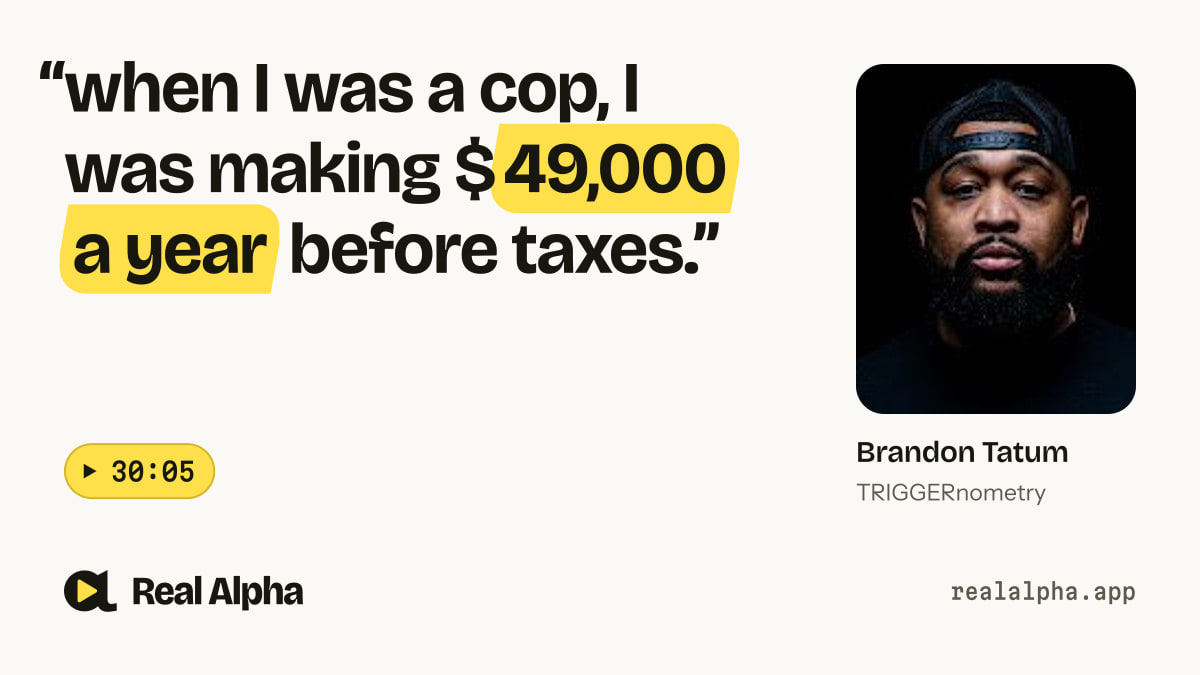
“when I was a cop, I was making $49,000 a year before taxes.”
 Brandon Tatumat 30:05 · TRIGGERnometry
Takeaways
- Tatum says he earned $49,000 a year before taxes as a cop.
- He recalls choosing a $400 car payment and living alone.
- He says those choices contributed to living paycheck to paycheck.
About this segment
Brandon Tatum recalls earning $49,000 as a cop while choosing housing, car and spending costs that left him paycheck to paycheck. He uses the experience to argue that individual decisions matter.

Brandon Tatum is a former police officer and business owner.
Built The Officer Tatum into a conservative media platform reaching millions through its daily show and digital channels.

Konstantin Kisin, Host

Francis Foster, Host
From “Will Trump Nuke Iran? - Brandon Tatum”, Nov 14, 2026. Watch the full episode
Thanks. We'll look at and fix what's off.
Transcript
Transcribed by machine (Whisper) from the episode’s audio, so a word may be off here and there.
- 30:08
I don't know because when I was a cop, I was making $49,000 a year before taxes. And I lived a decent life. I was check to check, but there were decisions that I made that put me in that position. I had a house that I purchased. I was blessed enough to not have to put a down payment because it was in a rural area, and the USDA was giving out loans in unincorporated areas, so I didn't have to put any money down. They kind of rolled a little fractional fee into a 30-year mortgage. I had two bedrooms in the house. I could have had a roommate, and that would have split my rent by 50%. I didn't want a roommate. I wanted to have my own house, and I wanted to do everything on my own. I didn't want to deal with anybody else, So I paid the full amount. I was negligent enough to purchase a car.
- 30:56
I had bad credit and I was over. on a vehicle. I turned it in, what we call upside down, which means I owe more on the car than what the car was worth to the bank. So when I purchased a new car, they roll extra money into the new car or whatever. And so now I'm over leveraged and now my car payment is $400 a month. I still bought the bike I wanted. I still traveled, you know, to places that I didn't have to do. I had all the internet and everything. I stayed in the nicest apartment that I wanted to live at.
- 31:31
I mean, you know, I bought the house. Well, then I moved to the house. I stayed in a nice house. I could have stayed in a house that was cheaper. So a lot of those decisions that led me to end up being check to check was all decisions that I made. No sacrifice. I could have lived with somebody. I could have not had the new car. I could have had a used car. I could have stayed closer to my workplace.
- 31:53
I mean, there's a lot of things that I think people could be doing that they're not doing, and they're getting into debt. I go to Disneyland, packed with people. The economy is, people are struggling. They're saying the eggs are too much. Disneyland is packed with people. Why are people doing all this discretionary income, or using their discretionary income to have fun? But I thought the economy was bad.
- 32:15
You go to the airport. There's no shortage of people flying everywhere. And I know they're not flying for business. Not most of them. People, they're spending their money in ways that are illegitimate. And a lot of people, including myself when I was younger, are very short sighted when it comes to money. I want it now. I want to spend it now. I want the best now. I don't care about my electric bill. I do all the spending when I should have been saving and investing into the stock market and doing things like that, which would give me leverage over time.
- 32:46
Now, people just want it now. If I now I had a scholarship to go to the university, I didn't have to pay for it. some people that don't have a scholarship why are you going to get a hundred thousand dollars in a debt to go to a university when you're getting a degree that you're not going to ever use you could probably go and you can leverage debt to start a company or even if you didn't want to start a company you can leverage debt to do other things that can help you financially versus squandering your money that is a very um i could say amateur version the way to look at it but that's the way I see it. Now, somebody who's an economist can see it at a, at a bigger scale.
- 33:24
I just think people need to make better decisions with their money. Um, I, I own a couple of businesses. I sell products. People are still buying it. There's still, there's no, there's