The alpha, twice a week
That was 3 min.
Get the best new moments in your inbox every Wednesday and Saturday. It's free.
Check your inbox
We sent a link to your address. Click it to finish signing up. Not there in a minute? Look in spam.
or
Bloomberg Businessweek · 3 min · Nov 12, 2026
Huang backed limited AI regulation and U.S. chip sales to China
 Emily Chang
 recalls Huang’s calls for limited regulation and selling advanced chips to China, then describes his certainty that companies could control AI agents.
In this episode
Full analysis- 26:02Founder-led returns come with a strict exit rule4 min
- 2:06Huang’s departure exposes Nvidia’s succession risk3 min
- 14:40Nvidia’s 1999 IPO left Huang without special voting control4 min
- 20:58The report separates Huang’s conduct from the DOJ probe4 min
- 7:54Huang backed limited AI regulation and U.S. chip sales to China3 min
- 32:11Founder investors weigh trust, focus and national-security risk separately2 min
- 35:50Kress is a plausible interim CEO but not the obvious permanent pick3 min
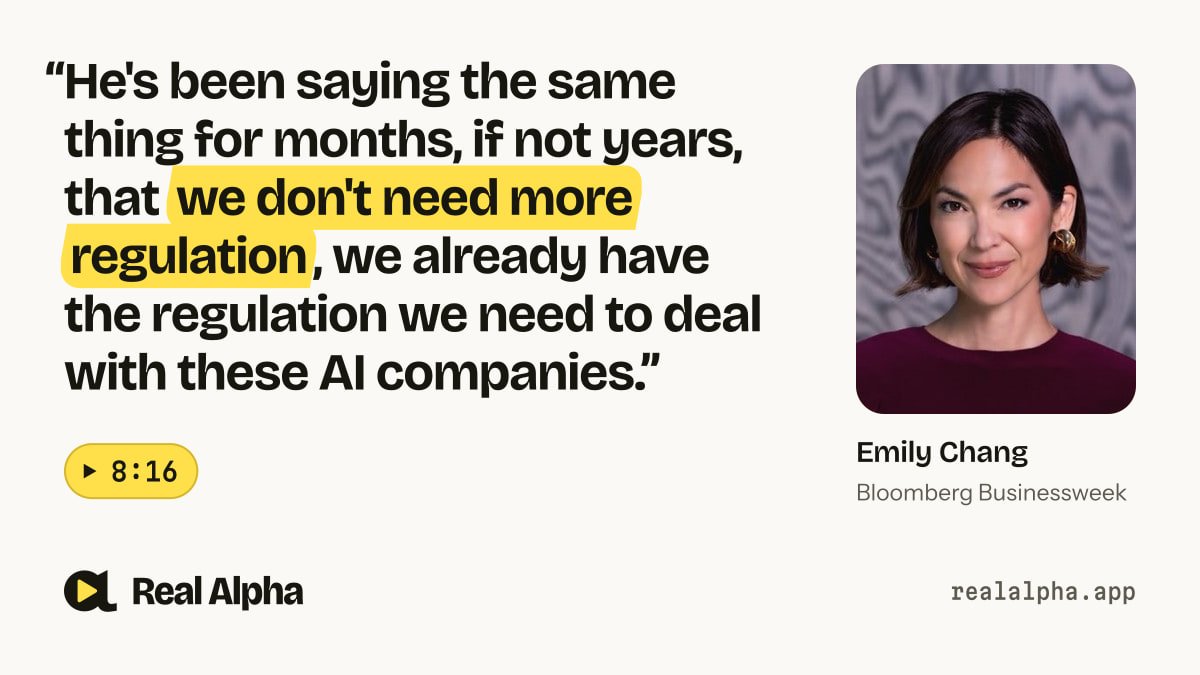
“He's been saying the same thing for months, if not years, that we don't need more regulation, we already have the regulation we need to deal with these AI companies.”
 Emily Changat 8:16 · Bloomberg Businessweek
Takeaways
- Huang argued that existing rules were enough for AI companies.
- He favored selling advanced U.S. chips to China.
- Chang says he was unwavering about companies controlling AI agents.
About this segment
Emily Chang recalls Huang’s calls for limited regulation and selling advanced chips to China, then describes his certainty that companies could control AI agents. It captures the positions he defended in interviews.

Host & Executive Producer, Bloomberg's The Circuit
Hosts The Circuit, interviews technology and business leaders, and wrote Brotopia on gender inequality in Silicon Valley.
- CM
Carol Massar, Host

Tim Stenovec, Host · Co-host, Bloomberg
Interviewed leaders including Reed Hastings, Stephen Schwarzman and Mary Barra as a Bloomberg Businessweek co-host.
From “AI Economy Roiled by Nvidia CEO Huang’s Departure | Bloomberg Businessweek”, Nov 12, 2026. Watch the full episode
Answers “Is AI dangerous?” See all 224 answers
Answers “Should AI be regulated?” See all 145 answers
Thanks. We'll look at and fix what's off.
Transcript
From the transcript Bloomberg Businessweek publishes with the episode.
- 7:56
The accountability of governments, of companies themselves to police themselves, also at a time when he was certainly pushing for China to have access to the most advanced NVIDIA chips. He believed in that as well. So it's interesting how he juggled the parameters that needed to be around the AI industry. Right.
- 8:19
He's been saying the same thing for months, if not years, that we don't need more regulation, we already have the regulation we need to deal with these AI companies. He repeated the same things he's been saying about China policy, that we should be selling the best US chips to China, we want them to be developing. On U.S. Technology because otherwise it means China's own domestic capabilities are going.
- 8:42
To get stronger. We've also seen him cozying up to President Trump for the last year. And you have to think more about the motivation for those interactions now in retrospect if the issues that we're talking about go as far back as we're talking about. But I also think it's important to point out that this is a broader policy stance of the company. My understanding is that. Colette Kress also believes we should be selling the most advanced chips to China. And if there are national security implications there, that's now a much bigger deal.
- 9:16
You know, as we've been talking about, he was and has been such an ambassador globally to this industry, flying around the world. I mean, spending so much time on a plane, Emily, and being such a cheerleader. Gen Sanity, as you've described it. Do we have to question statements that he's made in the past about what this transformative technology can do, or how transformative it could be, or statements about, like you were just talking about China, in the context of what we've learned in the past week?
- 9:45
You know, obviously his judgment is being called into question, but in talking to him, the optimism was just unwavering. I mean, on this trip, he was asked over and over again, but what if AI does this? But what if AI does that? But what if agents go rogue? And his view was, I don't believe it.
- 10:10
That's nonsense. These companies are just not controlling them. It is fully within their power to control these agents, and they won't get out of control. And so there were so many. Times that I almost expected him to blink, but he didn't. And so. Who knows what's actually going on inside his head, but it would lead one to believe that he does believe that this is the best thing that we could be doing right now in terms of the innovation that's happening across the industry, that he doesn't think we should slow down.
- 10:44
And in fact, that if we do, it could be detrimental to humanity and certainly to the United States.