The alpha, twice a week
That was 3 min.
Get the best new moments in your inbox every Wednesday and Saturday. It's free.
Check your inbox
We sent a link to your address. Click it to finish signing up. Not there in a minute? Look in spam.
or
Prof G Markets · 3 min · Nov 17, 2026
Huang’s structure left little room for internal challenge
 Ed Elson
 cites a study linking limited subordinate pushback to CEOs overrating their judgment and doubling down.
In this episode
Full analysis- 18:40Nvidia's next CEO must sustain its moat and funding rolePro pick 6 min
- 25:00AI infrastructure needs financial discipline to keep growingPro pick 2 min
- 29:30Export-control probes are Nvidia’s biggest near-term risk3 min
- 36:47Huang’s structure left little room for internal challenge3 min
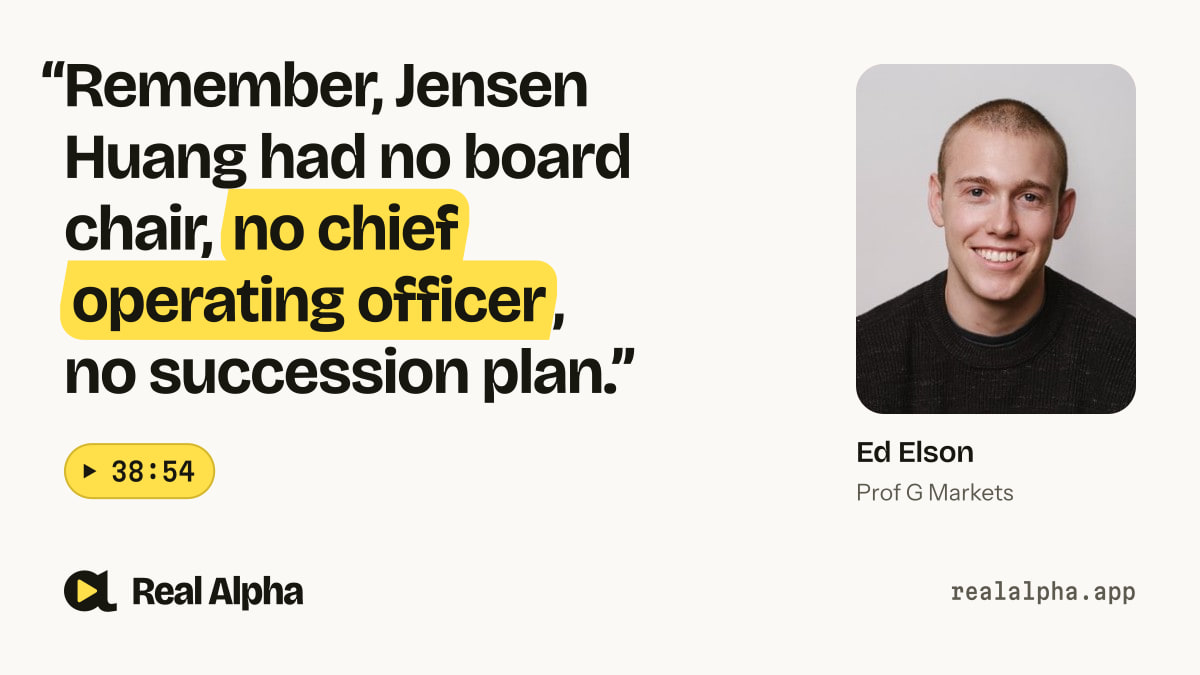
“Remember, Jensen Huang had no board chair, no chief operating officer, no succession plan.”
 Ed Elsonat 38:54 · Prof G Markets
Takeaways
- Ed says Huang had 60 direct reports and no COO or succession plan.
- The study linked less pushback with leaders doubling down on mistakes.
- Ed argues that weak internal challenge creates a governance risk for shareholders.
About this segment
Ed Elson cites a study linking limited subordinate pushback to CEOs overrating their judgment and doubling down. He applies it to Nvidia’s 60 direct reports and missing COO, board chair and succession plan.

Ed Elson, Host
From “Could Jensen Huang Actually Return To Nvidia?”, Nov 17, 2026. Watch the full episode
Thanks. We'll look at and fix what's off.
Transcript
Transcribed by machine (Whisper) from the episode’s audio, so a word may be off here and there.
- 36:51
So, did Jensen know or didn't he know? That is the question. Because if he did, well, then he might actually go to prison. Violating U.S. export law is an offense punishable by up to 20 years. And I know no guilt has been proven in a court of law. But all I'm saying is, if it is, well, those are the stakes. But if he didn't know, well, then shareholders have a different problem. Because then they must ask the following question, which is, how didn't he know?
- 37:21
You're telling me he struck up a relationship with a former TV reporter for Chinese state media who mysteriously became the CEO of a Singaporean shell company turned compute provider and then showed up one day with billions of dollars to buy his chips for her offices, which turned out to be empty. And he never thought that there was a problem at any point in this process. If that isn't ignorance, well, then it would demonstrate what I think many would call unfathomably bad judgment.
- 37:51
So, no, in my view, he should not be CEO. On that note, though, there is an interesting question. And that is, how could a man who was paid billions of dollars to make good decisions make so many bad decisions so many times? What happened in Jensen Huang's head that made him think, yeah, this is all fine? That is a genuine question. Well, the answer, I believe, lies in a 2011 study from the University of Michigan that is known as the Icarus Paradox.
- 38:24
In this study, they looked at nearly 600 CEOs along with their employees. and they measured how much pushback these executives received from their subordinates. And they found that the less pushback a CEO received, the higher they rated their own judgment and, more importantly, the less likely they were to change course when they made the wrong decision. Put another way, they didn't just make mistakes, they doubled down on their mistakes.
- 38:51
That was the price of excessive flattery. And it explains pretty much everything about the downfall of Jensen Huang. Remember, Jensen Huang had no board chair, no chief operating officer, no succession plan. Instead, he employed 60 direct reports in a culture that his own biographer described as having, quote, little tolerance for disagreement. The entire company was built around him, or more specifically, around agreeing with him.
- 39:20
These levels of obsequence might feel good, but they also screw with your head. They make you think that you're flawless, that you could never put a foot wrong, which, of course, increases the likelihood that you will. And I know that because a Michigan study empirically proved it. As the name of the study implies, Jensen Huang flew too close to the sun. The parallels to the myth of Icarus are plain to see.
- 39:45
The only difference, however, is who got burned. Because every S&P 500 holder owns NVIDIA, which means we all hold NVIDIA. So it's not just Jensen this time. It's the rest of us as well.