The alpha, twice a week
That was 5 min.
Get the best new moments in your inbox every Wednesday and Saturday. It's free.
Check your inbox
We sent a link to your address. Click it to finish signing up. Not there in a minute? Look in spam.
or
Bloomberg Law · 5 min · Oct 30, 2026
Immigration detention exposes a split over bond hearings
 Leon Fresco
 explains why most appeals courts require bond hearings for some immigrants detained after crossing the border, while two circuits do not.
The episode’s best minutes
Full analysis- 4:24Collusive settlements can bypass the normal rulemaking processPro pick 5 min
- 15:16Immigration detention exposes a split over bond hearingsPro pick 5 min
- 28:22An edited clip can turn political rhetoric into a factual claimPro pick 3 min
- 3 more moments in the full episode
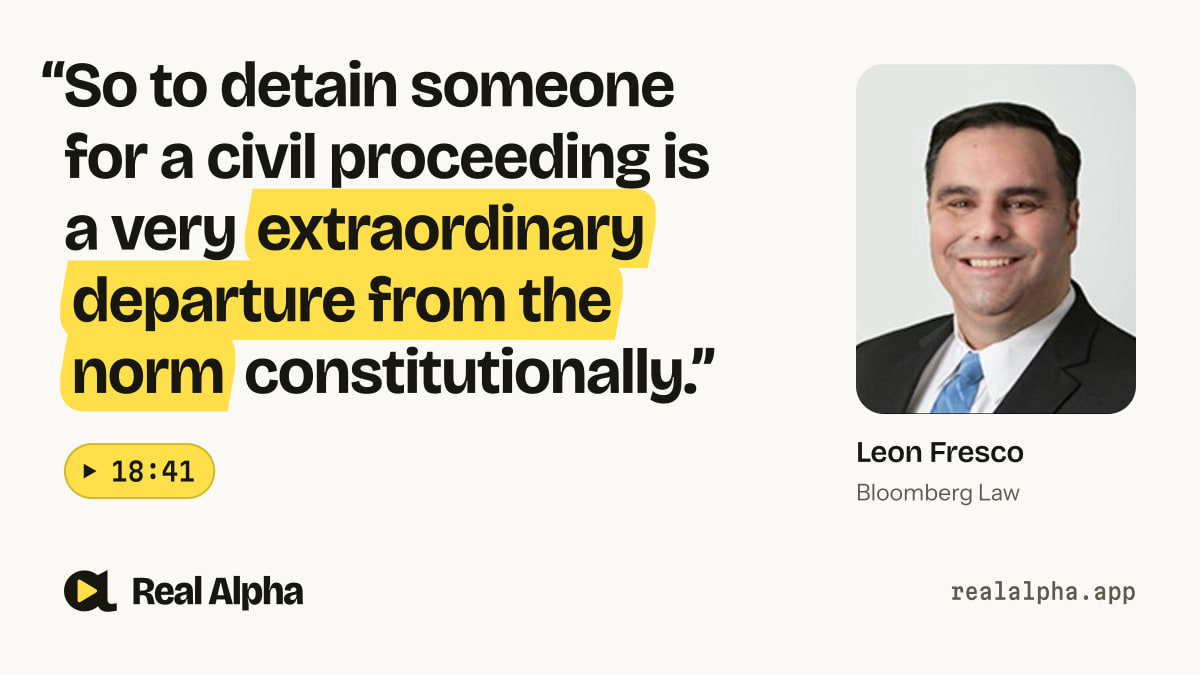
“So to detain someone for a civil proceeding is a very extraordinary departure from the norm constitutionally.”
 Leon Frescoat 18:41 · Bloomberg Law
Takeaways Pro pick
- Nine circuits say some detained immigrants can seek bond hearings.
- Two circuits say they remain applicants for admission.
- A statutory ruling could determine whether a constitutional question follows.
One of Pro's picks, open to you here. Try Pro free for 7 days
One of Pro's picks. The rest of the summary and the 3 takeaways are in Real Alpha Pro; the video, the quote and the transcript stay free.
Read it with Pro, 7 days freeAbout this segment
Leon Fresco explains why most appeals courts require bond hearings for some immigrants detained after crossing the border, while two circuits do not. The disagreement may force the Supreme Court to weigh statutory and constitutional rights.

Partner, Holland & Knight
Drafted the Senate’s 2013 immigration reform bill and oversaw federal civil immigration litigation at DOJ.
- JG
June Grasso, Host
From “SCOTUS Gives Trump Another Win & Hasan Piker Sues Scott Jennings for Defamation | Bloomberg Law”, Oct 30, 2026. Watch the full episode
Thanks. We'll look at and fix what's off.
Transcript
From the transcript Bloomberg Law publishes with the episode.
- 15:19
I bet the wall is going up there. So speaking of due process, we had the full Fifth Circuit rule that this policy of mandatory detention for non-citizens... is okay. I mean, are they basically saying that non-citizens aren't entitled to constitutional due process?
- 15:38
Well, so there's two parts of this case. So the issue is a specific subset of foreign nationals. Who are they? They are people who illegally crossed the border, not people who came in on a visa and overstayed, but people who illegally crossed the border. So no federal government official was ever involved with how they got to America. So the question is, once the federal government catches one of these people and puts them into deportation proceedings, are they entitled to a bond hearing or not? And what nine of the 11 appellate courts have said is, Yes, they are, so long as they're not caught immediately there at the border.
- 16:18
If they made their way into the country and you catch them later, they're entitled to a bond hearing because they're not at the moment trying to get into the country when you catch them. There are two circuits, the Fifth Circuit is one of them, who said that on the statutory argument, and the Eighth Circuits is the other one, that no, whenever you catch these people, they're not entitled to a bond hearing because these people are, quote unquote, still seeking admission to the country because the very nature of fighting your deportation case means you're trying to seek admission.
- 16:54
So you're always, even if it's 20 years later, like the person who's trying to cross the border at that moment. So the other nine courts said seeking admission meant right now, that minute, trying to get into the country. And the two courts said, no, no, no, that means ever trying to get into the country, not just at that first minute you're actually physically trying to enter, but it's if you're ever trying to remain in America, you're seeking that ultimate ability to win your admission into America, it goes on forever. So that's the statutory argument. That claim is going to the Supreme Court right now. But here's what happened.
- 17:34
The people in Ninth Circuit are okay. They get bond hearings. But if you live still in Texas, Louisiana, Mississippi, or in the Eighth Circuits, Minnesota, et cetera, in those areas, you can't get a bond hearing. So what did those people start doing? They said, fine, if I don't have a statutory right to bond, I should still be able to file a habeas petition against in a federal court saying that I have a constitutional right to bond because you can't just keep me in detention for God knows how many months without giving me a bond hearing when even criminals get bond hearing. The whole point of immigration is that it's a civil hearing. It's not a criminal hearing.
- 18:18
This is something that the government uses to their advantage because they say it's a civil hearing, so you don't have a right to an attorney. You don't have a right to a jury. It's an expedited process, etc. You don't have any of the constitutional criminal rights. But the flip side is the reason the government can detain you without bond in a criminal proceeding is because it's criminal and you have all of these other protections. So to detain someone for a civil proceeding is a very extraordinary departure from the norm constitutionally. You're not really supposed to detain people when they're in civil proceedings. So that's what these people say. They say, I have a constitutional right to a bond hearing because you're keeping me detained for months and months and months and months, and I'm not
- 19:05
getting a bond hearing to show that I'm not dangerous and I'm not a flight risk. If I'm dangerous or a flight risk, just deny me bond. but give me a hearing. That's what they're saying. And the 10-7 decision of the Fifth Circuit said, absolutely not. There is no constitutional right, no matter how long we hold you to a bond hearing, because in the end, you're conflating a false choice, which is that the criminal has only a choice of bond or freedom, but the foreign national doesn't only have a choice of detention or freedom, meaning in a criminal case, you're either in jail or out of jail.
- 19:41
Those are your only Two choices. In a foreign national context, you have the keys. You go home. If you don't like what's going on, here, go home. And that's basically what the Fifth Circuit said. And they said it's unfathomable that you would give constitutional rights to foreign nationals who should just go home if they don't like that they're being detained.
- 20:03
Especially with the split in the circuits, is this going up to the Supreme Court?