The alpha, twice a week
That was 6 min.
Get the best new moments in your inbox every Wednesday and Saturday. It's free.
Check your inbox
We sent a link to your address. Click it to finish signing up. Not there in a minute? Look in spam.
or
Masters in Business · 6 min · Nov 7, 2026
Incumbents can turn overlooked data into new growth
 Ann Berry
 argues that nimble AI startups can build niche products, while large companies can unlock value in data they already hold.
The episode’s best minutes
Full analysis- 24:38Strong operators and cash discipline guide her investments5 min
- 33:07Incumbents can turn overlooked data into new growth6 min
- 47:44AI’s promise is clearer than the return on its spending4 min
- 5 more moments in the full episode
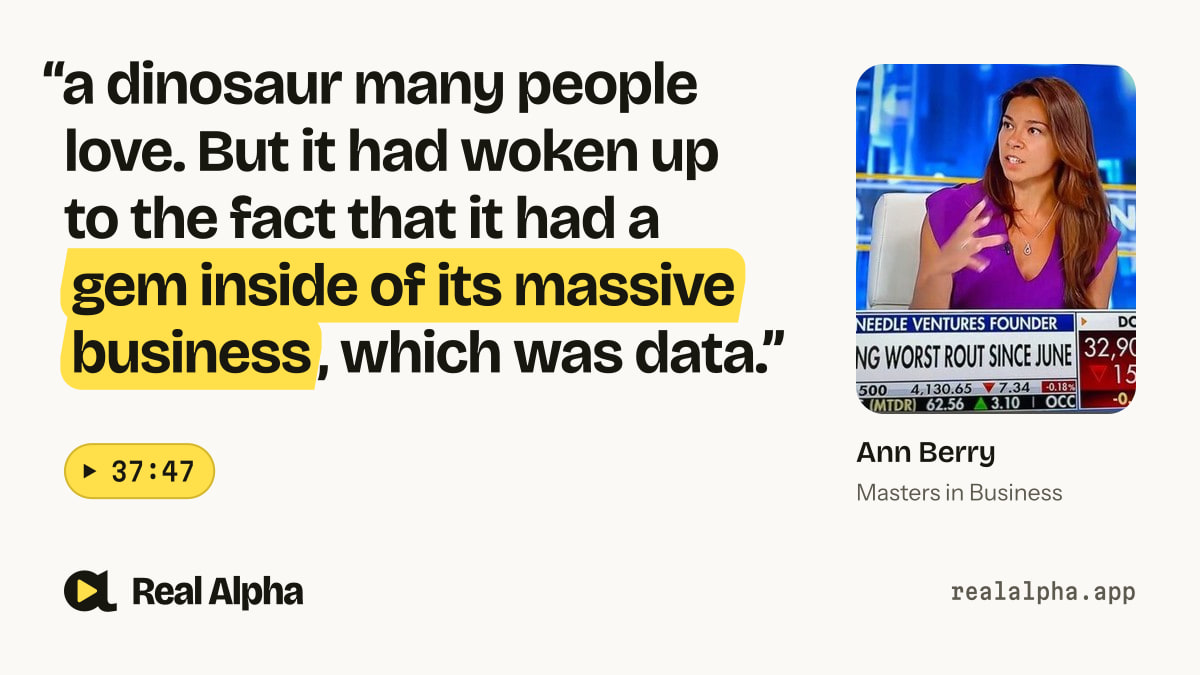
“a dinosaur many people love. But it had woken up to the fact that it had a gem inside of its massive business, which was data.”
 Ann Berryat 37:47 · Masters in Business
Takeaways
- AI startups can create niche products and become acquisition targets.
- Incumbents may have valuable data sitting in legacy systems.
- Walmart turned e-commerce data into a multibillion-dollar ad business.
About this segment
Ann Berry argues that nimble AI startups can build niche products, while large companies can unlock value in data they already hold. Walmart’s fast-growing ad business shows how an incumbent can do it at scale.

Ann Berry is founder and managing partner of Threadneedle.
Built investment experience at Goldman Sachs and Wheelhouse, then founded Threadneedle to pair capital with operating support.
- BR
Barry Ritholtz, Host · Columnist, Bloomberg
From “Providing Capital to Tech Companies: Masters In Business with Ann Berry | Masters in Business”, Nov 7, 2026. Watch the full episode
Thanks. We'll look at and fix what's off.
Transcript
From the transcript Masters in Business publishes with the episode.
- 33:10
Back to why I still love those mature businesses that have been around from what seems like the dawn of time. Look, I think from the startups, there are still real opportunities. I mentioned I've invested in Yann LeCun's recent startup, AMI. And he's focused on world... Are you familiar with world models, Barry? Bigly. So in a nutshell, if we think about ChatGPT and we think about Claude, which I use enormously, as I'm sure you do, these large language models have been trained for the most part on written text. Yes, we're also now in the world of generative AI and visuals and pictures and videos. But text has really been the core.
- 33:47
That's why they're called LLMs. World models move into the idea of AI being able to understand the three-dimensional or multi-dimensional physical world.
- 33:56
Important for robotics and things like that. Exactly right. And I was lucky that several years ago, I sort of heard enough about world models that I was actually looking actively for an opportunity to start investing in them. And I'd invested with the group behind this particular raise, back in 2014, before AI was a thing. It used to be called predictive analytics, right? You remember big data? Sure.
- 34:21
And none of that truly meant AI in terms of the same kind of ability to generate. But the idea of the merits of huge repositories of data and inference and prediction have been around a lot longer than the last five years.
- 34:32
Well, we could go back to, what was it, Big Blue and the chess competition. Yes, that's right. And then What was the model behind the Jeopardy? Go is a big one. Go is a giant one, which is a simple but very nuanced, complex game. So versions, predecessors to AI have certainly been around for decades. It's just become, it is the future Star Trek promised 50 years ago. In a format the consumer understands.
- 35:01
That's right. And that's what's caught mindshare and that's what's caught attention and that's what's caused proliferation that people get behind, I think. It's not just B2B anymore, or it's not just a nerd like me getting excited about what this data could be. But to go. Back to your original question, Barry, there's absolutely space to play for startups who can move faster, who can be more nimble, who can be quicker in using AI to create, I think, niche products. And then they become fabulous targets, acquisition targets for some of the bigger scale players. Where I find opportunity... exists, and I'm frustrated that not all big companies have capitalized on it. So many businesses are sitting on huge troves of data on their hardware. Not everyone's in the cloud, right? It's sitting there on the
- 35:51
on-premise ERP systems that haven't gone to the cloud yet. Or we can take something that is more virtual, and it's a public stock that's frustrated me, PayPal. It baffles my mind that PayPal, with its scale and its first view of advantage, has not done more faster with the sheer amount of historical transaction data consumer emergent is sitting on.
- 36:14
That's the kind of business you should do more. Well, you look at what happened with Stripe and with Square, which I think is now Cube.
- 36:20
And BNPL came out, right, and took share. And a whole bunch of things kind of leapfrogged over. I mean, I remember when they were just the processor for eBay. 30 years ago, it feels like. Yeah, that's right. Hey, isn't that the crossing the chasm? Isn't that the innovator's dilemma that your success plants the seed for your eventual failure? It can anchor you.
- 36:48
That being said, if you have success and you have the wherewithal to figure out how to use that success as a way in which to leapfrog the next person, I think that's where there's opportunity. You know, January 2022, Barry, I wrote a piece, I published it on LinkedIn, I talked about it on CNBC. And the name of the piece I wrote was, a tech stock by any other name is Walmart. Right. Okay, so January 2022. And the reason I wrote that was I was starting to see in Walmart's filings, it's a business I've been obsessed with for ages.
- 37:20
Right. Starting to talk about this ad business that was sort of hiding inside it. That Walmart, in its transcripts and its filings, was starting to talk about all of the data it was getting from its e-commerce platform. and growing demand by brands to figure out how to get in front of clients or consumers beyond just social media, because it was getting expensive now just to have campaigns on Facebook or Instagram. And so I wrote this piece to call attention to. Here was Walmart. Some called them a dinosaur, a dinosaur many people love. But it had woken up to the fact that it had a gem inside of its massive business, which was data. Fast forward to today, it's a nearly $ 6. 5 billion revenue part of the business.
- 38:01
And it moved. its listing to NASDAQ to really hammer home the idea that Walmart believes itself now to be a tech company.
- 38:09
That's really interesting. I used to think of them as a logistics company. Were they chasing what Amazon had done in that space prior, or was it truly their own innovation? By the way, my favorite data point on Walmart is they are the single biggest deployer of solar panels in the country because they just have endless... Giant flat stores, giant flat warehouses, primarily, at least they used to be primarily in the Sun Belt. They've expanded, obviously, everywhere. But the single biggest consumer of solar energy, which dramatic reduction in energy consumption costs.
- 38:47
It's interesting, too. I remember researching virtual reality headsets and Oculus. And someone should fact check me on this. But the time I looked at this a couple of years ago, Walmart had trained a million store associates using VR headsets and Oculus. for things like role play, dealing with a difficult customer, or figuring out how to stack shelves more safely. Talk about adopting technology at scale. That's the kind of thing where, you know, these big companies, they may be in danger of being leapfrogged, but they're also there with the potential to grab new technology and do new things with it if they have the wherewithal to do so.